

The Best Multilingual AI Chatbots for UK Businesses
Insights / The Best Multilingual AI Chatbots for UK Businesses
Table of Contents
What is Multilingual Chatbot ?
A multilingual chatbot is an AI-native virtual assistant that can understand, process, and respond to users in multiple languages within a single conversation. It uses natural language processing (NLP) and machine learning to detect the user’s language, translate or interpret inputs, and deliver accurate, context-aware replies—allowing businesses to support global audiences without needing separate chat systems for each language.
This is a core capability of multilingual conversational AI.
Multilingual AI Support in the UK: What Languages Do Your Customers Actually Speak?
Before choosing a multilingual chatbot platform, it is worth looking at which languages matter most for UK-based businesses — not just globally popular ones.
The UK is one of Europe’s most linguistically diverse markets. According to ONS data, the most widely spoken languages in England and Wales after English include Polish, Punjabi, Urdu, Bengali, Gujarati, Arabic, and Welsh. For businesses operating in cities like Birmingham, Leicester, Bradford, or London, this is not a niche concern — it directly affects customer service quality and conversion rates.
What to look for in a UK-focused multilingual chatbot:
Welsh language support: If you operate in Wales or serve Welsh public sector clients, WCAG-compliant Welsh language support may be a legal or contractual requirement.
GDPR compliance: Data processed by the chatbot must comply with UK GDPR. Confirm where conversation data is stored and processed — EU-based servers may add complexity post-Brexit.
British English defaults: Ensure the chatbot uses British spelling, idioms, and tone as the baseline. Some US-headquartered platforms default to American English in their models.
Worktual is built for the UK market, with British English as the default language model baseline, GDPR-compliant UK data processing, and support for 30+ languages relevant to UK business audiences.
Languages most relevant for UK businesses:
| Language | Key UK demographic | Business sectors most affected |
|---|---|---|
| Polish | Estimated 600,000+ speakers | Retail, logistics, construction, healthcare |
| Punjabi / Urdu | Large communities in West Midlands, Yorkshire | Finance, retail, healthcare |
| Welsh | Legal requirement in Wales for public sector | Government, education, public services |
| Arabic | Growing community, plus Gulf-based online shoppers | Finance, luxury retail, travel |
| Bengali | Large communities in East London, Birmingham | Retail, hospitality, healthcare |
| Spanish | International customers, Latin American diaspora | E-commerce, travel |
| German / French | Cross-channel business, EU customers post-Brexit | B2B, professional services, e-commerce |
How Multilingual AI Chatbots Work
Multilingual AI chatbots combine language detection, natural language processing (NLP), and translation technologies to deliver accurate, context-aware conversations across different languages in real time.
This is where multilingual conversational AI becomes powerful.
1. Language Detection (Auto vs Manual)
- Automatic detection: The chatbot identifies the user’s language instantly based on input text or speech, enabling a seamless experience without user effort.
- Manual selection: Users choose their preferred language from a list, which ensures accuracy but adds an extra step. Most modern chatbots use auto-detection for speed and convenience.
2. NLP & Intent Recognition
Once the language is identified, the chatbot uses NLP (Natural Language Processing) to:
- Understand the intent behind the message (e.g., query, complaint, request)
- Extract key details like names, dates, or products
- Interpret variations in phrasing across languages
This ensures the chatbot responds based on meaning, not just keywords.
3. Machine Translation vs Native Models
- Machine translation approach: The chatbot translates the user’s input into a base language (e.g., English), processes it, then translates the response back.
- Native multilingual models: Advanced systems understand and respond in multiple languages directly without translation layers.
Native models offer better accuracy and context, while translation-based systems are easier to scale.
4. Context Retention Across Languages
A key capability is maintaining conversation context, even when users switch languages mid-chat.
- Tracks previous messages and user intent
- Maintains tone and continuity
- Ensures consistent responses across languages
This allows for natural, human-like conversations, regardless of language changes.
Advanced multilingual AI chatbots can automatically detect a customer’s language from their very first message and respond in the same language without requiring manual selection. This capability is particularly valuable for businesses serving international customers or multilingual communities across the UK.
Modern multilingual conversational AI platforms combine language detection with contextual understanding, allowing conversations to continue naturally even when users switch languages during a chat session. For example, a customer may begin a conversation in Polish and later switch to English without disrupting the interaction.
When evaluating multilingual chatbot platforms, businesses should look for accurate language detection, support for regional dialects, and the ability to maintain context across multiple languages. These capabilities help deliver seamless customer experiences while reducing friction during support, sales, and service interactions.
Do Multilingual AI Chatbots Require Manual Translation or Training Data?
No. Modern multilingual AI chatbots do not require manual translation or separate training data for each language. This is one of the most common misconceptions businesses have before adopting the technology.
Older, rule-based chatbot systems did require manual effort — you had to build conversation flows, write responses, and configure intent recognition separately for every language you wanted to support. Adding a new language could take weeks.
Today’s AI-native chatbots work differently. They are built on large language models (LLMs) trained on vast multilingual datasets covering dozens of languages simultaneously. This means:
No manual translation needed: The model understands and generates responses in the target language directly — it does not translate from English behind the scenes.
No separate training per language: You train your chatbot once (on your products, policies, and tone of voice), and it automatically applies that knowledge across all supported languages.
Instant language coverage: When you add a new language to your support mix, there is no retraining cycle. The underlying model already knows the language.
The practical difference for UK businesses: If you operate across European markets — say, serving customers in French, German, Spanish, and Polish — you configure your chatbot once and deploy it across all four. You do not need a separate chatbot or a translation vendor for each.
What still requires human input: While the AI handles language automatically, you will still want native speakers to review tone, idioms, and brand voice in each language during initial setup. The AI gets the language right; a native reviewer ensures it sounds right.
Translation vs Localization in AI Chatbots
Translation and localization are often used interchangeably, but they serve very different purposes in AI chatbots. While translation focuses on converting words from one language to another, localization ensures the message feels natural, relevant, and culturally appropriate for the user.
1. Cultural Context
- Translation: Converts text word-for-word, which can miss cultural meaning
- Localization: Adapts content based on cultural norms, values, and expectations
For example, a greeting or phrase that works in one country may sound awkward or even inappropriate in another. Localization ensures the chatbot communicates in a way that feels familiar and respectful.
2. Regional Dialects
- Translation: Uses standard or generic language
- Localization: Adjusts for regional variations, slang, and dialects
The same language can differ widely by region (e.g., UK vs US English, or different forms of Spanish). Localization helps the chatbot sound native, not robotic or generic.
3. Tone Adaptation
- Translation: Preserves the original wording but may lose emotional tone
- Localization: Adapts tone based on audience expectations
For instance:
- Formal tone for banking or legal industries
- Friendly and casual tone for e-commerce or support
Localization ensures the chatbot’s tone matches the brand voice and user expectations.
Key Difference: How Languages Are Handled
| Feature | Rule-Based Localisation | AI-Driven Translation |
|---|---|---|
| Approach | Predefined rules and scripts for each language | Uses AI models to translate and generate responses dynamically |
| Flexibility | Limited – requires manual updates for each language | Highly flexible – adapts to new inputs automatically |
| Language Coverage | Restricted to configured languages | Scales easily to multiple languages |
| Context Understanding | Low – follows fixed patterns | High – understands intent and context |
| Context Understanding | Low – follows fixed patterns | High – understands intent and context |
| Cultural Adaptation | Strong (manually customized) | Moderate (depends on training data) |
| Accuracy | High for predefined scenarios | Varies based on model quality |
| Maintenance | High effort – manual updates needed | Lower effort – improves with data and usage |
| Response Quality | Consistent but rigid | Natural and conversational |
Compare the Best Multilingual AI Chatbots for UK Businesses
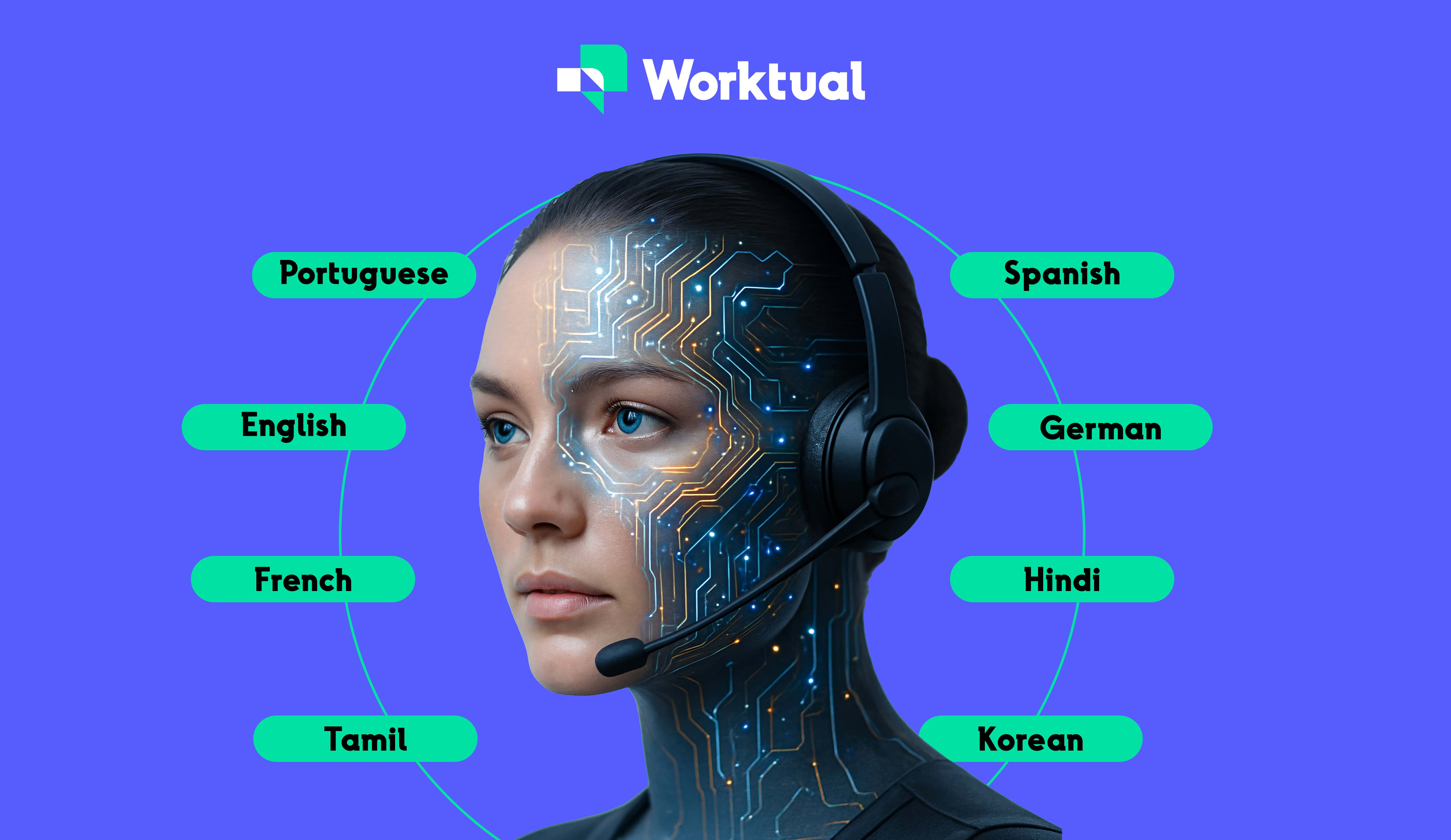
1. Worktual (worktual.co.uk)
- Languages: 30+
- Best for: Small to mid-sized UK businesses that value actual accuracy over buzzword bingo
- Standout feature: Context-aware translation (understands slang, idioms, and British sarcasm)
- Pricing: Custom pricing based on requirements
2. Tidio
- Languages: Over 40 languages supported
- Best for: Businesses seeking a balance between live chat and A automation
- Standout feature: User-friendly interface with powerful automation features
- Pricing: Free plan available; paid plans start at $39/month
3. ChatGPT by OpenAI
- Languages: Supports multiple languages with advanced conversational abilities
- Best for: Businesses needing versatile AI for various tasks
- Standout feature: High adaptability across diverse domains
- Pricing: Free tier available; premium plans
4. Zendesk Answer Bot
- Languages: Supports multiple languages with a customer service focus
- Best for: Businesses prioritising customer experience (CX)
- Standout feature: Trained on billions of customer service interactions
- Pricing: Varies based on plan and usage
5. PolyAI
- Languages: Supports multiple languages with a focus on voice assistants
- Best for: Call centres and businesses requiring voice AI solutions
- Standout feature: Advanced AI voice assistants capable of handling complex inquiries
- Pricing: Custom pricing based on requirements

Multilingual AI Chatbots for Customer Service: Where They Deliver the Most Impact
Customer service is one of the most valuable applications of multilingual AI chatbots. When customers can communicate in their preferred language, businesses reduce friction, improve satisfaction, and increase the likelihood of successful outcomes.
E-commerce businesses use multilingual AI chatbots to answer product questions, provide order updates, manage returns, and support international customers without maintaining separate support teams for every language. Faster responses and language accessibility often contribute to higher conversion rates and improved customer retention.
In healthcare, multilingual chatbots help patients book appointments, receive reminders, and access important information in their preferred language. This improves accessibility while reducing administrative workload for support teams.
For contact centres and customer support operations, multilingual conversational AI enables businesses to handle enquiries across multiple languages from a single platform. Customers receive consistent support experiences, while human agents can focus on more complex interactions that require personal attention.
By removing language barriers and delivering faster responses, multilingual AI chatbots help organisations improve customer experience, reduce support costs, and scale global customer engagement more efficiently.
Enterprise Multilingual Chatbots: What to Evaluate Before Deployment
Enterprise organisations require more than basic language translation. The best multilingual chatbot solutions combine language support, security, scalability, CRM integration, and AI-native automation to deliver consistent customer experiences across global markets.
When evaluating a multilingual chatbot for enterprise deployment, consider these key factors:
Scalability and Performance
A multilingual AI chatbot should be able to manage thousands of simultaneous conversations across multiple languages while maintaining fast response times during peak demand.
Security and Compliance
Enterprise deployments require strong data protection, access controls, and compliance with regulations such as UK GDPR. Businesses should understand where customer data is stored and how it is processed.
CRM and Business System Integration
The platform should integrate seamlessly with CRM, helpdesk, and customer data systems. This allows customer information, conversation history, and support workflows to remain connected across every channel.
Human Handoff and Context Retention
For complex queries, the chatbot should transfer conversations to a human agent without losing context. Customers should not need to repeat information when escalation occurs.
Analytics and Localisation
Enterprise teams need language-specific reporting, customer insights, and localisation controls. Beyond translation, the chatbot should support regional language preferences, cultural nuances, and consistent brand voice across markets.
Enterprise Multilingual Chatbot Checklist
Before choosing a platform, ensure it offers:
- Support for multiple languages at scale
- UK GDPR and enterprise-grade security
- CRM and helpdesk integrations
- Human agent escalation with full context
- Language-level analytics and reporting
- Localisation and brand voice controls
- Omnichannel support across chat, voice, email, and messaging channels
As customer expectations continue to grow, enterprise multilingual chatbots help organisations deliver consistent support, improve operational efficiency, and provide seamless customer experiences across every market they serve.
How to Choose the Right Multilingual Chatbot for Your Business
Ask yourself:
- Does it support the languages your actual customers speak?
- Can it integrate with your CRM, or will it just ghost customer data?
- Is the pricing transparent, or will you need a forensic accountant to decode it?
(Worktual’s advantage? No surprises—just a chatbot that works without requiring a Rosetta Stone subscription.)
FAQs
1. Can AI chatbots handle multiple languages?
Yes. Modern AI chatbots can handle multiple languages within a single conversation. They use automatic language detection to identify the user’s language from their input text, then respond in that same language without any manual switching. Advanced platforms support 30 to 100+ languages simultaneously and can handle mid-conversation language switches without losing context.
2. Do multilingual AI chatbots require manual translation of training data?
No. AI-native multilingual chatbots do not require you to manually translate training data for each language. They are built on large language models trained across multiple languages simultaneously. You configure your chatbot once — with your product information, policies, and brand tone — and it applies that knowledge across all supported languages automatically.
3. Which AI chatbot offers the best multilingual support for UK businesses?
For UK businesses, the most important factors are: British English as the default language model, GDPR-compliant UK data processing, support for languages commonly spoken in the UK (including Polish, Punjabi, Welsh, Urdu, Arabic, and Bengali), and transparent pricing without hidden translation costs. Worktual is built specifically for the UK market with these requirements built in. Other strong options include Tidio for SMBs, Zendesk for enterprise customer service, and PolyAI for voice-first use cases.
4. What is the best chatbot platform for automatic language detection?
The best platforms for automatic language detection are those using native multilingual LLMs rather than third-party translation APIs. These detect language at the input level, handle short or ambiguous messages using session context, support mid-conversation language switching, and cover regional dialects. Worktual, PolyAI, and Zendesk AI all offer robust automatic language detection. When evaluating any platform, test it with short inputs (single words, greetings) and dialect variations to assess detection accuracy.
5. Are multilingual AI chatbots affordable for small businesses?
Yes. Entry-level multilingual chatbot plans are available from Affordable, with free tiers available for very low-volume use. For small UK businesses with modest chat volumes, self-serve platforms provide genuine multilingual capability without enterprise-level investment. Custom-priced platforms like Worktual are scaled to your actual usage, meaning you are not paying for capacity you do not need.
6. Which AI assistants available in the UK support multiple languages?
In the UK market, multilingual AI assistants include Worktual (30+ languages, UK-built), Tidio (40+ languages), Zendesk AI (customer service focus, broad language coverage), PolyAI (voice AI, multiple languages), and ChatGPT-powered solutions via API. For businesses with Welsh language requirements or UK GDPR constraints on data residency, Worktual and similar UK-based providers offer the clearest compliance pathway.
7. What is the difference between multilingual chatbot translation and localization?
Translation converts words from one language to another. Localization goes further — it adapts the message so it feels culturally natural to the target audience, including regional dialect choices, appropriate formality levels, culturally relevant examples, and local date/currency formats. A translated chatbot may be technically accurate but feel robotic or out of place. A localized chatbot sounds like it was written by a native speaker for that specific audience.
8. How do multilingual AI chatbots help in global customer service?
Multilingual AI chatbots allow businesses to provide 24/7 customer support across all languages simultaneously, without hiring multilingual agents for every shift. They handle first-line resolution for common queries (order status, FAQs, returns, bookings) in the customer’s preferred language, escalate complex queries to human agents with full context, and generate language-level analytics to identify where support quality needs improvement.
Related Posts
10 Best Drift Alternatives for Businesses in 2026
Conversational AI has revolutionised customer engagement, lead generation, and support automation. With businesses increasingly relying on chatbots to streamline interactions, choosing the right platform is crucial. Two leading contenders in 2025 are Worktual and Drift, each catering to different business needs.
Top Zendesk Alternatives & Competitors in 2026
Customer service has entered an era where AI chatbots are no longer optional but essential. From rapidly scaling startups to large enterprises aiming to reduce costs, the right conversational AI can reshape customer experiences and boost business outcomes.

Top 6 AI Voice Bot Use Cases for Businesses Across Key Industries
Once a novelty, AI chatbots and AI agents have quietly become the PAs and shop assistants of the digital high street. If you’re exploring Tidio alternatives, you’re likely looking for tools that not only chat but also think, reason, and grow with your business. Now, they’re everywhere: handling support, grabbing leads, and speaking your customers’ language (even if it’s Japanese and it’s 3 am).


