

Agentic AI as a Service (AaaS): The Future of AI in Business
Insights / Agentic AI as a Service (AaaS): The Future of AI in Business

Agentic AI as a Service (AaaS)
Agentic AI as a Service (AaaS) delivers autonomous, goal-driven AI agents through a cloud platform — distinct from “agent as a service” or “AI agent as a service,” which describe the same underlying model.
The key differentiator of the agentic managed services model is autonomous, end-to-end task execution, with human oversight only at defined escalation points.
AaaS differs from SaaS and PaaS: SaaS delivers fixed applications, PaaS delivers development infrastructure, AaaS delivers agents that reason, decide, and act independently.
Businesses report up to 50% faster deployment and around 30% improvement in operational efficiency compared to traditional AI development.
AaaS is used across ecommerce, healthcare, finance, real estate, and retail/marketing — with UK businesses prioritising data residency and GDPR compliance in adoption decisions.
Artificial Intelligence (AI) is rapidly transforming how businesses operate across industries. Organisations are integrating AI into their processes to automate decisions, improve customer experiences, and increase operational efficiency. Industry analysts predict that by 2026, most enterprises will rely on AI-powered systems to support daily operations.
Agentic AI as a Service (AaaS) refers to cloud-based AI agents that operate autonomously to achieve business goals. These AI agents analyse data, make decisions, and execute tasks within defined objectives and governance frameworks. Compared to traditional automation, AaaS offers faster deployment, scalability, and cost efficiency, making it an attractive solution for modern businesses.
- What is Agentic AI as a Service?
- AaaS vs SaaS vs PaaS
- Key Features and Benefits of Agentic as a Service
- Measured Business Impact:
- Agentic as a Service Use Cases Across Industries
- AaaS vs Traditional AI
- Conclusion
- FAQs
What is Agentic AI as a Service?
Agentic AI as a Service (AaaS) is a cloud-based delivery model that provides autonomous, goal-driven AI agents through APIs or platforms. Unlike traditional software with fixed workflows, AaaS agents can analyse data, make decisions, execute tasks, and continuously learn from interactions with minimal human input.
These AI agents integrate into existing business systems and can be customised for specific operational needs. AaaS platforms also include governance features such as monitoring, policy controls, and optional human oversight to ensure accountability and compliance.
By enabling intelligent automation that adapts and improves over time, Agentic AI as a Service helps businesses streamline workflows, increase efficiency, and scale AI-driven operations more effectively.
Agent as a Service, Agents as a Service, AI Agent as a Service, and Agentic AI as a Service — Are They the Same?
These terms are often used interchangeably, but they describe the same underlying model from slightly different angles. “Agent as a Service” and “Agents as a Service” refer to the individual autonomous AI agents themselves being delivered as a cloud service. “AI Agent as a Service” emphasises the AI-driven nature of that agent. “Agentic AI as a Service” is the broader, more precise term — it describes the full delivery model: the platform, the governance layer, and the autonomous agents working together as one service.
In practice, when businesses search for “agent as a service” or “AI agents as a service,” they are almost always describing what Worktual delivers as Agentic AI as a Service (AaaS): autonomous, goal-driven agents provided through a managed cloud platform, with built-in oversight, integration, and continuous learning.
AaaS vs SaaS vs PaaS
| Model | Key Traits | Examples |
|---|---|---|
| SaaS | Pre-built software applications used as-is, with limited customisation | Salesforce, Mailchimp, HubSpot |
| PaaS | Development Platforms that provide the tools and interface for a developer to build, design, develop, and deploy their own application | AWS Beanstalk, Heroku |
| AaaS | Autonomous AI agents that make decisions, take actions, and adapt in real time. | Worktual AI agents |
What sets AaaS apart is its agentic nature. These agents are not rule-bound scripts. They are goal-oriented systems capable of reasoning, adapting, and taking goal-driven actions under enterprise-defined constraints, making them fundamentally different from traditional software models.
Key Features and Benefits of Agentic as a Service
Scalability
AaaS operates on a pay-per-use model, automatically scaling up or down based on demand. Businesses can handle traffic spikes or growth without infrastructure constraints.
Cost-Effectiveness
Organisations avoid upfront investments in hardware, data science teams, or long development cycles. AaaS significantly lowers the barrier to AI adoption.
Customisation
Creating AI agents that connect to existing tools, systems, platforms and workflows will not require extensive engineering to support specific work-time processes, industries, or customer experience by using Low-Code or No-Code (LowCode / NoCode) technologies
Seamless Integration
The ability to integrate Agentic AI as a Service easily with other technologies such as Customer Relationship Management systems (CRM), ecommerce platforms, and marketing software etc., allow users within your organisation to access all available information and functionality from any other application.
Continuous Updates
AaaS providers continuously maintain and update their AI models, ensuring that businesses using these services always benefit from current and up-to-date information. The agents that interact with AaaS service providers and customers are designed to be user-friendly and to “learn” from previous interactions. By applying machine learning techniques, these agents steadily improve their performance over time.
What Is the Key Differentiator of the Agentic Managed Services Model?
The key differentiator of the agentic managed services model is autonomous, end-to-end task execution — AI agents that learn, think, and act independently within defined business goals, rather than requiring manual oversight at every step.
This separates agentic managed services from older delivery models in three specific ways:
• Manual ticket triaging is replaced by autonomous routing and resolution — agents classify, prioritise, and act on incoming requests without a human reviewing each one first.
• Human-driven support becomes the exception, not the default — agents handle the majority of interactions independently and escalate only when a defined confidence or risk threshold is crossed.
• Native integration with existing platforms (including client ITSM systems, CRMs, and ticketing tools) means agents act inside the tools a business already uses, rather than operating as a disconnected add-on.
This is what distinguishes an agentic managed service from a traditional managed service: the agent doesn’t just assist a human worker — it owns the task from start to finish, under governance.
Measured Business Impact:
- Up to 50% faster deployment compared to traditional AI development
- Around 30% improvement in operational efficiency
These advantages collectively give businesses scalable AI superpowers, enabling them to compete with enterprise-grade intelligence regardless of size.
Businesses adopting Agentic AI as a Service are also improving customer experience, reducing operational workload, and accelerating workflow automation across departments.
Agentic as a Service Use Cases Across Industries
The influence of AaaS is expanding rapidly, with agent-driven workflow operations across sectors:
Ecommerce
- AI agents function as always-on customer service representatives for sales. They provide extremely personalised product recommendations based on what people are looking at, what they have purchased before, and what they want to buy. These agents offer real-time customer service through chat/email/social media, respond to customer inquiries about their order, and support post-purchase engagement activities, including upsells and reorders.
- By operating 24/7, Worktual’s omnichannel shopping AI agents have a substantial impact on improving conversion rates, decreasing cart abandonment, and increasing customer satisfaction.
- AI agents also help ecommerce businesses automate customer engagement at scale while improving conversion rates and post-purchase customer experiences.
Healthcare
- AI agents manage appointment scheduling, send automated reminders, assist with patient queries, and support preliminary diagnostic workflows by organising patient data.
- By reducing manual coordination and repetitive tasks, Worktual’s Agentic AI platform enables healthcare teams to dedicate more time to patient care while maintaining accurate and timely communication.
- These agents operate within healthcare compliance requirements such as data privacy and audit controls.
Finance
- Worktual’s Agentic AI platforms are designed to support enterprise security standards, compliance workflows, and continuous monitoring.
- Autonomous AI agents continuously monitor transactions and customer interactions to detect anomalies and potential fraud in real time. These agents adapt to evolving fraud patterns and assist with customer support, compliance-related queries, and transaction updates.
- The result is improved security, faster response times, and higher customer trust delivered by advanced Worktual AI agents.
- This enables financial institutions to improve operational efficiency, strengthen fraud prevention, and deliver faster customer support experiences through intelligent automation.
Real Estate
- Agentic AI functions as a virtual sales coordinator by conducting virtual property tours, qualifying leads based on buyer intent and preferences, and automating follow-ups across channels.
- Agnetic AI Systems ensure sales teams focus on high-intent prospects while maintaining personalised engagement.
Retail and Marketing
- AI agents act as a marketing copilot by autonomously planning, creating, optimising, and executing campaigns across channels such as email, SMS, WhatsApp, and web.
- By continuously analysing campaign performance and customer behaviour, the system improves targeting and takes autonomous action from the performance analysis.
These examples illustrate how AaaS industry takeovers are underway, with autonomous agents becoming integral to business growth.
Agentic AI as a Service for UK and Global Businesses
Agentic AI as a Service is being adopted across the UK, North America, and globally, though regional priorities differ slightly. UK businesses adopting AaaS place particular weight on data residency, UK GDPR compliance, and integration with established UK enterprise systems — Worktual’s AaaS platform is built with UK data handling and compliance requirements as a default, not an add-on.
In the US and other markets, adoption is often driven by scale and speed-to-deployment, with businesses prioritising rapid integration across large, multi-system environments. Across all regions, the core value of AaaS remains constant: autonomous agents that reduce operational load without the long implementation timelines associated with building AI in-house.
AaaS vs Traditional AI
- There are many challenges to developing artificial intelligence internally, such as time-consuming implementation, financial constraints, and a lack of qualified talent. The overwhelming complexity of implementing and maintaining such systems can add to these difficulties.
- Artificial Intelligence-as-a-Service (AaaS) overcomes these issues by providing companies with access to autonomous agents via the internet without having to make any long-term commitment or incur any technical costs.
- As AaaS becomes more commonplace in the next several years, it will change the way companies approach the deployment and utilisation of Ai.
- As businesses continue adopting AI-first operational strategies, Agentic AI as a Service is emerging as a scalable alternative to traditional AI deployment models.
Organizations adopting Agentic AI as a Service early are gaining competitive advantages through scalable automation, faster decision-making, and improved operational efficiency across business functions.
FAQS
1. Why is Agentic as a Service considered the future of AI in business?
AaaS delivers enterprise-grade, agent-driven intelligence without the cost and complexity of building and maintaining AI systems in-house, enabling faster and broader adoption.
2. How does AaaS differ from traditional SaaS or PaaS?
SaaS provides applications, PaaS provides development platforms, while AaaS delivers autonomous agents that act, learn, and adapt independently.
3. What are the main benefits of adopting AaaS?
Scalability, cost efficiency, faster deployment, seamless integration, and continuous improvement.
4. Which industries can leverage AaaS most effectively?
Ecommerce, healthcare, finance, real estate, retail, and marketing-driven industries.
5. How do AaaS agents ensure security and compliance?
Platforms like Worktual implement enterprise-grade security frameworks, compliance standards, and continuous monitoring to protect data and operations.
6. Is “agent as a service” the same as “Agentic AI as a Service”?
Yes. “Agent as a service,” “Agents as a service,” and “AI agent as a service” all describe the same delivery model as Agentic AI as a Service (AaaS) — autonomous AI agents provided through a managed cloud platform with built-in governance and integration.
7. What is the key differentiator of the agentic managed services model?
The key differentiator is autonomous, end-to-end task execution: agents that learn, think, and act independently within defined business goals, replacing manual ticket triaging and reducing reliance on human-driven support, while integrating natively with existing client systems such as ITSM platforms.
8. What does AAAS stand for in AI?
AAAS stands for “Agentic AI as a Service” (sometimes written “Agent as a Service”) — a cloud delivery model for autonomous, goal-driven AI agents, distinct from SaaS (Software as a Service) and PaaS (Platform as a Service).
9. Is Agentic AI as a Service suitable for UK businesses?
Yes. AaaS platforms such as Worktual are built to support UK GDPR compliance and UK data residency requirements as standard, making them suitable for UK enterprises across regulated sectors including finance and healthcare.
10. How is AaaS different from AI infrastructure as a service?
AI infrastructure as a service provides the underlying compute, storage, and model-hosting resources needed to run AI workloads. Agentic AI as a Service operates a layer above this — it delivers fully functioning autonomous agents that use that infrastructure to reason, decide, and act, without the business needing to manage the infrastructure layer directly.
Related Posts
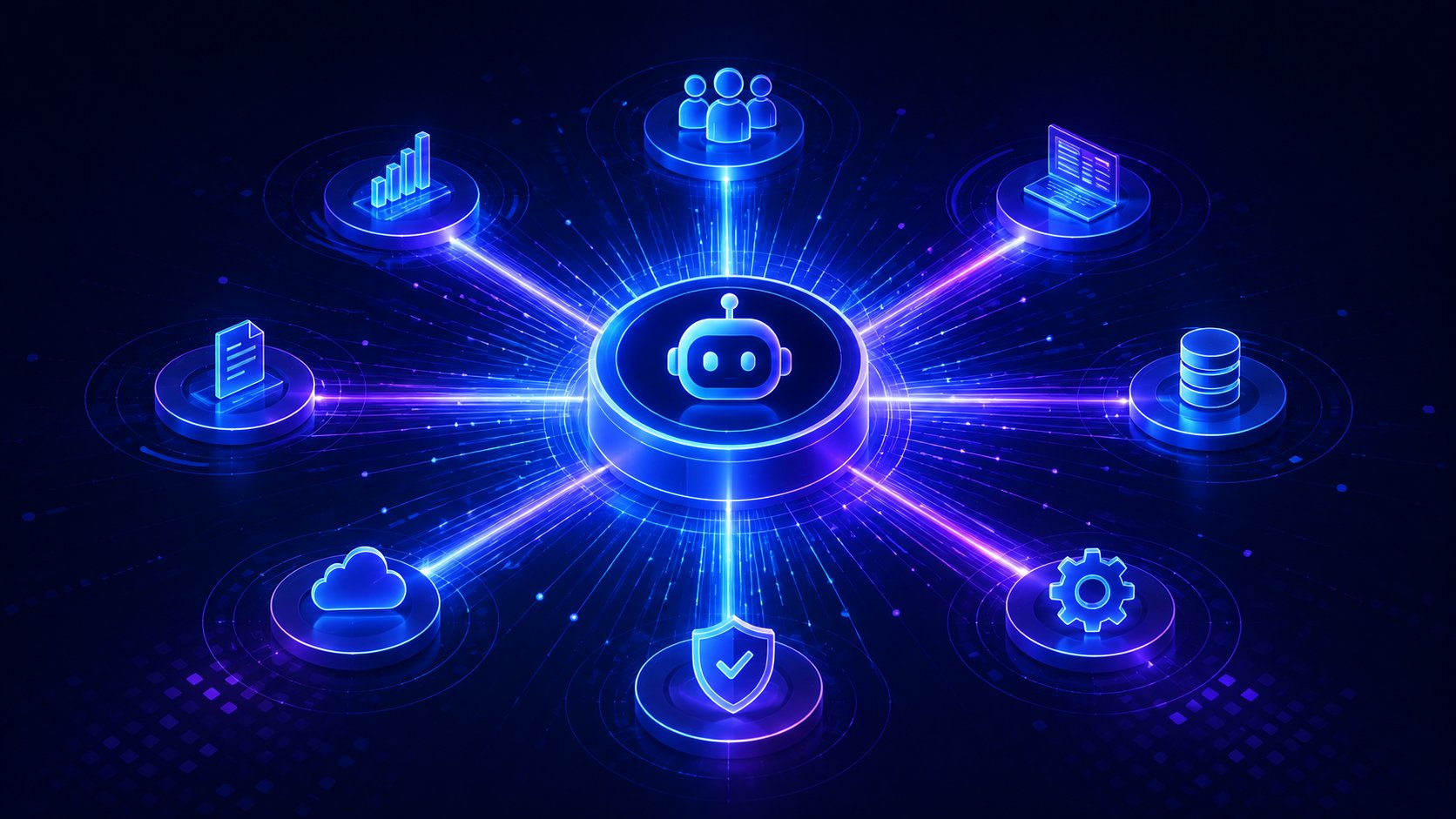
Hub-and-Spoke Architecture for AI Agents: How It Connects Enterprise
Business-to-business (B2B) customer engagement has changed significantly as buyers now expect faster responses, connected interactions, and highly personalised experiences across every stage of the customer journey. Decision-makers no longer compare B2B experiences only with competitors within the same industry. They compare them with the seamless digital experiences they receive across retail, banking, streaming platforms, and consumer applications. This shift has increased pressure on enterprises to modernise how they manage customer relationships, support operations, and lifecycle engagement.

AI Contact Centre for Banking: Why Customer Outcomes Matter More Than Cost Savings
Business-to-business (B2B) customer engagement has changed significantly as buyers now expect faster responses, connected interactions, and highly personalised experiences across every stage of the customer journey. Decision-makers no longer compare B2B experiences only with competitors within the same industry. They compare them with the seamless digital experiences they receive across retail, banking, streaming platforms, and consumer applications. This shift has increased pressure on enterprises to modernise how they manage customer relationships, support operations, and lifecycle engagement.

Why UK Businesses Are Moving from AI Tools to Unified Intelligence Platforms
Business-to-business (B2B) customer engagement has changed significantly as buyers now expect faster responses, connected interactions, and highly personalised experiences across every stage of the customer journey. Decision-makers no longer compare B2B experiences only with competitors within the same industry. They compare them with the seamless digital experiences they receive across retail, banking, streaming platforms, and consumer applications. This shift has increased pressure on enterprises to modernise how they manage customer relationships, support operations, and lifecycle engagement.


