B2B Buyer Intent in the UK Market: Predicting the Moment before the RFP

Insights / B2B Buyer Intent in the UK Market: Predicting the Moment before the RFP

B2B Buyer Intent before rfp

The RFP Arrives Too Late

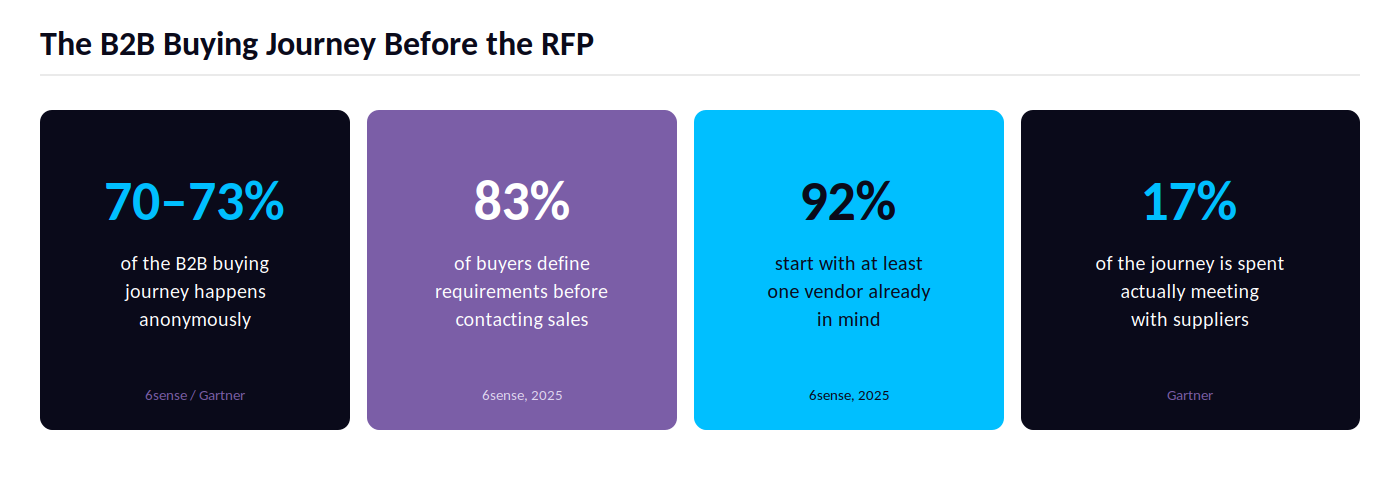
By the time an RFP or tender is issued, the shortlist has typically already formed. Research from 6sense and Gartner indicates that a substantial majority of the B2B buying journey happens anonymously, before a vendor is ever contacted — placing control of the timeline firmly with the buyer rather than the seller.

B2B Buyer Journey

Gartner further reports that 61% of buyers prefer a rep-free buying experience where one is available. Taken together, these figures describe a buying journey that is largely complete before an RFP is issued, and increasingly resistant to direct sales contact. The competitive window that remains is earlier — in the research and evaluation stage the buyer completes independently. Winning it requires reading buyer intent before the RFP exists, rather than responding more quickly once it does.

  • What Buyer Intent Actually Means
  • The Signals That Precede an RFP
  • The UK Dimension
  • From Signal to Action
  • FAQs

What Buyer Intent Actually Means

Buyer intent data is information indicating that a prospect is actively researching or evaluating a purchase, derived from behaviour rather than stated preference. It falls into three categories, distinguished by their balance of confidence and reach:

TypeWhat it isStrength
First-partyBehaviour on your own properties (e.g. repeat pricing-page visits, content downloads)Highest confidence, low volume
Second-partyA partner's audience data (e.g. review-site activity on G2, TrustRadius)High quality, narrow scope
Third-partyResearch across a publisher network (e.g. topic surge above baseline via Bombora)Broad reach, earlier stage

First-party intent is the most reliable signal because it reflects direct interaction with an organisation’s own brand, though it only captures buyers who have already found it. Third-party data extends visibility earlier to accounts researching the category before engaging with any single vendor at the cost of lower certainty per signal. The most effective UK B2B intent programmes combine all three rather than relying on any one in isolation.

The Signals That Precede an RFP

No single signal reliably predicts a purchase. Signal-stacking combining several weaker indicators is what separates a genuine buying signal from ordinary account activity.

Research signals (early stage):

  • Topic surge — sustained content consumption on a category, above the account’s established baseline.
  • Competitor comparison activity — engagement with “alternatives to” or vs-competitor content.
  • Review-site engagement — category browsing on G2, TrustRadius, or Gartner Peer Insights.

Trigger signals (imminent stage):

  • Relevant job postings — implementation, integration, or change-management roles often precede a purchase decision.
  • Budget or procurement chatter — LinkedIn activity referencing tenders, budget approval, or procurement processes.
  • Contract-renewal timing — a competitor’s contract approaching expiry, visible via tech-stack intelligence tools.
  • Champion job change — a former user moving to a new UK organisation frequently brings their preferred tools with them.

A single pricing-page visit justifies nothing on its own. A pricing-page visit, competitor-comparison activity, and a relevant job posting occurring within the same account, in the same window, is a materially stronger signal and the one worth acting on.

The UK Dimension

Buyer intent in the UK operates under constraints that do not apply in the US market, shaping both what data can be used and how buying committees behave.

  • Legitimate interest is the lawful basis. Under UK GDPR (Article 6(1) (f)), organisations may act on intent signals and contact a business contact without prior consent, provided the message is relevant to their role, the data source is disclosed, and an opt-out is offered.
  • Compliance has become a selection criterion. Data sovereignty and UK-first data handling are increasingly treated as procurement requirements, particularly among enterprise and public-sector buyers.
  • UK-native signal sources exist and matter. Companies House data (SIC codes, persons of significant control, dissolved-company suppression) and consent-based cooperatives such as Bombora map cleanly onto UK accounts in a way generic global datasets often do not.
  • UK buying committees are larger and slower. Groups of six to ten or more stakeholders, moving through longer cycles than their US counterparts, make early signal detection more valuable.

Two figures illustrate the scale of the underlying data environment. Dark-funnel visitor-identification coverage runs at roughly 40–60% of B2B traffic across the UK and EU, according to GrowthSpree, and cumulative GDPR fines have reached €7.1 billion since enforcement began, per DLA Piper’s tracking; a reminder that the compliance basis for using this data matters as much as the data itself. Separately, DemandScience’s 2026 State of Performance Marketing report found that 91% of B2B marketers now use intent data, but only 24% report exceptional ROI from it, a gap that typically traces back to how the signal is activated, not whether it was collected.

From Signal to Action

B2B buyer journey and intent

Signals sitting in a dashboard do not generate pipeline. Acting on them requires a defined path from data to sales motion.

  1. Operationalise first-party signals first. Most UK teams already hold unused website and content intent before it makes sense to invest in third-party feeds.
  2. Define intent topics. Specify the categories and problems that should trigger a sales action, rather than treating all engagement as equally meaningful.
  3. Build a composite score. Require intent, fit, and a trigger event together before flagging an account as high-priority; this materially reduces false positives.
  4. Route to action, not a dashboard. Sync qualifying signals directly to CRM task queues and sequences so an SDR receives them the same day; intent signals decay quickly.

Intent-data users see roughly 1.5–2x higher close rates than teams relying on firmographics alone, according to Demandbase, and Gartner has found that buyers are three times more likely to complete larger, low-regret purchases when given genuinely helpful information during the research stage rather than a sales pitch.

The operational challenge typically sits between steps two and four; a signal is identified, but by the time it has been manually checked against fit criteria and passed to an SDR, several days have often elapsed. This is the specific gap Worktual’s Cognitive CDP is built to close for UK teams.

Rather than intent signals living in one tool, a customer profile in another, and a CRM task queue disconnected from both, Worktual’s hub-and-spoke architecture keeps every source — first-party site behaviour, third-party intent feeds, review-site activity, and Customer Relationship Management software history feeding a single, continuously updated account profile. A topic surge, a pricing-page visit, and a relevant job posting are scored together the moment they occur, rather than reconciled manually across three different dashboards.

On top of that unified profile, an AI-Native NBA (next-best-action) engine determines whether an account has crossed the composite intent-fit-trigger threshold, and routes it directly into the CRM task queue for the right rep, with the reasoning behind the flag attached, with scoring built on the account’s own behavioural baseline, not a static rule applied uniformly across every account.

The underlying data is held in a UK-compliant environment throughout, so the sovereignty expectation raised earlier is addressed structurally rather than bolted on as a separate workstream. Teams can track the commercial result directly: time from signal to first outreach (TAT), and the resulting shift in LTV per account cohort; the two metrics that actually indicate whether faster signal detection is translating into revenue, not just faster dashboards.

FAQs

1. What is B2B buyer intent data?

B2B buyer intent data is behavioural evidence that a company is actively researching or evaluating a purchase, drawn from first-party, second-party, or third-party sources. It allows sales teams to identify in-market accounts before an RFP is submitted.

2. How can I predict a B2B purchase before the RFP?

By tracking signal-stacking across research and trigger signals including topic surges, competitor comparisons, and relevant job postings occurring together in the same account. No single signal is reliable alone; the combination indicates genuine intent.

3. Is using buyer intent data GDPR-compliant in the UK?

Yes, when it relies on legitimate interest under UK GDPR Article 6(1)(f). This requires the outreach to be relevant to the contact’s role, the data source to be disclosed, and an opt-out to be offered.

4. What are the strongest B2B intent signals?

Competitor-comparison activity, relevant job postings, and procurement-related chatter are among the strongest trigger signals. Combined with a sustained topic surge, they indicate an account is close to a buying decision.

5. How is UK B2B intent different from the US?

UK buying committees tend to be larger and slower-moving, and legitimate interest rather than consent is the primary lawful basis for acting on intent data. UK-native sources such as Companies House also add signal quality that generic global datasets lack.

6. What is the dark funnel in B2B?

The dark funnel refers to the substantial share of the buying journey, an estimated 70–73% that happens anonymously, before a buyer contacts a vendor directly. Intent data is largely how this hidden activity becomes visible.

7. Do I need to buy expensive intent-data tools to start?

No. Most UK teams already hold unused first-party intent in their existing website and content data; operationalising that is the logical starting point before investing in third-party feeds.

Related Posts

Top 10 AI-Native SaaS Companies in UK 2026

Top 10 AI-native SaaS Companies in the UK (2026): Transforming Customer Experience, Business Growth and Intelligent Engagement

Business-to-business (B2B) customer engagement has changed significantly as buyers now expect faster responses, connected interactions, and highly personalised experiences across every stage of the customer journey. Decision-makers no longer compare B2B experiences only with competitors within the same industry. They compare them with the seamless digital experiences they receive across retail, banking, streaming platforms, and consumer applications. This shift has increased pressure on enterprises to modernise how they manage customer relationships, support operations, and lifecycle engagement.

Unified Intelligence for Energy and Utilities

Unified Intelligence AI for Energy & Utilities: Enhancing Service Efficiency, Payment Timeliness, Cost Optimisation

Business-to-business (B2B) customer engagement has changed significantly as buyers now expect faster responses, connected interactions, and highly personalised experiences across every stage of the customer journey. Decision-makers no longer compare B2B experiences only with competitors within the same industry. They compare them with the seamless digital experiences they receive across retail, banking, streaming platforms, and consumer applications. This shift has increased pressure on enterprises to modernise how they manage customer relationships, support operations, and lifecycle engagement.

AI-Native Cognitive Data Platform for Retail

AI-Native Cognitive Data Platform for Retail: Solving Fragmented Customer Journeys, Cart Abandonment, and Inconsistent Personalisation

Business-to-business (B2B) customer engagement has changed significantly as buyers now expect faster responses, connected interactions, and highly personalised experiences across every stage of the customer journey. Decision-makers no longer compare B2B experiences only with competitors within the same industry. They compare them with the seamless digital experiences they receive across retail, banking, streaming platforms, and consumer applications. This shift has increased pressure on enterprises to modernise how they manage customer relationships, support operations, and lifecycle engagement.