

The Enterprise AI Spectrum: Is Your Stack AI-Enabled, AI-First, or AI-Native?
Insights / The Enterprise AI Spectrum: Is Your Stack AI-Enabled, AI-First, or AI-Native?

Table of Contents
Ask ten people in the same organisation whether the business is AI-enabled, AI-first or AI-native, and you could easily get ten different answers. The terms are often used interchangeably, but they describe very different levels of AI adoption and, more importantly, very different ways of building and running a business.
The distinction matters because adding AI to an existing process is very different from redesigning that process around AI. The same applies at the enterprise level: an organisation can have dozens of AI tools and still rely on processes, data and decision-making built for a pre-AI world.
AI adoption is accelerating rapidly. The global AI software and applications market is projected to reach $1.68 trillion by 2031, according to Statista’s narrower market definition. But the bigger question for any business isn’t how quickly the market is growing. It’s where your own organisation actually sits on the AI maturity spectrum and whether that matches where you think it is.
This article breaks down the three stages and offers a simple way to assess where your organisation stands.
Three Different Relationships With AI, Not Three Levels of the Same Thing
The three labels describe more than different levels of AI adoption. They reflect how deeply AI is built into the way an organisation operates.
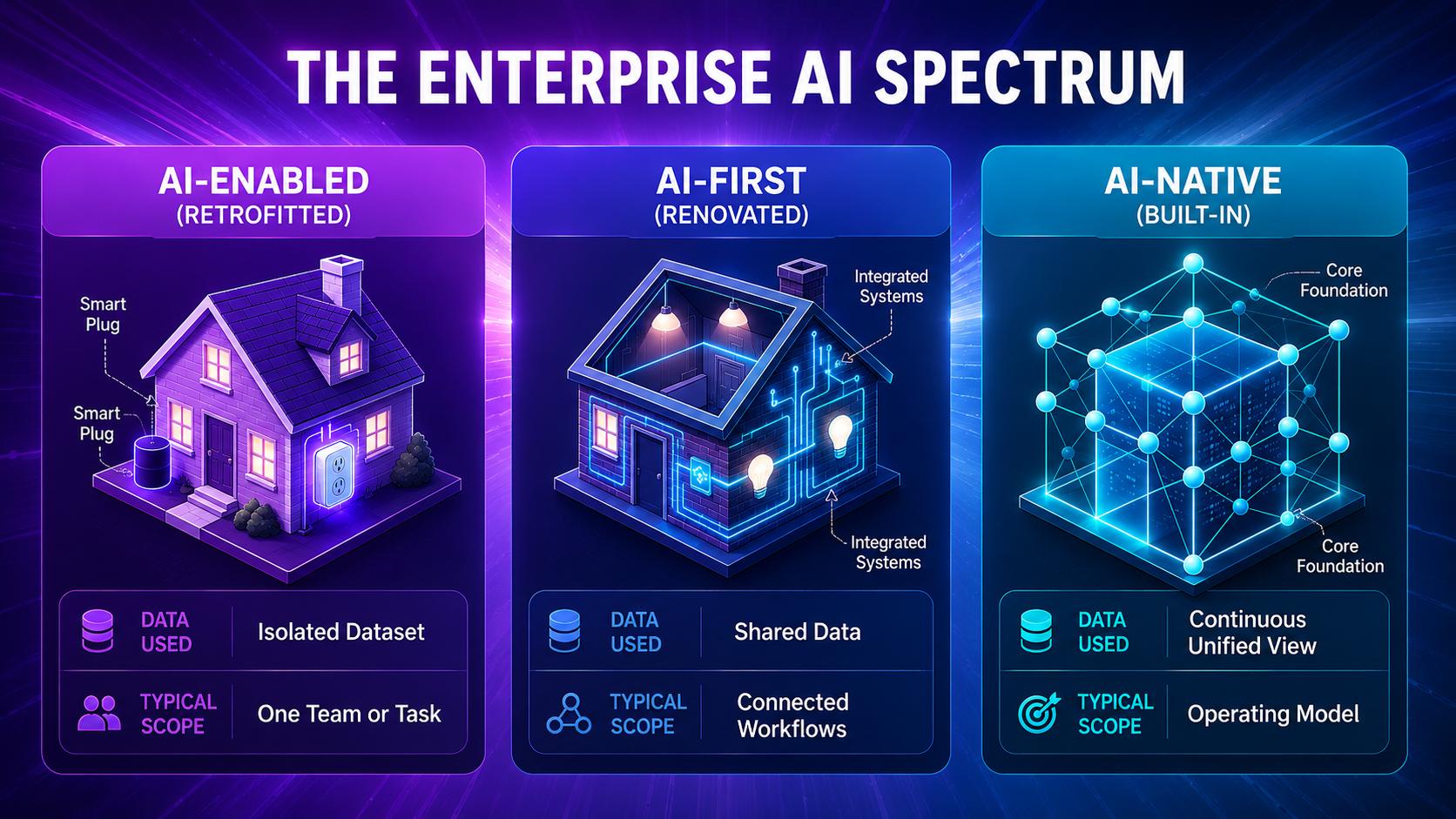
Think of it like a house.
- An AI-enabled house has smart devices added to rooms that were designed without them. They can make life easier, but the house works perfectly well without them.
- An AI-first house has been redesigned so those smart systems work together. The original structure is still there, but AI is now part of how the house operates.
- An AI-native house was designed around intelligent systems from the beginning. AI isn’t an addition to the structure—it is part of what makes the structure work.
The same distinction applies to enterprise technology: AI-enabled adds intelligence to existing processes; AI-first redesigns workflows around it; AI-native builds the architecture around AI from the outset.
AI-Enabled: AI Added to What Already Exists
An AI-enabled organisation takes an existing process and makes it faster or smarter, without changing the process itself. A support team using AI to triage a higher volume of tickets. A forecasting spreadsheet replaced by a machine-learning model that still feeds the same manual planning meeting. The underlying workflow, and the underlying business model, stay exactly as they were — just faster.
- What this looks like: AI projects get framed as “let’s automate this task” or “let’s improve this one metric,” rather than a question about how the process itself should work.
This is not a weak position. It delivers real, measurable efficiency including shorter cycle times, fewer manual errors, freed-up capacity. It is simply bounded by the scope of whichever task it was applied to.
AI-First: AI as the Default, Not the Add-On
An AI-first organisation goes a step further. Instead of adding AI to individual tasks, it starts designing workflows with AI as the default.
Data is shared across connected processes, and AI can support decisions at several points rather than sitting inside one isolated tool. The organisation hasn’t necessarily rebuilt its entire technology stack, but important workflows are now designed around AI from the outset.
- What this looks like: The question changes from “Where can we add AI?” to “How would we design this process if AI were the starting point?”
The return here compounds beyond a single team, because the workflows themselves — not just individual tasks within them — have been rebuilt around the same shared, current data.
AI-Native: Built for This From the Start
An AI-native organisation takes the concept further still. Its data model, architecture and decision-making processes were designed around AI from the beginning.
AI isn’t simply helping an existing system work better. It is part of how the system operates, learns from interactions and makes decisions. Remove the intelligence layer and the underlying product or workflow would no longer function in the same way.
- What this looks like: leadership conversations have moved from “where should we use AI” to “how do we design this around AI from the outset.”
The Spectrum at a Glance
| AI-Enabled | AI-First | AI-Native | |
|---|---|---|---|
| Where AI sits | Added to an existing process | Built into core workflows | Foundation of the system |
| Typical scope | One task or team | Several connected workflows | The wider operating model |
| Data | Often isolated | Shared across connected systems | Continuously unified |
| What improves | Efficiency and specific KPIs | Day-to-day decisions | How the business creates value |
| Potential return | Gains within a defined area | Broader cross-functional gains | Compounding, enterprise-wide value |
Where UK Businesses Actually Sit Today
AI adoption is growing quickly across the UK, but adoption doesn’t necessarily mean maturity. According to the British Chambers of Commerce, 54% of UK SMEs were using AI in 2026, up from 25% two years earlier.
For many organisations, that use still means adding AI to an existing task or process. Far fewer have redesigned core workflows around AI, and genuinely AI-native organisations remain relatively uncommon.
The important question, then, isn’t simply “Are we using AI?” It’s “How deeply has AI changed the way we work?”
That distinction is what the self-assessment below is designed to uncover.
A Short Self-Assessment
Instead of asking where you think your organisation sits, look at how AI actually works across the business. Ask:
- What has changed? Have core processes been redesigned around AI, or have AI tools simply been added to existing workflows?
- What happens without AI? If the AI layer disappeared tomorrow, would the process continue as normal or would it stop working?
- How connected is your data? Do teams work from a shared, current view, or does each function maintain its own version?
- Does AI lead to action? Do predictions and recommendations trigger the next step, or do they sit in reports waiting for someone to respond?
The answers will give you a more realistic picture of your AI maturity than the label on a strategy document.
Where Worktual Sits on This Spectrum
Worktual is designed around AI rather than adding AI as a separate layer after the fact. Cognitive CDP continuously brings customer data together into a current, unified profile, while CVM uses that intelligence to identify customer signals, score opportunities and determine the next best action.
This means AI isn’t limited to generating insights for someone to review later. The intelligence can feed directly into engagement and workflows, helping the business move from understanding what is happening to acting on it.
That is the key distinction between an AI-enabled tool and an AI-native platform: intelligence is part of how the system operates, not simply an additional feature sitting on top.
Conclusion
AI maturity isn’t determined by how many AI tools an organisation has deployed. It depends on how deeply AI is embedded in the way the business operates.
AI-enabled can deliver valuable efficiency gains. AI-first takes that further by redesigning important workflows around AI. AI-native goes deeper still, with AI built into the data, architecture and decision-making from the start.
There is no single stage every organisation needs to reach overnight. The important first step is understanding where your business actually sits—and whether your technology, data and operating model are ready for the next stage.
Frequently Asked Questions
1.What is the difference between AI-enabled, AI-first and AI-native?
AI-enabled adds AI to an existing process. AI-first designs workflows with AI as the default. AI-native builds the underlying architecture and decision-making around AI from the beginning.
2. Is AI-native always better than AI-enabled?
Not necessarily. AI-enabled solutions can deliver meaningful efficiency gains with less disruption. AI-native architecture is more suited to organisations looking to make AI central to how their products, processes and decisions work.
3. How can a business tell which stage it is at?
Look at what happens when AI is removed. If the process continues as before, AI is probably supporting an existing workflow. If removing it fundamentally changes how the process operates, AI is much more deeply embedded.
4. Can a business be AI-first in some areas and AI-enabled in others?
Yes. Most organisations will sit at different points of the spectrum across different functions. A business might have AI-first customer service workflows while other departments are still experimenting with individual AI tools.
5. What does it mean for AI to be core to the architecture?
It means AI isn’t simply an additional capability sitting on top of an existing system. The data model, workflows and decision logic are designed to work with AI as an integral part of the system.
6. Where does Worktual fit on the AI spectrum?
Worktual is designed around AI, with Cognitive CDP providing a continuously unified customer profile and CVM using that intelligence to identify signals and determine the next best action. AI is therefore part of the way the platform operates, rather than a separate feature added to an existing workflow.

Related Posts
Why Intelligent CRM Is Becoming a Compliance Requirement, Not Just a Sales Tool
For years, CRM software had one job: keep track of leads, log calls, and give sales teams a pipeline to work from. That’s still how many organisations view it today — a sales tool, and little more.

How AI Is Reducing Customer Service Costs for UK Enterprises (CCaaS)
An AI CRM is customer relationship management software with artificial intelligence built into its core workflows. Rather than simply storing contact records, it scores leads, drafts follow-ups, forecasts deals, and surfaces the next action automatically. The difference from a normal CRM is not an added chatbot; it is that the software itself does some of the work, not just the record-keeping.
Why AI Agents Are Replacing Static Workflows
A prospective customer visits your website looking for pricing. During the conversation, they mention they’re evaluating several vendors, ask for a product demo and request information for their procurement team.


