Hub-and-Spoke Architecture for AI Agents: How It Connects Enterprise

Insights / Hub-and-Spoke Architecture for AI Agents: How It Connects Enterprise
Hub and Spoke Architecture Ai Agents

Most UK organisations no longer need convincing that AI agents are useful.

The harder question is: how do you get all those agents to work together?
UK enterprises are now running an average of 13 AI agents each, and that number is expected to roughly double within two years. Sixty-nine per cent of UK organisations say most or all teams and functions have already adopted AI agents.

The challenge is connectivity. More than half of these agents currently operate in isolated silos. UK enterprises also run an average of 796 applications, with only around a third integrated with one another.

That creates a familiar enterprise problem: lots of systems, lots of connections, and very little shared context. This is where hub-and-spoke architecture comes in.

What is Hub-and-Spoke Architecture

Think of an enterprise with 50 different systems. In a point-to-point model, every system connects directly to the others it needs to communicate with. As the number of systems grows, the number of connections grows rapidly too.

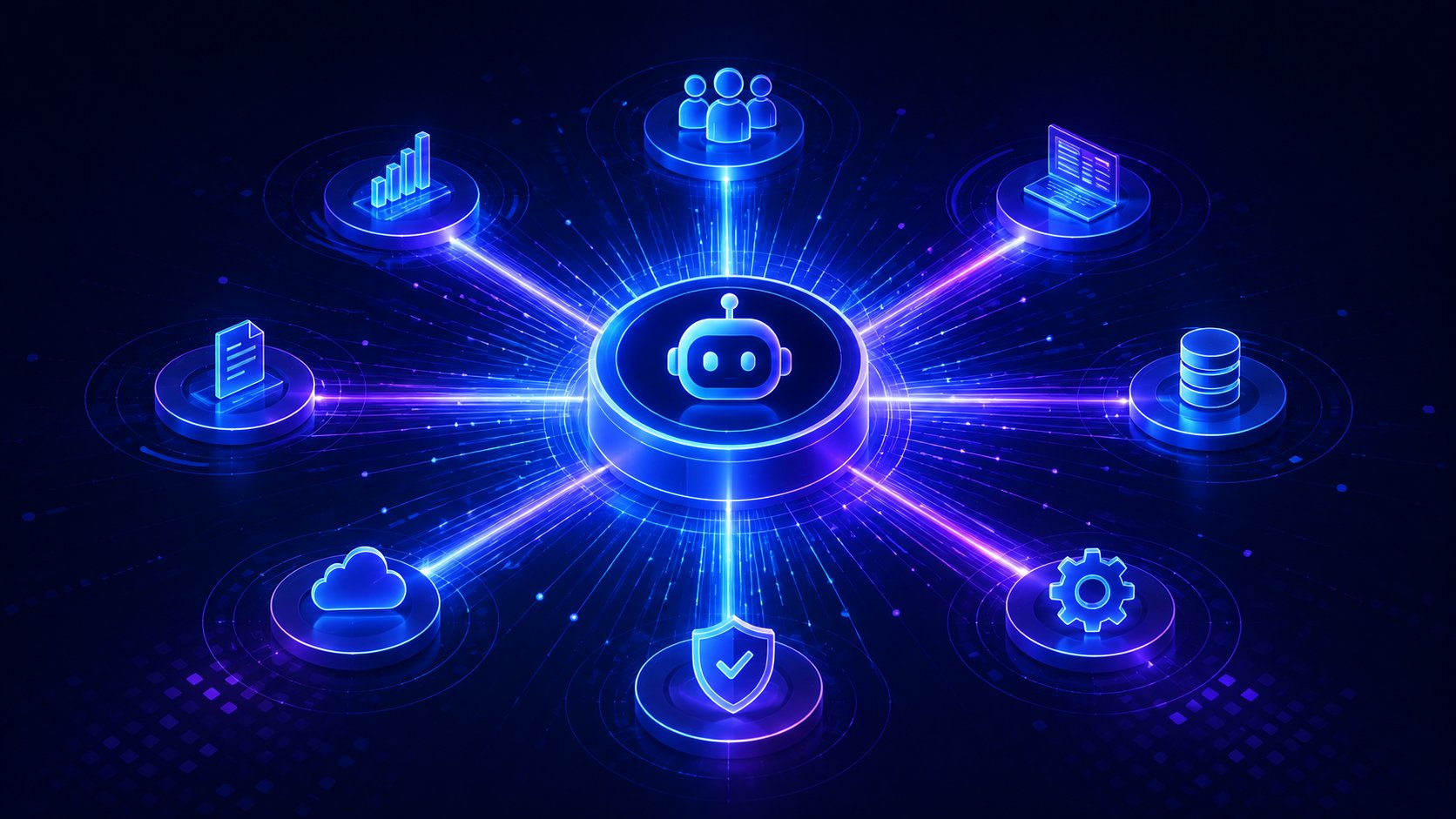
A hub-and-spoke model takes a different approach. Instead of every system connecting directly to every other system, each system connects to a central hub.

The hub manages:

  • Data exchange
    Routing
  • Translation between systems
  • Access permissions
  • Business rules

Adding a new system then means connecting it to the hub rather than creating multiple new connections across the enterprise. The basic architecture isn’t new. Enterprise data integration and ERP systems have used similar approaches for years.

The architecture is familiar. What’s new is that AI agents are increasingly becoming part of the connected ecosystem, alongside traditional enterprise applications. Increasingly, those connections include autonomous AI agents.

Why Point-to-Point Breaks Down Once Agents Are Involved

Traditional applications generally retrieve data and present it to a user. AI agents can do much more.

They can: Retrieve → Understand → Reason → Decide → Act

For example, an agent might:

  • Update a customer record
  • Send an email
  • Escalate a support case
  • Trigger a workflow
  • Recommend an offer

That makes fragmented connections much more problematic. Imagine a sales agent and a service agent both working with the same customer.

If each has its own direct connections to the CRM, ticketing system and billing platform, you can end up with:

  • Duplicate integration work
  • Different versions of customer information
  • Conflicting decisions
  • No central visibility into what an agent has done

The more agents you add, the harder this becomes to manage.

The Risk of Agent Sprawl

The UK data shows why this matters. An estimated 22% of APIs are currently ungoverned, while only 56% of UK organisations have a centralised governance framework for their agentic systems.

Cross-application data governance is also cited as a major integration challenge. This creates the possibility of shadow AI: agents being connected and operating without enough central visibility or governance.

And unlike a passive application, an agent may be making decisions or taking actions. That raises the stakes.

A Simple Example

Consider a UK retailer. A customer emails about a delayed order. The service agent sees the complaint and offers the customer a goodwill discount.

An hour later, the marketing agent sends that same customer a full-price upsell email. Neither agent has technically made a mistake. The service agent didn’t know what marketing was doing. The marketing agent didn’t know about the service interaction. The customer, however, sees both messages.

This is what happens when multiple agents work with different pieces of the same customer context. A shared architecture gives those agents access to the information they need to work from the same picture.

What Should the Hub Actually Do?

A hub for AI agents needs to do more than move data around. It should provide a common foundation for connected agents.

At a minimum, it should:

1. Maintain consistent information

Connected agents should be able to work from the same current customer or business record.

2. Apply consistent rules

Permissions, policies and business rules should apply regardless of which agent is accessing the information.

3. Provide visibility

The organisation should be able to see what agents accessed, what they decided and what actions they took. This becomes particularly important when agents are making decisions that affect customers.

The UK’s Information Commissioner’s Office has made clear that data protection obligations still apply when decisions are made by AI agents. Where automated decisions have significant effects, organisations need appropriate safeguards, including the ability for people to review decisions.

A governed hub makes this easier to manage than a collection of disconnected agent integrations.

Hub and Spoke Architecture AI Agents Enterprise

Where Worktual Fits

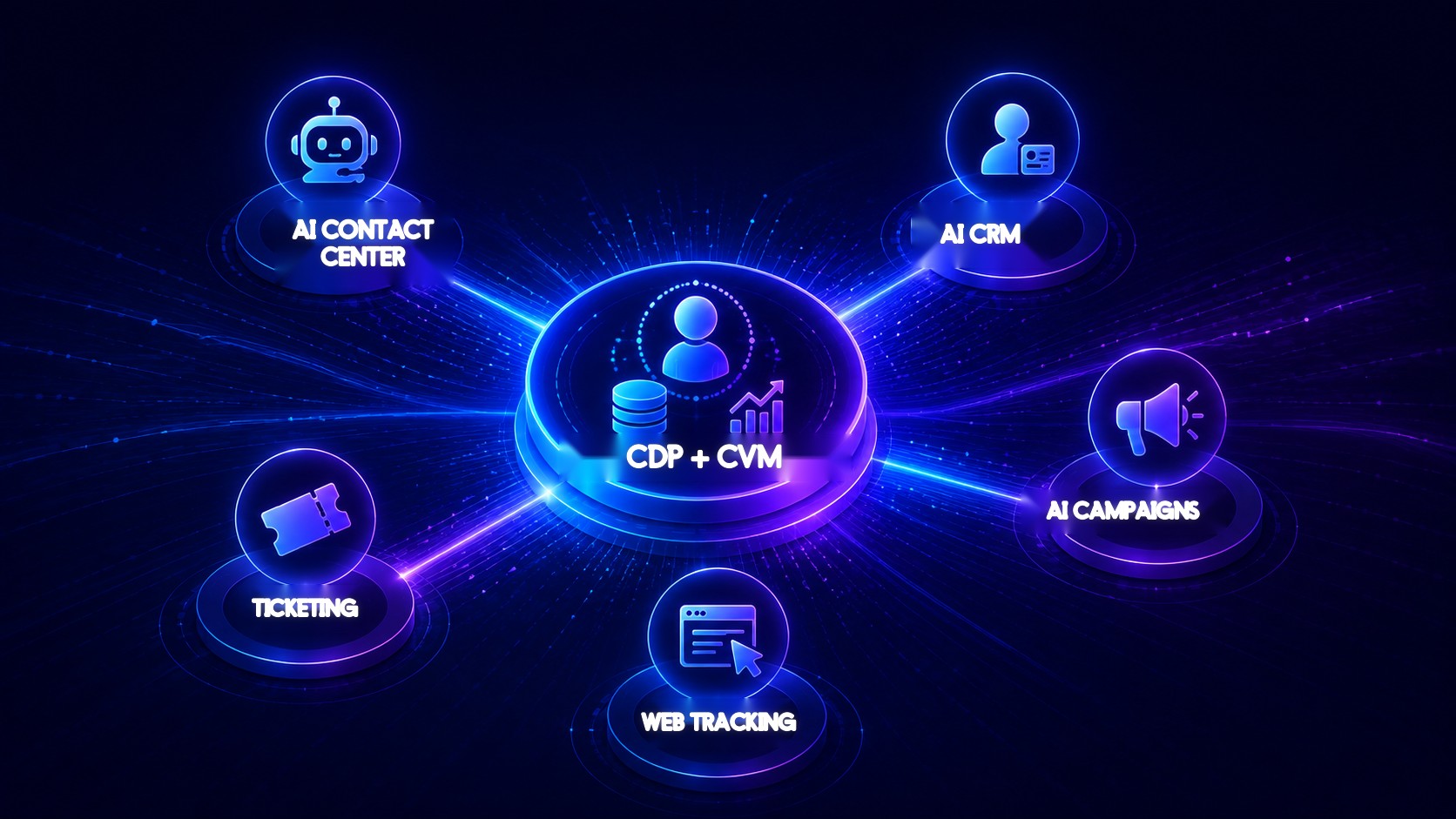
Worktual uses a hub-and-spoke approach to separate the shared intelligence foundation from the agents that take action.

At the center are:

Cognitive CDP + CVM – The Cognitive CDP brings customer data and context from connected systems into a continuously updated customer profile.

CVM works on top of that profile to provide:

  • Value scoring
  • Prediction
  • Next-best-action decisioning

AI-native agents across the:

  • Contact center
  • CRM
  • Campaign management
  • Ticketing

can then work from the same shared foundation. The result is a clearer separation between where intelligence and context are maintained and where actions are taken.

Conclusion

Deploying more AI agents does not automatically mean an enterprise is becoming more intelligent. The agents also need to work together.

For UK organisations already running multiple agents across a large application landscape, the architecture connecting those agents becomes increasingly important. Hub-and-spoke provides a proven way to connect systems through a central, governed layer rather than creating a growing web of point-to-point integrations. For AI agents, a shared foundation can help ensure they work from consistent information, follow common rules and remain visible to the organisation.

Book a Free Demo.

Frequently Asked Questions

1. What is hub-and-spoke architecture?

It is an integration model where connected systems link to a central hub rather than directly to every other system. The hub manages data exchange, routing and access rules.

2. Why does hub-and-spoke matter for AI agents?

AI agents don’t just retrieve information. They can reason, make decisions and take action. A shared hub helps them work from consistent information and reduces conflicting actions.

3. What is agent sprawl?

Agent sprawl happens when organisations deploy many AI agents independently across different teams and systems. This can lead to duplicated integrations, fragmented data and limited visibility.

4. Are UK enterprises already facing agent sprawl?

Yes. UK organisations report an average of 13 AI agents, with more than half operating in isolated silos, according to the Salesforce 2026 Connectivity Benchmark Report cited in the article.

5. Does UK GDPR apply to AI agents?

Yes. The ICO has made clear that data protection obligations apply to decisions made by AI agents. Where automated decisions significantly affect someone, relevant UK GDPR safeguards apply, including human review.

6. Does hub-and-spoke require replacing existing systems?

No. Existing systems can connect to the hub as spokes. The model is intended to standardise how systems exchange information rather than require a complete platform replacement.

Related Posts

UK Ai Tools to Unified Intelligence

Why UK Businesses Are Moving from AI Tools to Unified Intelligence Platforms

Business-to-business (B2B) customer engagement has changed significantly as buyers now expect faster responses, connected interactions, and highly personalised experiences across every stage of the customer journey. Decision-makers no longer compare B2B experiences only with competitors within the same industry. They compare them with the seamless digital experiences they receive across retail, banking, streaming platforms, and consumer applications. This shift has increased pressure on enterprises to modernise how they manage customer relationships, support operations, and lifecycle engagement.

UK AISI Incident Ai Agent Governance

What the UK’s Own AI Safety Incident Reveals About Deploying Agents Without a Harness

Business-to-business (B2B) customer engagement has changed significantly as buyers now expect faster responses, connected interactions, and highly personalised experiences across every stage of the customer journey. Decision-makers no longer compare B2B experiences only with competitors within the same industry. They compare them with the seamless digital experiences they receive across retail, banking, streaming platforms, and consumer applications. This shift has increased pressure on enterprises to modernise how they manage customer relationships, support operations, and lifecycle engagement.

Ticket Deflection vs Ticket Resolution

Ticket Deflection vs Ticket Resolution: Why the Metric Everyone Tracks Is the Wrong One

Business-to-business (B2B) customer engagement has changed significantly as buyers now expect faster responses, connected interactions, and highly personalised experiences across every stage of the customer journey. Decision-makers no longer compare B2B experiences only with competitors within the same industry. They compare them with the seamless digital experiences they receive across retail, banking, streaming platforms, and consumer applications. This shift has increased pressure on enterprises to modernise how they manage customer relationships, support operations, and lifecycle engagement.