How AI-Native Cognitive Customer Data Platforms Are Transforming Ecommerce: Improving Customer Retention, Purchase Intelligence, and Real-Time Omnichannel Engagement

Insights / How AI-Native Cognitive Customer Data Platforms Are Transforming Ecommerce: Improving Customer Retention, Purchase Intelligence, and Real-Time Omnichannel Engagement

AI-Native Cognitive Data Platform for Ecommerce

The UK is Europe’s largest ecommerce market and the world’s third-largest, with online commerce continuing to shape how consumers discover, evaluate, and purchase products. As competition intensifies, sustainable ecommerce growth depends not only on attracting new customers but also on increasing repeat purchases, strengthening customer loyalty, and maximising Customer Lifetime Value (CLV).

Customer acquisition has never been easier or more expensive. Ecommerce businesses can reach millions of potential buyers through search, social media, marketplaces, influencers, and digital advertising, yet turning first-time buyers into loyal customers remains one of the industry’s biggest challenges. As acquisition costs continue to rise and competition intensifies, sustainable ecommerce growth increasingly depends on customer retention, repeat purchases, and CLV rather than simply acquiring more traffic.

The challenge is that most ecommerce businesses understand transactions better than they understand customers. While platforms capture orders, website analytics measure visits, marketing tools track campaigns, and customer service systems record support interactions, these insights often remain isolated. As a result, many businesses struggle to answer:

Which customers are ready to buy?
Which customers are at risk of leaving?
What is the next best action to increase conversion or retention?

Improving ecommerce performance requires more than reporting on historical behaviour. Businesses need AI native customer intelligence platforms that continuously connect behavioural signals, transactional history, engagement patterns, and lifecycle interactions into a unified customer intelligence layer. By recognising buying intent, predicting future behaviour, and recommending the next best action, organisations can deliver more relevant customer experiences, improve retention, increase repeat purchases, and maximise long-term customer value.

• What AI-Native Cognitive CDPs Mean for Ecommerce Customer Intelligence and Revenue Growth

• Ecommerce Challenges Affecting Retention, Purchase Intelligence, and Personalisation

• Solutions Ecommerce Businesses Need to Improve Customer Retention and Lifecycle Performance

• How Worktual Helps Ecommerce Businesses Improve Retention, CLV, and Revenue

• Conclusion

• FAQs

What AI-Native Cognitive CDPs Mean for Ecommerce Customer Intelligence and Revenue Growth

Every ecommerce interaction generates valuable customer data, from product searches and browsing behaviour to purchases, reviews, customer enquiries, and abandoned carts. The challenge is not collecting more data but connecting these interactions into meaningful customer intelligence that supports faster, more informed business decisions.

An AI-Native Cognitive Customer Data Platform (CDP) transforms fragmented behavioural, transactional, and engagement data into a continuously evolving customer intelligence layer. Rather than relying on historical reports or static customer segments, it interprets buying intent, identifies behavioural patterns, predicts future actions, and recommends the next best engagement strategy in real time.

Customer Intelligence: The questions every ecommerce business should be able to answer

Business QuestionAI-Native Cognitive CDP
Which visitors are most likely to purchase?Identifies buying intent from real-time behavioural signals.
Which customers are at risk of churning?Predicts retention risks using behavioural and transactional patterns.
Which products should be recommended next?Identifies product affinity and cross-sell opportunities.
Who should receive each campaign?Creates dynamic audiences based on behaviour, lifecycle stage, and engagement.
Which customers deliver the highest long-term value?Continuously evaluates CLV and loyalty potential.
What action should happen next?Recommends the next best action to improve engagement, conversion, or retention.

As ecommerce competition continues to intensify, success depends on making faster, smarter decisions throughout the customer lifecycle. AI-Native Cognitive CDP enable businesses to move beyond understanding what customers have done to anticipating what they are likely to do next. The result is more relevant customer engagement, improved marketing effectiveness, higher repeat purchases, stronger customer retention, and sustainable ecommerce growth.

Ecommerce Challenges Affecting Retention, Purchase Intelligence, and Personalisation

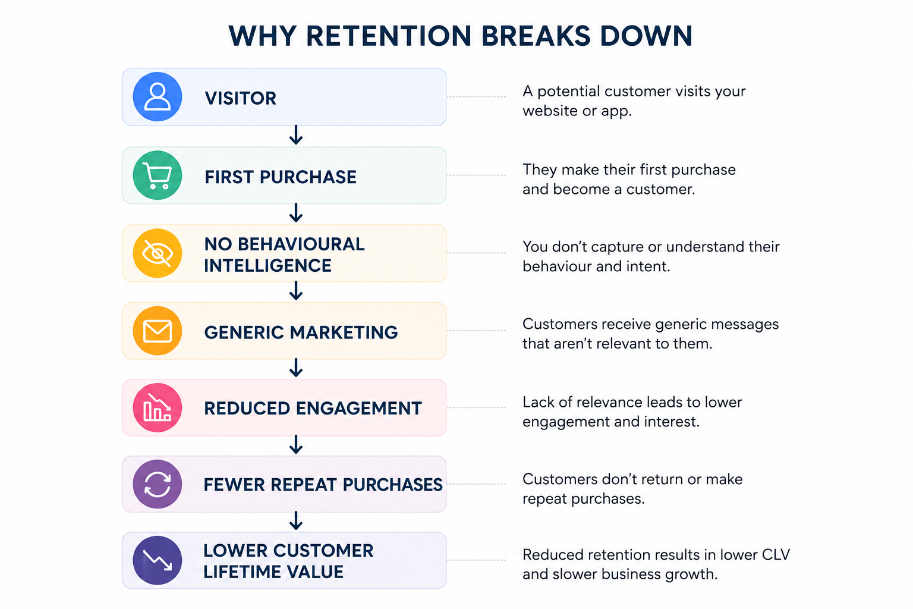
For many ecommerce businesses, the biggest challenge isn’t attracting customers; it’s keeping them engaged after the first purchase. While marketing teams invest heavily in customer acquisition, sustainable growth depends on increasing repeat purchases, strengthening customer loyalty, and maximising CLV. Yet many businesses struggle because customer intelligence remains fragmented across multiple systems.

Customer data is often spread across:

Ecommerce platforms
Marketplaces
Customer Relationship Management (CRM) systems
Marketing automation platforms
Loyalty programmes
Customer service applications

Without a unified view of customer behaviour, organisations struggle to:

Identify purchase intent in real time
Personalise customer engagement
Predict churn and retention risks
Deliver relevant product recommendations
Increase repeat purchases
Maximise CLV

The commercial impact extends beyond customer experience. Disconnected customer intelligence results in:

Higher customer acquisition costs
Lower repeat purchase rates
Inefficient marketing spend
Missed upsell and cross-sell opportunities
Weaker customer loyalty
Reduced long-term profitability

Why Retention Breaks Down

Why Retention Breaks Down

Solutions Ecommerce Businesses Need to Improve Customer Retention and Lifecycle Performance

Improving ecommerce performance requires more than disconnected marketing, commerce, and customer service tools. Businesses need a unified intelligence platform that connects customer behaviour, transactional history, engagement activity, and lifecycle interactions into one continuously evolving customer view. This enables organisations to understand not only what customers have done, but also why they behave the way they do and how best to engage them next.

Worktual’s AI-Native Cognitive CDP brings together behavioural signals, purchase history, customer interactions, loyalty activity, and engagement data into a single intelligence layer. By continuously analysing customer behaviour, Worktual helps ecommerce businesses identify buying intent, predict future actions, and deliver personalised experiences across the customer lifecycle.

With Worktual, ecommerce businesses can:

Build unified customer profiles across every touchpoint
Recognise buying intent and behavioural patterns in real time
Deliver personalised recommendations and customer journeys
Trigger AI-driven engagement across multiple channels
Improve repeat purchases and customer loyalty
Maximise CLV through intelligent lifecycle management

Rather than functioning as another standalone application, Worktual acts as the intelligence layer that connects customer engagement, marketing, commerce, customer service, and loyalty into one coordinated ecosystem.

How Worktual Helps Ecommerce Businesses Improve Retention, CLV, and Revenue

AI Native Cognitive CDP for Ecommerce

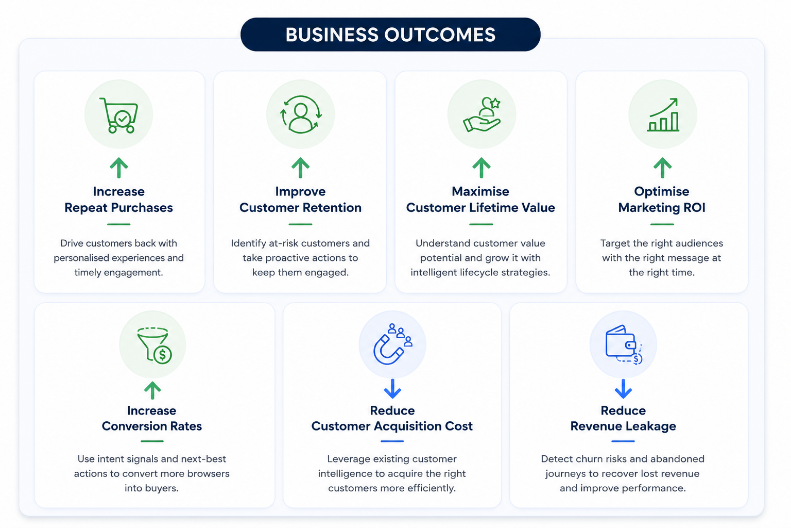
Customer intelligence delivers value only when it improves commercial performance. Worktual helps ecommerce businesses transform behavioural insights into measurable business outcomes by connecting customer intelligence with real-time engagement, personalised experiences, and AI-driven decision-making across the customer lifecycle.

By combining an AI-Native Cognitive CDP with Customer Value Management, Worktual enables ecommerce businesses to engage customers more intelligently at every stage of the buying journey. This helps organisations improve marketing effectiveness, increase repeat purchases, optimise promotional spend, and strengthen CLV while creating more consistent customer experiences.

Business Outcomes with Worktual

Business Outcomes with Worktual

Worktual’s consultancy-led approach ensures that customer intelligence strategies align with commercial priorities rather than technology alone. By combining AI, behavioural intelligence, and lifecycle optimisation into one connected platform, Worktual helps ecommerce businesses build stronger customer relationships, improve profitability, and achieve sustainable long-term growth.

Conclusion

As ecommerce continues to evolve, competitive advantage will increasingly depend on how effectively businesses understand and engage their customers rather than how much customer data they collect. Organisations that invest in AI-native customer intelligence are better positioned to:

Increase customer retention and repeat purchases
Deliver personalised experiences at every stage of the customer journey
Recognise buying intent and recommend the next best action
Optimise marketing investment and improve conversion
Maximise CLV and long-term profitability

Worktual’s AI-Native Cognitive CDP helps ecommerce businesses transform fragmented customer interactions into connected intelligence by enabling organisations to:

Unify behavioural, transactional, and engagement data
Identify customer intent in real time
Deliver AI-driven personalised engagement
Strengthen customer loyalty and lifecycle performance
Drive measurable business outcomes through intelligent decision-making

FAQs

1. What is a Cognitive Customer Data Platform (CDP)?

A Cognitive Customer Data Platform (CDP) connects customer data, behavioural signals, transactional activity, and engagement interactions into a continuously evolving intelligence layer. Unlike traditional customer data platforms that primarily consolidate information, a Cognitive CDP uses AI to interpret customer behaviour, identify buying intent, and support more personalised engagement across ecommerce platforms, marketplaces, loyalty programmes, customer service channels, and digital commerce channels.

2. How is a Cognitive CDP different from a traditional CDP?

Traditional CDPs focus on consolidating customer data for reporting, audience segmentation, and campaign execution. A Cognitive CDP builds on this foundation by adding AI-driven intelligence, predictive analytics, behavioural insights, and next-best-action recommendations. Rather than simply storing customer information, it helps ecommerce businesses understand customer intent, anticipate future behaviour, and make faster, more informed business decisions.

3. Why do ecommerce businesses need a Cognitive Customer Data Platform?

UK ecommerce businesses engage customers across ecommerce websites, marketplaces, mobile applications, loyalty programmes, customer service channels, and digital marketing platforms. A Cognitive CDP connects these interactions into a unified customer view, enabling businesses to improve personalisation, strengthen customer retention, reduce cart abandonment, optimise marketing performance, and maximise Customer Lifetime Value (CLV).

4. How does a Cognitive Customer Data Platform create unified customer profiles?

A Cognitive CDP combines browsing behaviour, purchase history, loyalty activity, customer service interactions, transactional data, and engagement signals into a continuously updated customer profile. This enables ecommerce businesses to better understand customer preferences, recognise buying intent, and deliver more relevant customer experiences across every digital touchpoint.

5. Can a Cognitive Customer Data Platform help reduce cart abandonment?

Yes. A Cognitive CDP analyses behavioural signals, purchase intent, and engagement patterns throughout the buying journey. By enabling ecommerce businesses to trigger personalised reminders, contextual offers, product recommendations, and timely customer engagement, it helps recover abandoned carts, improve conversion rates, and reduce lost revenue.

6. How does AI improve ecommerce personalisation?

AI continuously analyses customer behaviour, purchase patterns, browsing history, product preferences, and engagement activity to identify trends and predict customer intent. This enables ecommerce businesses to deliver personalised recommendations, relevant offers, and context-aware shopping experiences that improve customer satisfaction, increase repeat purchases, and strengthen long-term customer loyalty.

7. Why is omnichannel orchestration important in ecommerce?

Today’s customers interact with brands across ecommerce websites, marketplaces, mobile applications, email, customer service channels, and loyalty programmes before making a purchase. Omnichannel orchestration preserves customer context across these touchpoints, enabling ecommerce businesses to deliver consistent, personalised experiences that improve engagement, strengthen customer relationships, and increase customer retention.

8. How is Worktual different from standard ecommerce customer data platforms?

Worktual combines an AI-Native Cognitive Customer Data Platform with Customer Value Management (CVM), behavioural intelligence, and a consultancy-led approach to customer lifecycle optimisation. Rather than functioning as a static customer database, Worktual continuously interprets customer behaviour, predicts buying intent, and recommends the next best action. This enables ecommerce businesses to improve conversion, strengthen customer retention, maximise Customer Lifetime Value (CLV), and deliver measurable commercial outcomes through connected customer intelligence.

Related Posts

AI-Native Cognitive Data Platform for Retail

AI-Native Cognitive Data Platform for Retail: Solving Fragmented Customer Journeys, Cart Abandonment, and Inconsistent Personalisation

Business-to-business (B2B) customer engagement has changed significantly as buyers now expect faster responses, connected interactions, and highly personalised experiences across every stage of the customer journey. Decision-makers no longer compare B2B experiences only with competitors within the same industry. They compare them with the seamless digital experiences they receive across retail, banking, streaming platforms, and consumer applications. This shift has increased pressure on enterprises to modernise how they manage customer relationships, support operations, and lifecycle engagement.

Unified Intelligence for Media & Advertising

Unified Intelligence AI for Media & Advertising: Boosting Audience Engagement, Ad Revenue Yield, Advertiser Retention

Business-to-business (B2B) customer engagement has changed significantly as buyers now expect faster responses, connected interactions, and highly personalised experiences across every stage of the customer journey. Decision-makers no longer compare B2B experiences only with competitors within the same industry. They compare them with the seamless digital experiences they receive across retail, banking, streaming platforms, and consumer applications. This shift has increased pressure on enterprises to modernise how they manage customer relationships, support operations, and lifecycle engagement.

Unified Intelligence for Technology

Unified Intelligence AI for Technology: Accelerating Product Adoption, Customer Retention, Expansion Revenue

Business-to-business (B2B) customer engagement has changed significantly as buyers now expect faster responses, connected interactions, and highly personalised experiences across every stage of the customer journey. Decision-makers no longer compare B2B experiences only with competitors within the same industry. They compare them with the seamless digital experiences they receive across retail, banking, streaming platforms, and consumer applications. This shift has increased pressure on enterprises to modernise how they manage customer relationships, support operations, and lifecycle engagement.