

Unified Intelligence AI for Technology: Accelerating Product Adoption, Customer Retention, Expansion Revenue
Insights / Unified Intelligence AI for Technology: Accelerating Product Adoption, Customer Retention, Expansion Revenue

Table of Contents
Technology companies operate in a market defined by rapid innovation cycles, intense competition, rising customer expectations, and increasing pressure to grow efficiently. Technology buyers worldwide expect intuitive onboarding, immediate value, responsive support, and continuous product improvement. At the same time, many businesses face margin pressure, rising acquisition costs, fragmented systems, and expanding service complexity. When onboarding is slow, adoption stalls, or support experiences feel inconsistent, churn risk rises quickly. In this environment, technology customer lifecycle management has become central to sustaining growth, protecting recurring revenue, and building long-term customer value across SaaS and digital platforms.
These pressures rarely remain isolated. Weak onboarding journeys can delay time-to-value, while low product usage reduces renewal confidence and expansion readiness. Fragmented data across customer relationship management (CRM) systems, product analytics, billing platforms, support tools, and marketing technology limits visibility into behaviour, health, and commercial opportunity. Manual workflows slow customer responses and raise operating costs. Poor segmentation can lead to irrelevant outreach, while reactive success programmes intervene too late. Limited cross-sell and upsell execution weakens monetisation. The combined effect is revenue leakage, inefficient acquisition spend, lower net retention, and reduced lifetime value across customer portfolios globally.
Worktual addresses these challenges through a consultancy-led and bespoke model of unified intelligence for technology companies. Powered by a bespoke Cognitive Data Platform, it connects customer data, engagement activity, service operations, and lifecycle execution into one intelligence system. This creates clearer visibility into user behaviour, account health, expansion potential, and operational friction. With stronger coordination across sales, marketing, product, support, and customer success teams, organisations can act earlier, improve relevance, and streamline decisions. The result is a stronger path to accelerating product adoption, customer retention, and expansion revenue through connected execution and informed growth decisions.
• What unified intelligence means for technology customer lifecycle and revenue growth
• Technology pain points affecting product adoption, customer retention, and expansion revenue
• Solutions technology organisations need to improve lifecycle performance and cost efficiency
• Impact, ROI, and revenue gains from unified intelligence in technology
• Why Worktual works for technology organisations
• FAQs
What unified intelligence means for technology customer lifecycle and revenue growth
Worktual Unified intelligence for technology companies means connecting customer data, product usage signals, engagement activity, service interactions, and lifecycle execution into one continuously updated operating layer. Rather than relying on disconnected CRM systems, product analytics tools, billing platforms, support software, and marketing automation, organisations work from a shared source of insight. This improves visibility across acquisition, onboarding, adoption, retention, expansion, and renewal journeys. It also enables faster decisions, better prioritisation, and more consistent execution across sales, product, marketing, customer success, and support teams.
The customer journey in this sector is dynamic and behaviour-led. A prospect may attend a demo, activate selected features, request support, upgrade users, and expand usage later. Existing customers generate signals through login frequency, feature adoption, support history, contract milestones, satisfaction trends, and spend patterns. Each interaction can indicate risk, intent, or revenue opportunity. Worktual helps unify these signals so organisations can understand changing needs earlier and respond with timely and relevant actions across self-serve, mid-market, and enterprise accounts more effectively over time.
For leadership teams, this creates a shift from siloed functional management to lifecycle-led commercial performance. Growth becomes driven by stronger product adoption, healthier retention, improved expansion revenue, and lower operating friction rather than acquisition alone. Worktual’s unified intelligence supports better forecasting, faster execution, and clearer accountability across departments. It aligns product, sales, marketing, finance, support, and customer success around one customer view. Worktual enables organisations to combine AI-native customer insights technology leaders need with practical decision discipline, helping pursue sustainable growth with greater confidence, precision, resilience, and enterprise-wide coordination across changing market conditions.
Technology pain points affecting product adoption, customer retention, and expansion revenue
Technology companies face commercial pressures that directly affect recurring revenue and growth quality. Buyers compare alternatives quickly and expect rapid value after purchase. New customers may sign contracts or begin trials yet fail to adopt core features fully. Weak onboarding journeys, unclear product guidance, and inconsistent success engagement can reduce confidence early. Many businesses also struggle to grow expansion revenue when offers are generic or poorly timed. Without precise targeting, seat growth, tier upgrades, add-ons, and renewals underperform, limiting monetisation across self-serve, mid-market, and enterprise customer segments.
Operational inefficiencies place further strain on margins and service quality. Support teams often manage high volumes of repetitive requests relating to setup, integrations, permissions, billing changes, feature queries, and technical issues. Manual case handling slows resolution times and increases workload pressure. Customers moving between chat, email, help centres, account managers, and product interfaces may need to repeat information, creating friction and dissatisfaction. Internal handovers between sales, support, engineering, and customer success can also become fragmented, affecting responsiveness and trust. These issues increase servicing costs while weakening retention outcomes across accounts.
Data fragmentation compounds these challenges. Customer information is frequently spread across CRM platforms, product analytics systems, billing tools, support software, and marketing applications. This limits a unified view of behaviour, profitability, health score, and churn risk. Teams may work from conflicting reports, slowing action and reducing accountability. Cross-sell opportunities are missed when usage trends and lifecycle triggers are invisible. Retention strategies become reactive instead of predictive. Without SaaS performance analytics and insights, the result is revenue leakage, higher operating cost, inconsistent engagement, and lower lifetime value.
Solutions technology organisations need to improve lifecycle performance and cost efficiency
Improving technology performance requires a unified intelligence hub rather than disconnected operational tools. Organisations need a real-time data layer that combines CRM records, product usage signals, billing history, support interactions, marketing activity, and commercial data into one trusted customer view. This enables clearer prioritisation, faster decisions, and stronger accountability across teams. Leaders gain visibility into adoption barriers, churn risks, and expansion opportunities without waiting for delayed reports. With Worktual unified intelligence for technology companies, decision-making becomes more responsive, coordinated, and commercially relevant across product-led and sales-led growth models.
Technology organisations increasingly depend on connected execution capabilities to manage customer engagement, onboarding, support interactions, and retention journeys across digital channels effectively. Customers expect responsive and seamless experiences whether they interact through websites, in-app workflows, chat, email, customer success teams, or support centres. Worktual AI chatbots, omnichannel customer engagement platforms, workflow automation, intelligent routing, and proactive communication capabilities help streamline interactions while improving responsiveness and service quality. Internal teams benefit from stronger coordination, clearer accountability, faster escalations, and more efficient collaboration across departments. This creates a more dependable operating environment where every interaction strengthens customer retention instead of weakening engagement through delays, repetitive communication, or disconnected experiences across the customer lifecycle.
Worktual’s Customer Data Platform capabilities, Customer Value Management framework, and lifecycle orchestration intelligence help organisations convert operational insight into measurable commercial outcomes. Connected customer profiles enable segmentation based on account value, behavioural patterns, lifecycle maturity, engagement activity, and expansion readiness. Predictive intelligence can identify customers requiring proactive engagement, while next-best-action recommendations support renewals, upgrades, feature adoption, seat growth, and customer reactivation initiatives. Automated lifecycle workflows can streamline onboarding completion, product engagement reminders, training communication, renewal readiness, and customer advocacy programmes. By bringing these capabilities together within one connected operating environment, Worktual enables organisations to improve product adoption, strengthen long-term customer retention, and increase expansion revenue through coordinated lifecycle execution.
Impact, ROI, and revenue gains from unified intelligence in technology
Revenue performance in technology companies is largely influenced by how effectively users activate, adopt, and continue using the product over time. When product analytics, onboarding journeys, billing data, and support interactions are connected using Worktual AI-native platform, teams gain earlier visibility into user behaviour. This can lead to improvements in activation rates of 15–30% and deeper feature adoption of 10–25%. Faster time-to-value reduces early-stage drop-offs and improves conversion across trials, freemium users, and paid subscriptions, making acquisition efforts more efficient and commercially productive.
Expansion revenue becomes more consistent when driven by real usage patterns rather than periodic sales interventions. With clear visibility into account activity, feature utilisation, and engagement signals, organisations can perform time upgrades, seat expansion, and add-on offers more effectively with Worktual’s unified intelligence. This can contribute to a 5–15% uplift in expansion revenue. At the same time, early indicators such as declining usage or increased support dependency can trigger targeted retention actions, potentially reducing churn by 3–10%. This approach shifts growth from renewal-driven cycles to continuous, behaviour-led expansion across the customer lifecycle.
Operational efficiency adds another layer of return. Automation can manage 40–60% of routine interactions, including onboarding support, billing queries, and account updates. Teams can focus on high-value or at-risk accounts using real-time insights rather than static prioritisation. This improves execution across sales, support, and customer success teams. Over time, organisations can grow revenue, improve retention, and scale customer engagement without a proportional increase in headcount using Worktual AI, and support more efficient and sustainable SaaS growth models.

Why Worktual works for technology organisations
Worktual supports technology organisations by treating growth as a connected lifecycle-execution problem, not a set of disconnected tools. In SaaS environments, demand generation, onboarding, product usage, support, renewals, and expansion are interdependent. When managed in silos, signals are missed and execution weakens. Worktual brings these into a single operating layer driven by real-time usage and engagement data. This allows teams to act with precision, improve conversion and retention, and align revenue with actual product value across segments.
The approach begins by identifying breakdowns across the lifecycle. Worktual analyses onboarding friction, low feature adoption, renewal risk, support inefficiencies, and gaps in expansion execution. It also evaluates how data moves across CRM, product analytics, billing, and support systems. This highlights where effort is misaligned or wasted. Based on this, a focused execution model is defined, prioritising areas with the highest revenue impact. Teams gain clarity on where adoption is stalling and which accounts need intervention. The result is a roadmap that improves lifecycle performance without adding complexity.
Execution is anchored in the bespoke Worktual Cognitive Data Platform, which unifies product usage, customer interactions, billing data, and support activity into a live intelligence layer. This enables early detection of churn risk, expansion readiness, and adoption gaps. Built with strong security and compliance, it supports scalable SaaS operations. Automation and workflow optimisation improve response speed and execution consistency. Over time, this enables stronger product adoption, higher retention, and more predictable expansion revenue.
FAQs
1. What is unified intelligence for technology companies, and why is it important today?
Unified intelligence for technology companies connects customer data, product usage, service activity, and lifecycle execution into one connected enterprise ecosystem for faster decision-making and stronger commercial growth. Modern technology organizations increasingly require real-time operational visibility to improve customer retention, platform adoption, and revenue performance. Worktual enables this through AI-native orchestration, a bespoke Cognitive Data Platform, intelligent customer insights, and connected enterprise execution.
2. Why does customer retention matter for technology businesses?
Customer retention is critical because it protects recurring revenue, reduces customer acquisition replacement costs, and increases long-term customer lifetime value. Strong retention also improves forecasting stability and strengthens expansion revenue opportunities. Worktual helps technology organisations improve customer retention through AI-driven engagement orchestration, predictive customer intelligence, and connected lifecycle management.
3. How does fragmented data hurt growth and operational efficiency in technology companies?
Fragmented data weakens growth and operational efficiency because disconnected systems reduce visibility into adoption risk, churn signals, customer behavior, and expansion opportunities. This slows execution and limits strategic responsiveness across customer operations. Worktual addresses this challenge through unified intelligence architecture that connects customer insights, operational workflows, AI-driven analytics, and enterprise execution into one coordinated environment.
4. How can AI reduce churn and improve engagement in SaaS customers?
AI reduces churn and improves engagement by identifying inactivity, dissatisfaction, declining usage behavior, and retention risks before customer relationships weaken significantly. This enables organisations to deliver timely support, personalised engagement, and proactive retention strategies. Worktual enables this through predictive customer intelligence, AI-native engagement orchestration, and adaptive communication workflows designed for SaaS lifecycle management.
5. How does automation help reduce operating costs in technology companies?
Automation reduces operating costs by minimising repetitive manual workload, improving response speed, and streamlining onboarding, support, renewals, and customer administration processes. Intelligent automation also improves scalability without proportionally increasing operational overhead. Worktual delivers these outcomes through workflow orchestration, AI-powered communication automation, and connected operational execution environments.
6. How does Customer Value Management improve revenue performance in SaaS businesses?
Customer Value Management improves revenue performance by helping SaaS organisations identify high-value accounts, personalise engagement strategies, optimise expansion opportunities, and strengthen customer retention outcomes. Intelligent account prioritisation enables more strategic lifecycle engagement and revenue growth. Worktual supports this through AI-driven customer intelligence, behavioral analysis, predictive engagement, and lifecycle orchestration capabilities.
7. Why is lifecycle orchestration important for technology organisations?
Lifecycle orchestration is important because it coordinates onboarding, adoption, renewals, upsell journeys, support engagement, and retention activity consistently across customer touchpoints and operational channels. Without orchestration, customer experiences become fragmented and operationally inefficient. Worktual enables intelligent lifecycle orchestration through adaptive workflows, conversational AI, omnichannel engagement, and connected enterprise execution.
8. How is Worktual different from standalone SaaS growth or CRM tools?
Worktual differs from standalone SaaS growth or CRM tools because it combines consultancy-led transformation strategy, a bespoke Cognitive Data Platform, AI-powered intelligence, lifecycle orchestration, conversational engagement, and connected execution within one unified enterprise ecosystem. Rather than solving isolated operational challenges, Worktual helps technology organisations operationalsze intelligent customer engagement, scalable automation, and AI-led growth transformation.

Related Posts

AI Contact Centre for Banking: Why Customer Outcomes Matter More Than Cost Savings
Business-to-business (B2B) customer engagement has changed significantly as buyers now expect faster responses, connected interactions, and highly personalised experiences across every stage of the customer journey. Decision-makers no longer compare B2B experiences only with competitors within the same industry. They compare them with the seamless digital experiences they receive across retail, banking, streaming platforms, and consumer applications. This shift has increased pressure on enterprises to modernise how they manage customer relationships, support operations, and lifecycle engagement.
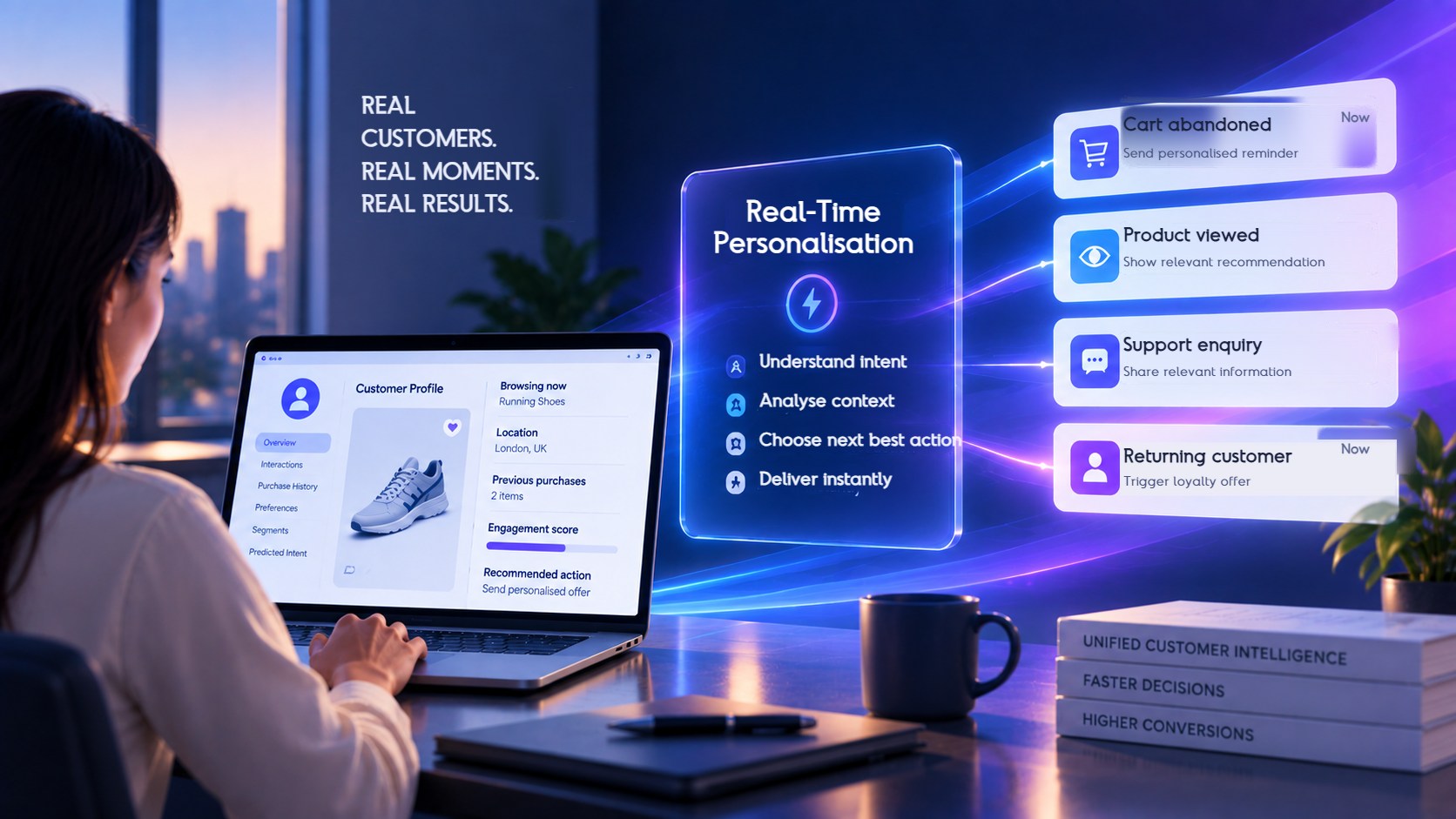
Real-Time vs. Batch Personalisation: Why the Lag Is Costing You the Sale
Business-to-business (B2B) customer engagement has changed significantly as buyers now expect faster responses, connected interactions, and highly personalised experiences across every stage of the customer journey. Decision-makers no longer compare B2B experiences only with competitors within the same industry. They compare them with the seamless digital experiences they receive across retail, banking, streaming platforms, and consumer applications. This shift has increased pressure on enterprises to modernise how they manage customer relationships, support operations, and lifecycle engagement.

What the UK’s Own AI Safety Incident Reveals About Deploying Agents Without a Harness
Business-to-business (B2B) customer engagement has changed significantly as buyers now expect faster responses, connected interactions, and highly personalised experiences across every stage of the customer journey. Decision-makers no longer compare B2B experiences only with competitors within the same industry. They compare them with the seamless digital experiences they receive across retail, banking, streaming platforms, and consumer applications. This shift has increased pressure on enterprises to modernise how they manage customer relationships, support operations, and lifecycle engagement.


