What Is a Super Agent in AI? Architecture, Components and Use Cases for UK Enterprises

Insights / What Is a Super Agent in AI? Architecture, Components and Use Cases for UK Enterprises

What is a Super Agent in AI

What Is a Super Agent?

“Super agent” is being used to describe several different approaches to enterprise AI. Some vendors use it for an agent with a large tool library. Others use it for an orchestrator that manages several smaller agents.

For this article, we use the definition supported by the research: a super agent is a single, well-scoped agent that can work across a broad set of tools, data sources and channels while using one shared, current context.

The important idea is simple: the agent can handle a wide range of tasks while keeping the same view of the situation.

Super Agent vs. Other AI Agent Models

ApproachHow It WorksMain Challenge
Conventional AI agentHandles a specific task, such as answering a question or retrieving a record.Limited scope.
Multi-agent systemSeveral specialist agents divide a larger task and hand work between themselves.Each agent may hold only part of the context.
Super agentOne well-scoped agent reasons across many tools, systems and channels using shared context.Requires strong permissions, governance and context management.

The super agent approach aims to combine broad capability with a single reasoning process. That can reduce the need to pass partial information between separate agents.

Super Agent Architecture

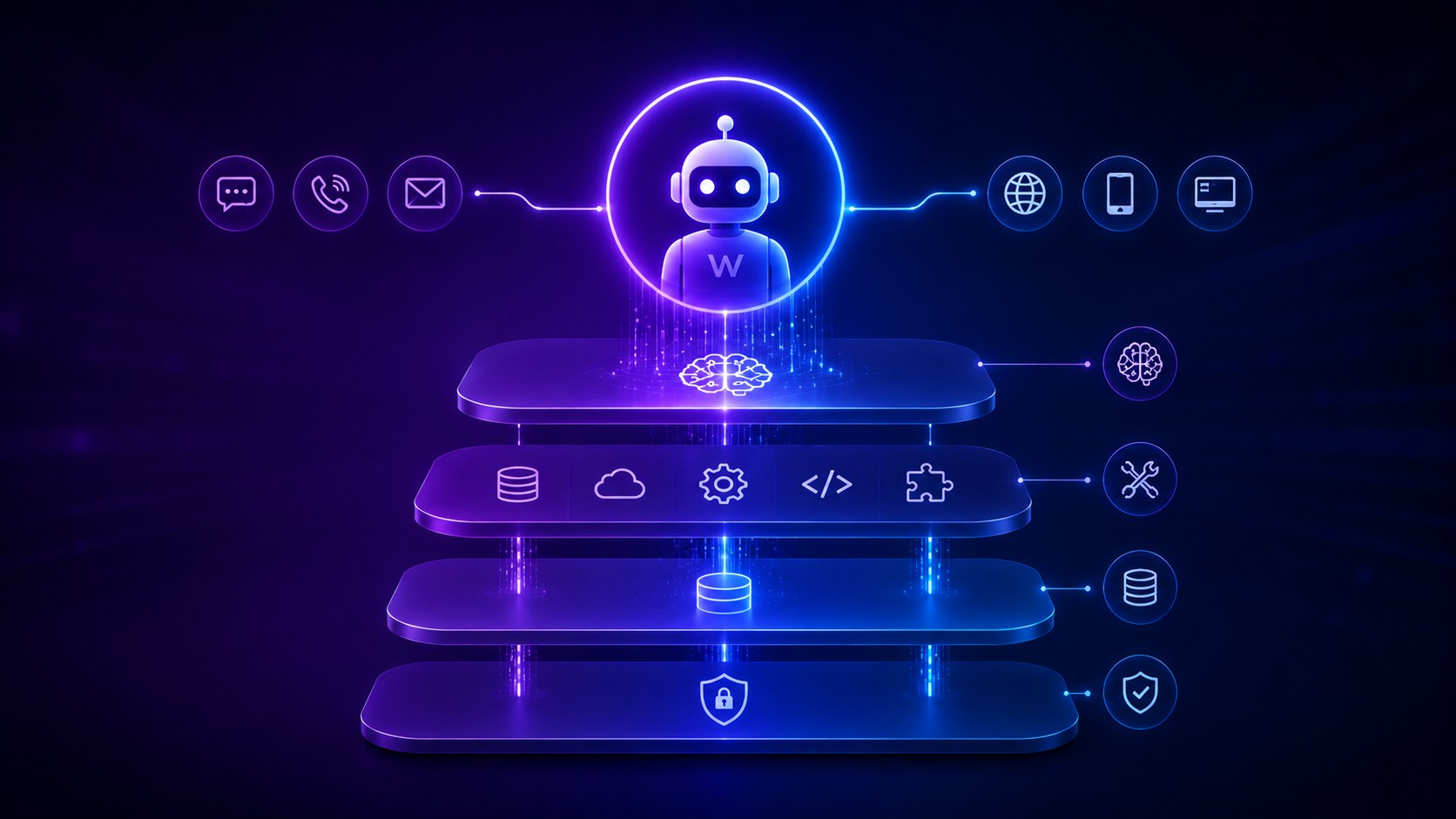
A credible super agent can be understood through five layers:

1. Interaction layer

The customer or employee interacts through chat, voice, email or an in-product experience. Input from different channels is normalized so the reasoning layer can work with it consistently.

2. Reasoning and orchestration layer

This is the decision core. It understands intent, plans the work, selects tools and decides when a human should take over.

3. Tool and action layer

These are the connections that let the agent take action, such as updating a CRM record, changing a ticket, checking a payment, scheduling an appointment or sending a message. Broad access needs strong permissions and controls.

4. Context and memory layer

This brings together customer, account and interaction information so the agent can work from current context rather than isolated pieces of data.

5. Governance layer

Permissions, audit trails, escalation rules, data controls and human approval points help keep the agent within defined boundaries.

Core Components of a Super Agent

  • Intent recognition across text and voice, with confidence thresholds for human handover.
  • Planning and task decomposition within a single reasoning process.
  • A tool registry with permissions defined by tool, role and data type.
  • A unified context store covering identity, history and current state.
  • Action execution with confirmation or rollback for consequential actions.
  • Observability that records what the agent decided and why, supporting debugging and compliance.

Why Shared Context Matters

The case for a single reasoning process becomes clearer when you look at how multi-agent systems can fail.

Princeton NLP benchmarking found that a single, well-scoped agent matched or outperformed multi-agent systems on 64% of the tasks tested. Where multi-agent systems performed better, they added 2.1 percentage points of accuracy at roughly twice the cost.

Anthropic’s engineering research identified vague delegation between agents as a repeatable problem. If one agent gives another a poorly defined instruction, the second agent may misunderstand the task or repeat work.

Microsoft has also limited its own group-chat agent orchestration to three participants or fewer because of the risk of sycophancy cascading, where agents reinforce an incorrect majority view.

The International AI Safety Report has highlighted another issue: errors can spread between agents, and agents using the same underlying model can fail in correlated ways.

Across these examples, the common issue is incomplete or outdated context. Adding more agents does not automatically solve that problem.

The UK Enterprise Picture

ONS data shows UK business AI adoption rising from roughly 12% to 35% since 2023. At the same time, the average adopting business uses just 1.6 AI tools.

That suggests many organizations are still working with a relatively small number of separate AI deployments, each with its own data and context.

For UK enterprises, this makes shared context an important architectural consideration. Existing tools may be useful individually while still leaving teams with fragmented customer and business information.

What is Super Agent in AI

Where Super Agents Can Be Used

1. Customer service across channels

One agent can handle chat, voice and email using the same account history. A customer who moves from email to a phone call can continue the conversation without starting again.

2. Sales and revenue operations

Qualification, follow-up and pipeline tasks can use a shared account view instead of information sitting across individual inboxes and systems.

3. Onboarding and account setup

The agent can coordinate multi-step processes involving documents, verification and system provisioning, while tracking what has already been completed.

4. Internal operations

Procurement, IT and HR requests often require information from several systems. A broader toolset allows the agent to work across those systems.

5. Regulated workflows

Financial services and healthcare can benefit from broader automation when permissions, audit trails and human escalation are built into the process.

How Worktual Fits

Worktual separates the key responsibilities across its architecture.

  • Cognitive CDP unifies data, resolves identity and provides a current shared view of customer context.
  • CVM uses that context for scoring, prioritization and next-best-action decisions.
  • The conversational AI layer handles customer interaction across chat and voice.

This separation gives each layer a clear role while allowing them to work from the same customer context. The result is a shared intelligence architecture in which interaction, customer data and decisioning can work together.

Conclusion

A super agent is primarily an architectural approach. One agent can work across a broad set of tools and tasks while keeping a shared, current view of the situation.

For UK enterprises, the value comes from reducing fragmented context across systems and giving AI the information it needs to make better decisions. That requires more than a broad toolset. Permissions, governance, observability and human escalation all need to be part of the design.

Before evaluating a super agent, ask one practical question: can the system work from the same current customer and business context across the tasks it is expected to handle?

Frequently Asked Questions

1. What is a super agent in AI?

A super agent is a single, well-scoped AI agent that can reason across a broad set of tools, data sources and channels while using one shared, current context.

2. How is a super agent different from a multi-agent system?

A multi-agent system distributes work across specialist agents that hand tasks between each other. A super agent keeps the reasoning process in one place and extends its capabilities through tools and shared context. Princeton NLP benchmarking found a single well-scoped agent matched or outperformed multi-agent systems on 64% of the tasks tested.

3. What are the main components of a super agent?

The main components are an interaction layer, a reasoning and orchestration core, a tool and action layer, a unified context and memory layer, and a governance layer covering permissions, audit, escalation and data controls.

4. Are multi-agent systems ever the better choice?

Yes. Multi-agent systems can be useful for genuinely complex cross-functional work. Princeton’s benchmarking found that where multi-agent systems performed better, they added 2.1 percentage points of accuracy at roughly twice the cost.

5. Why do AI agent systems fail in practice?

Documented issues include vague delegation between agents, sycophancy cascading where agents reinforce an incorrect view, and correlated errors when agents share the same underlying model. Incomplete or outdated context can contribute to these problems.

6. Is UK AI adoption ready for super agents?

ONS data shows UK business AI adoption rising from roughly 12% to 35% since 2023, while the average adopting business uses 1.6 AI tools. This suggests that many organizations are still working with fragmented AI deployments, making shared context an important consideration for broader automation.

Related Posts

AI Contact Centre Banking UK Consumer Duty

AI Contact Centre for Banking: Why Customer Outcomes Matter More Than Cost Savings

Business-to-business (B2B) customer engagement has changed significantly as buyers now expect faster responses, connected interactions, and highly personalised experiences across every stage of the customer journey. Decision-makers no longer compare B2B experiences only with competitors within the same industry. They compare them with the seamless digital experiences they receive across retail, banking, streaming platforms, and consumer applications. This shift has increased pressure on enterprises to modernise how they manage customer relationships, support operations, and lifecycle engagement.

AI Driven Campaign Management UK

AI-Driven Campaign Management: A Simple Guide for UK Businesses

Business-to-business (B2B) customer engagement has changed significantly as buyers now expect faster responses, connected interactions, and highly personalised experiences across every stage of the customer journey. Decision-makers no longer compare B2B experiences only with competitors within the same industry. They compare them with the seamless digital experiences they receive across retail, banking, streaming platforms, and consumer applications. This shift has increased pressure on enterprises to modernise how they manage customer relationships, support operations, and lifecycle engagement.
Hub and Spoke Architecture Ai Agents

Hub-and-Spoke Architecture for AI Agents: How It Connects Enterprise

Business-to-business (B2B) customer engagement has changed significantly as buyers now expect faster responses, connected interactions, and highly personalised experiences across every stage of the customer journey. Decision-makers no longer compare B2B experiences only with competitors within the same industry. They compare them with the seamless digital experiences they receive across retail, banking, streaming platforms, and consumer applications. This shift has increased pressure on enterprises to modernise how they manage customer relationships, support operations, and lifecycle engagement.