Why AI Agents Are Replacing Static Workflows

Insights / Why AI Agents Are Replacing Static Workflows
Ai Agents vs Static Workflows

A prospective customer visits your website looking for pricing. During the conversation, they mention they’re evaluating several vendors, ask for a product demo and request information for their procurement team.

A static workflow treats each request separately. An AI agent understands they’re part of the same buying journey, qualifies the lead, shares the right information and schedules a demo without losing context.

This shift is already underway. According to the British Chambers of Commerce’s Future of Work Report 2026, 54% of UK SMEs are now using AI—more than double the figure from just two years ago. The next step isn’t simply using more AI tools; it’s using AI that can think, act and adapt.

  • AI Agents vs Static Workflows: What’s the Difference?
  • Why Static Workflows Are No Longer Enough
  • Why Businesses Are Moving to AI Agents
  • Real-World Example: How Lola Replaces Static Workflows
  • The UK Market Shift — What the Data Shows
  • How to Move From Static Workflows to AI Agents
  • FAQs

AI Agents vs Static Workflows: What's the Difference?

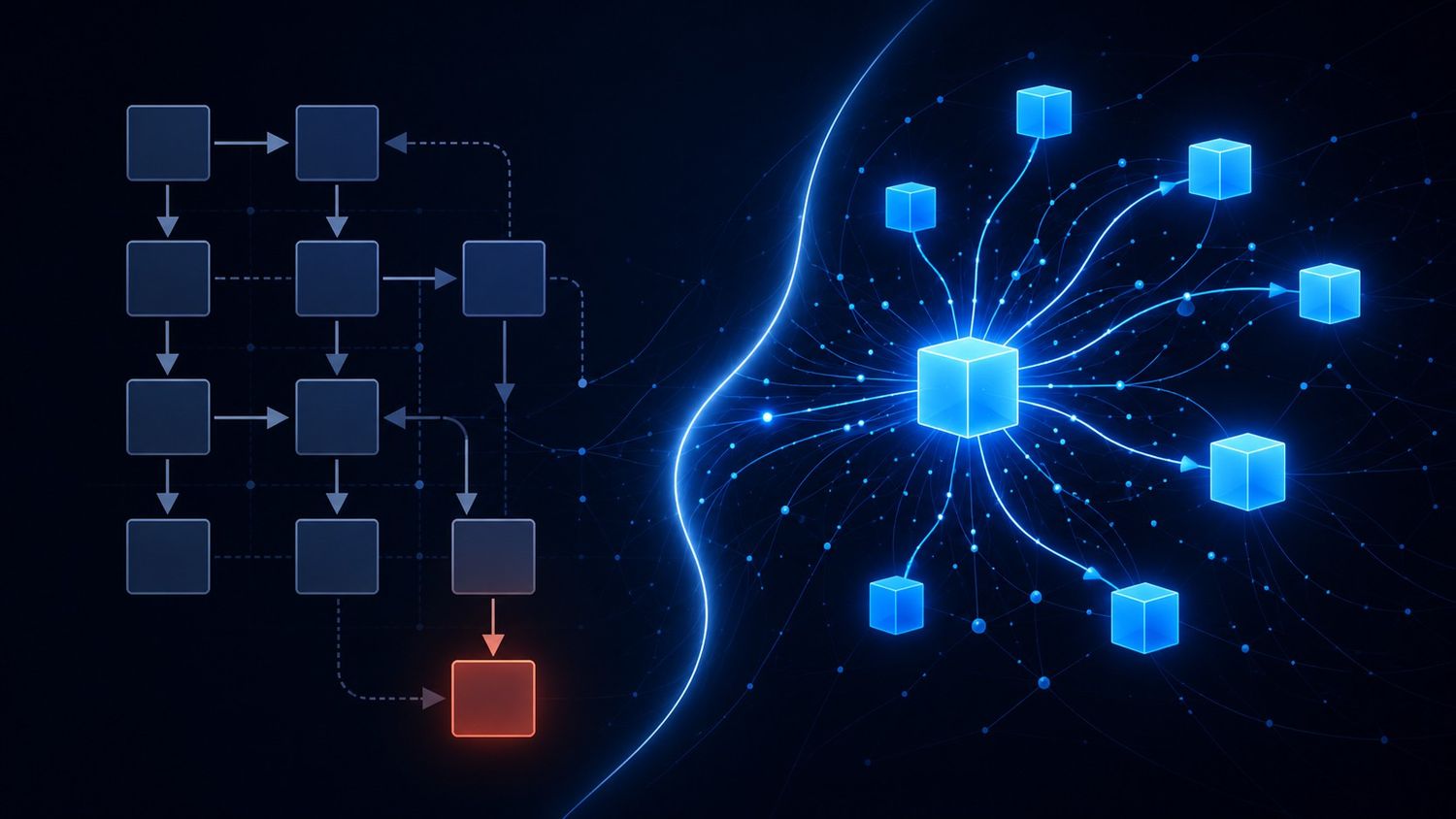
A static workflow follows a fixed set of rules. Every request follows the same path, regardless of the situation. If something falls outside those rules, the workflow either stops or passes the task to a human.

An AI agent works differently. It understands context, reasons through a request, decides what to do next and takes action. Instead of following a fixed script, it adapts to the conversation and learns from previous interactions.

In simple terms, static workflows follow rules. AI agents make decisions.

The table below highlights the key differences.

DimensionStatic workflowAI agent
TriggerFixed rule or keywordIntent, tone and context
FlexibilityNone outside the defined pathHandles novel cases in real time
Exception handlingFails or escalates blindlyReasons through the exception
MaintenanceManual rebuild for every new scenarioLearns and adapts continuously
LearningNone — static until rebuiltImproves from every interaction
Cost to scaleRises with every new rule addedScales without added headcount

Why Static Workflows Are No Longer Enough

Static workflows work well when every customer follows the same path. The challenge is that real conversations rarely do.

Common limitations include:

  • They can’t handle exceptions. An unexpected request often requires manual intervention.

  • They require constant updates. Every new scenario means creating or modifying workflow rules.

  • They don’t understand context. Static workflows respond to predefined triggers, not customer intent or sentiment.

  • They create disconnected experiences. Conversations across email, chat and WhatsApp often remain separate.

  • They struggle to scale with complexity. As customer journeys become more dynamic, managing rule-based workflows becomes increasingly difficult.

Why Businesses Are Moving to AI Agents

AI agents help businesses go beyond rule-based automation. Instead of following a fixed path, they adapt to each customer interaction and make decisions based on context.

Key benefits include:

  • Understand context instead of relying on keywords or predefined rules.
  • Respond in real time based on customer intent, conversation history and available data.
  • Deliver consistent experiences across voice, email, chat and messaging channels.
  • Automate routine tasks while handing complex or sensitive cases to the right person.
  • Continuously improve by learning from interactions and business feedback.
  • AI agents don’t just automate tasks—they help businesses deliver faster responses, better customer experiences and more efficient operations.

Real-World Example: How Lola Replaces Static Workflows

A customer contacts a UK retailer through website chat to ask about a delayed order. During the conversation, they also ask about a different product and mention they’re unhappy with the delivery experience.

A static workflow treats each request separately. It may answer one question, transfer another to a different queue and miss the customer’s frustration altogether.

Instead of following a script, Lola handles the conversation much like a human would. It understands the customer’s intent, recognises context and sentiment, connects related questions, and decides the best next action. It resolves what it can automatically and, if the customer explicitly asks to speak to a person, or the issue requires human judgement, it transfers the conversation seamlessly, giving the agent the full context so the customer doesn’t have to start over.

Whether the customer starts on WhatsApp, web chat or email, Lola keeps the conversation connected. Customers don’t have to repeat themselves, and agents receive the full context when they take over.

Ai Agents vs Static Workflows UK

The UK Market Shift — What the Data Shows

AI agents are moving from experimentation to real business adoption, and the UK is no exception.

  • AI adoption is accelerating. According to the British Chambers of Commerce, AI adoption among UK SMEs has grown from 25% in 2024 to 54% in 2026.

  • Agentic AI is gaining momentum. Gartner predicts that 40% of enterprise applications will include task-specific AI agents by the end of 2026, up from less than 5% in 2025.

  • Businesses are still early in the journey. While many organisations use AI today, much of it supports existing processes rather than making autonomous decisions.

  • Skills remain a challenge. According to Accenture, 54% of UK employees are willing to reskill for AI, but only 7% of executives believe their workforce is fully prepared for agentic AI.

The opportunity isn’t simply to adopt AI; it’s to move beyond isolated AI tools and build intelligent systems that can understand context, make decisions and work alongside people.

How to Move From Static Workflows to AI Agents

Moving to AI agents doesn’t have to happen all at once. Most organisations start with one high-impact use case and expand as they gain confidence.

A practical approach is to:

  • Identify repetitive, high-volume workflows where AI can deliver the biggest impact.
  • Start with one channel or process, such as website chat, customer support or lead qualification.
  • Connect AI to your existing systems, including your CRM, knowledge base and business applications, so it has the context it needs.
  • Define clear handover rules so customers are transferred to a human agent when they request it or when the situation requires human judgement.
  • Measure performance using metrics such as response time, resolution rate and customer satisfaction before expanding AI to other workflows.

Businesses that take a phased approach often see faster adoption, better customer experiences and a smoother transition to AI-powered operations.

Conclusion — The Future Is Agentic, Not Static

Static workflows were built for a world of predictable, single-channel queries — that world is gone. AI agents scale judgement, not just volume, which is exactly what UK businesses need as customer expectations keep rising. See how Lola replaces static workflows with agentic AI – Book a Demo 

FAQs

1. What is an AI agent, in simple terms?

An AI agent is software that understands context, makes decisions and takes action to achieve a goal. Unlike traditional automation, it can adapt to changing situations instead of following a fixed set of rules.

2. What is a static workflow?

A static workflow is a rule-based process that follows the same predefined steps every time. It works well for predictable tasks but struggles when requests fall outside those rules.

3. What is the difference between AI agents and workflow automation?

Workflow automation follows predefined rules. AI agents understand context, make decisions and choose the best next action, allowing them to handle more complex and unpredictable situations.

4. Are AI agents replacing RPA?

Not entirely. RPA is still effective for repetitive, rule-based tasks. AI agents are better suited to processes that require judgement, context and decision-making. Many organisations use both together.

5. Can AI agents work without human supervision?

AI agents can manage many routine tasks independently. However, they should also be able to transfer conversations to a human when the customer requests it or when the situation requires human judgement.

6. How much do AI agents cost for a UK business?

Costs vary depending on the platform, number of users and use case. When comparing solutions, consider the total cost of ownership alongside the potential savings from automation and improved productivity.

7. What industries benefit most from AI agents?

AI agents deliver strong value in customer service, retail, financial services, healthcare and other industries that manage large volumes of customer interactions.

8. Is agentic AI safe for customer data (GDPR/UK)?

It can be, provided the platform supports UK GDPR, offers appropriate security controls and includes human oversight for automated decision-making where required.

9. What is the difference between agentic AI and generative AI?

Generative AI creates content such as text or images in response to a prompt. Agentic AI goes further by making decisions, using tools and completing tasks to achieve a specific goal.

10. Will AI agents replace customer service jobs?

Not entirely. Agents are best suited to routine, high-volume queries; complex and emotionally sensitive cases still need a person, and most deployments are built to route between the two.

11. How does an AI agent like Lola actually work?

Lola understands a customer’s intent, context and sentiment, decides the best next action and responds naturally across channels. It resolves routine requests automatically and transfers the conversation to a human agent with full context whenever the customer asks or the situation requires it.

12. Can AI agents work with existing CRM systems?

Yes. Modern AI agents can integrate with CRM platforms, knowledge bases and business applications, giving them the context they need to deliver more personalised and efficient customer interactions.

Related Posts

What is AI CRM

What Is an AI CRM? A Plain-English Guide for UK Businesses (2026)

An AI CRM is customer relationship management software with artificial intelligence built into its core workflows. Rather than simply storing contact records, it scores leads, drafts follow-ups, forecasts deals, and surfaces the next action automatically. The difference from a normal CRM is not an added chatbot; it is that the software itself does some of the work, not just the record-keeping.
Best Salesforce Alternative

Best Salesforce Alternative for UK Teams in 2026

AI-Native CRM That British Businesses Actually Adopt

It is 5:45pm on a Friday in Manchester, and a sales rep has just finished her fourth call of the afternoon. She knows she should log the notes in Salesforce before the weekend. She also knows it’ll take fifteen minutes she doesn’t have, so it waits until Monday, half-remembered.

UK Voice Ai Regional Accent Gap

The Accent Gap: What UK Voice AI Still Gets Wrong About Geordie, Scouse, and Scottish English

Business-to-business (B2B) customer engagement has changed significantly as buyers now expect faster responses, connected interactions, and highly personalised experiences across every stage of the customer journey. Decision-makers no longer compare B2B experiences only with competitors within the same industry. They compare them with the seamless digital experiences they receive across retail, banking, streaming platforms, and consumer applications. This shift has increased pressure on enterprises to modernise how they manage customer relationships, support operations, and lifecycle engagement.