
The Accent Gap: What UK Voice AI Still Gets Wrong About Geordie, Scouse, and Scottish English

Insights / The Accent Gap: What UK Voice AI Still Gets Wrong About Geordie, Scouse, and Scottish English

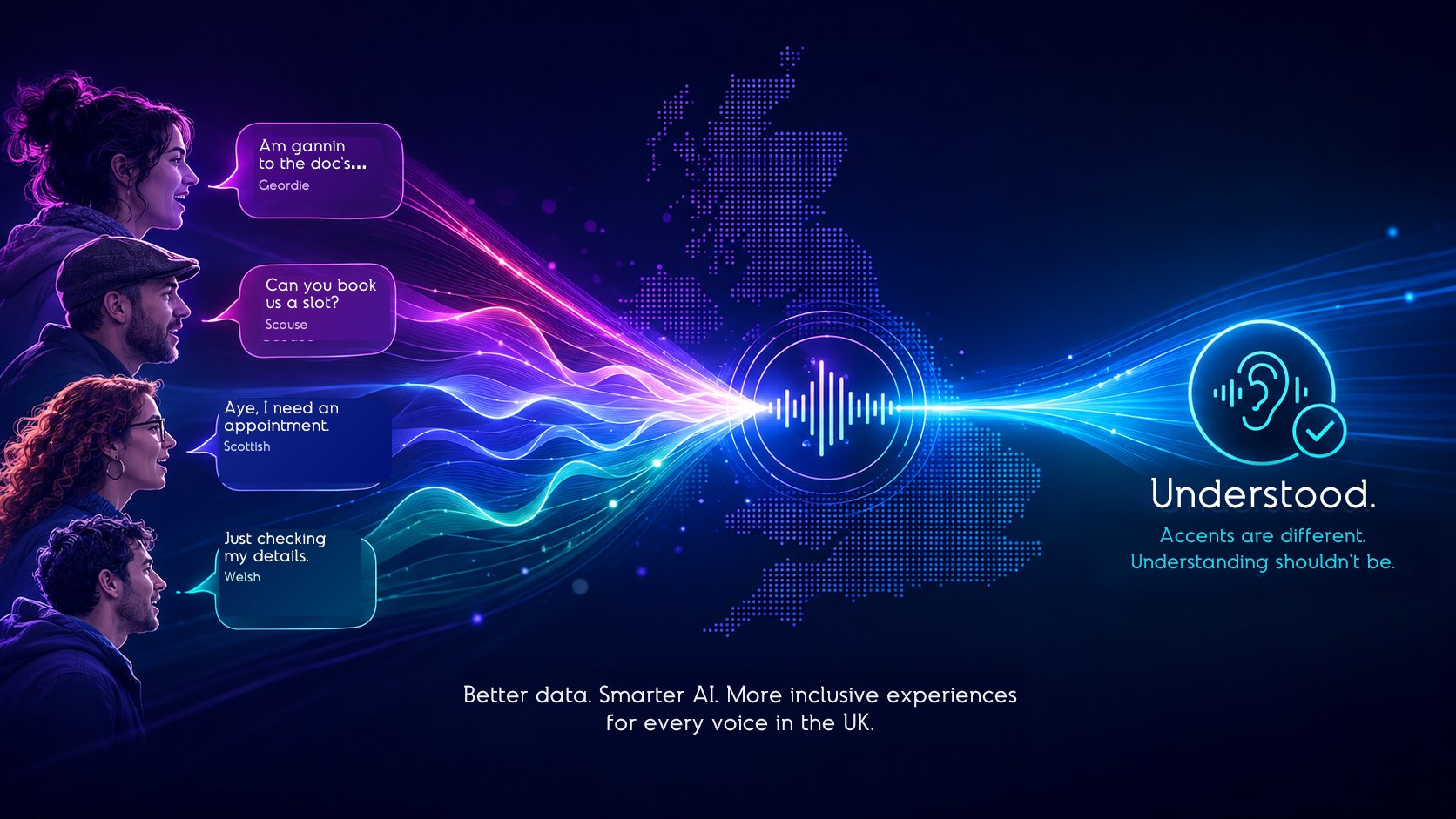
UK Voice Ai Regional Accent Gap

When voice AI doesn't understand your accent

A caller from Newcastle rings her GP surgery to book an appointment. The automated system asks for her date of birth.

She says it clearly, in her natural accent.

The system doesn’t understand her.

She repeats it, this time speaking more slowly and softening her accent slightly. The system gets it right.

It’s a small moment, but it reflects a much bigger issue: voice AI does not perform equally well across all UK accents.

A survey from Newcastle’s Life Science Centre found that 79% of people with a strong regional accent deliberately soften their accent when speaking to voice assistants because they have learned that the technology may otherwise struggle to understand them.

This is not simply about pronunciation. Research increasingly shows that the problem is linked to how speech recognition systems are trained.

What the Research Tells Us

UK research points to a clear pattern: voice recognition performance can vary significantly across regional accents, and the reasons are linked in part to how speech recognition systems are trained.

ResearchWhat it examinedWhat it foundWhy it matters
UK regional speech recognition studySpeech recognition performance across different UK regionsSouthern British English speakers consistently had the lowest word error rates. Speakers from Northern England and Northern Ireland had significantly higher error rates.The difference was linked to training data, rather than anything inherently wrong with the accents.
Newcastle English studyMore than 3,000 transcription errors from the Diachronic Electronic Corpus of Tyneside EnglishMisrecognition followed consistent patterns linked to the phonology of Newcastle English.The errors were systematic rather than random, showing that specific regional speech patterns can create predictable recognition problems.
2025 Scottish-accent studySpeech recognition for Scottish English, with a focus on public-service accessResearchers found that adapting speech recognition models to Scottish accents could improve recognition and highlighted the risk of regional-accent bias affecting vulnerable users.For services such as healthcare, benefits and local government, poor recognition can become an access issue, not simply a technical inconvenience.

The common thread:

These studies point to the same underlying issue:

  • Training data matters. Systems trained predominantly on particular varieties of English may perform less well on others.
  • Regional speech creates identifiable patterns. Recognition errors are not necessarily random; they can be linked to specific phonetic and phonological features.
  • The impact goes beyond accuracy. When voice AI is used to access essential services, repeated recognition failures can create additional barriers for users.
  • The problem is addressable. The research suggests that broader and more representative training data can improve recognition performance.

Why this matters for essential services

The issue becomes more serious when voice AI is used to access important services.

A 2025 study on Scottish-accented speech recognition looked at the issue specifically in the context of public-service access. The researchers highlighted the risk of regional-accent bias affecting vulnerable people who may rely on voice interfaces because other options are not readily available.

In the UK, automated voice systems increasingly sit at the front of services such as:

If a system struggles to understand a Geordie, Scouse, Scottish, Welsh or other regional accent, the result is more than an awkward conversation.

It can create friction at the point where someone is trying to access a service they need.

It’s not just about pronunciation

There is another layer to the problem.

Speech recognition systems do not only process individual words. They also interpret timing, pauses, rhythm and intonation.

Much of the earlier research into conversational features such as pauses and hesitation was based on relatively standard forms of Southern English. Regional accents can have different rhythms and patterns of speech.

That creates a potential problem.

A pause or change in rhythm that is completely natural for a regional speaker could be interpreted differently by a system trained on another speech pattern.

The result may not simply be a misheard word. The system may misunderstand what the speaker is doing conversationally whether they have finished speaking, are hesitating, or are continuing their thought.

Can the accent gap be fixed?

The research suggests that it can.

The 2025 Scottish-accent study tested fine-tuning speech recognition models with Scottish English data and found that this meaningfully improved recognition accuracy.

That is important because it suggests the problem is not an inherent limitation of voice AI.

It is, at least in part, a data problem.

The BBC took a similar approach after the Newcastle survey findings became public. Rather than assuming that a system trained on one variety of English would work equally well everywhere, it developed a voice assistant specifically designed around UK regional accents.

The lesson from both examples is straightforward:

Better regional representation in training data can improve voice AI performance.

There is no single model architecture that automatically solves the problem.

Where Does this Leave Voice AI Products?

This distinction matters when evaluating voice AI.

Understanding intent, and conversational context, including what has already been said during an interaction is different from claiming that every part of the system interprets regional prosody, hesitation and speech patterns with the same nuance as a human listener from that region.

The research suggests that regional speech recognition remains an active area of development across the industry.

For products serving UK customers, that means regional speech should not be treated as a minor edge case. It needs to be considered as part of how voice AI is trained, tested and improved.

UK Regional Accents Gap for Voice Ai

What Comes Next?

The research points towards a relatively practical direction.

The answer is not necessarily a completely new model.

It is better and broader training data that represents the people the system is expected to serve.

The Scottish research and the BBC’s approach point in the same direction: deliberately including regional speech can help reduce recognition gaps.

The technology can improve.

But the first step is recognising that “English” is not one way of speaking.

A voice AI system designed for the UK needs to account for the people actually using it from Newcastle to Liverpool, from Scotland to Wales, and across the many regional accents in between.

Otherwise, the burden remains with the caller to change how they speak.

And, as the Newcastle research suggests, people are already doing exactly that.

Where Worktual Stands

Worktual’s Lola is built to understand customer intent, conversational context and the meaning behind what a caller says; not simply match individual words. That distinction matters when conversations are natural, varied and shaped by how people actually speak.

At the same time, regional accent recognition is an evolving area across voice AI. The research discussed in this article shows why UK voice systems need to be continually tested against the diversity of accents they will encounter in real customer conversations.

For Worktual, that means treating accent coverage as an ongoing part of improving Lola with the goal of making voice interactions easier and more natural for every UK customer, without asking them to change the way they speak.

Conclusion: Building Voice AI That Understands the UK

The UK is not a single accent.

From Geordie and Scouse to Scottish, Welsh and the many regional varieties in between, people bring different speech patterns, rhythms and pronunciation to every conversation.

Research shows that voice AI can perform differently across these accents, particularly when training data does not adequately represent the people using the system. The encouraging part is that the gap is not necessarily a limitation of voice AI itself. Better, more representative training data can improve recognition.

For businesses deploying voice AI in the UK, accent diversity therefore needs to be part of the conversation from the start — alongside accuracy, intent recognition, context and customer experience.

The goal isn’t to make customers change how they speak. It’s to build AI that gets better at understanding how customers actually speak.

Frequently Asked Questions

1. Why does voice AI struggle with some UK accents?

Voice AI systems learn from speech data. If some regional accents are underrepresented in that data, the system may perform less accurately when processing those accents.

2. Which UK accents can voice AI struggle with?

Research has identified recognition challenges across several regional varieties, including accents from Northern England, Northern Ireland and Scotland. Newcastle English has also been studied in detail, with researchers identifying consistent patterns in transcription errors.

3. Is this a problem with the accents themselves?

No. Research suggests that differences in recognition performance are linked in part to training data and representation, rather than regional accents being inherently less understandable.

4. Can voice AI be trained to understand regional accents better?

Yes. Research into Scottish English has found that adapting speech recognition models using regional speech data can improve recognition accuracy.

5. Why does regional accent recognition matter for customer service?

Voice AI increasingly handles customer interactions before they reach a human agent. If customers have to repeat themselves or change how they speak to be understood, it can create unnecessary friction and affect the overall experience.

6. Does accent recognition affect access to public services?

It can. Research has highlighted concerns around regional-accent bias in voice interfaces used for public services, particularly where people may depend on voice systems to access essential support.

7. What should businesses consider when deploying voice AI in the UK?

Businesses should evaluate how their voice AI performs across different regional accents, not just against a standard or Southern British English benchmark. Training data, recognition accuracy, intent detection and the ability to recover gracefully when something is misunderstood all matter.

8. Can Worktual Lola understand different UK accents?

Lola is designed to understand customer intent, phrasing and conversational context. However, as the research discussed in this article shows, regional speech recognition is an ongoing area of development across the voice AI industry. Accent coverage should therefore be treated as something to continuously test and improve rather than assume is solved.

Related Posts

Contact Centre Automation UK Healthcare

Contact Centre Automation in UK Healthcare

Business-to-business (B2B) customer engagement has changed significantly as buyers now expect faster responses, connected interactions, and highly personalised experiences across every stage of the customer journey. Decision-makers no longer compare B2B experiences only with competitors within the same industry. They compare them with the seamless digital experiences they receive across retail, banking, streaming platforms, and consumer applications. This shift has increased pressure on enterprises to modernise how they manage customer relationships, support operations, and lifecycle engagement.

Ai Ccaas Customer Service Cost Reduction for Enterprises

How AI Is Reducing Customer Service Costs for UK Enterprises (CCaaS)

An AI CRM is customer relationship management software with artificial intelligence built into its core workflows. Rather than simply storing contact records, it scores leads, drafts follow-ups, forecasts deals, and surfaces the next action automatically. The difference from a normal CRM is not an added chatbot; it is that the software itself does some of the work, not just the record-keeping.
Ticket Deflection vs Ticket Resolution

Ticket Deflection vs Ticket Resolution: Why the Metric Everyone Tracks Is the Wrong One

Business-to-business (B2B) customer engagement has changed significantly as buyers now expect faster responses, connected interactions, and highly personalised experiences across every stage of the customer journey. Decision-makers no longer compare B2B experiences only with competitors within the same industry. They compare them with the seamless digital experiences they receive across retail, banking, streaming platforms, and consumer applications. This shift has increased pressure on enterprises to modernise how they manage customer relationships, support operations, and lifecycle engagement.