
Intelligent Case Management: How AI Transforms Ticketing into Predictive Support Infrastructure

Insights / Intelligent Case Management: How AI Transforms Ticketing into Predictive Support Infrastructure

intelligent case management ai ticketing

Customer service has evolved from a reactive support function into a strategic driver of customer loyalty, operational efficiency, and long-term business growth. As organisations manage increasing volumes of customer interactions across digital channels, every enquiry, complaint, and service request influences customer experience and business outcomes. Yet many organisations continue to rely on traditional ticketing systems that were designed to organise work, not understand customers.

Modern customer service challenges include:

  • Rising customer expectations for fast, personalised, and seamless service.
  • Increasing ticket volumes across email, chat, voice, social media, and messaging platforms.
  • Disconnected customer data spread across CRM, helpdesk, and communication systems.
  • Manual ticket classification and routing that slow resolution times.
  • Limited customer context, making it difficult to deliver consistent service experiences.

Traditional ticketing systems improve operational visibility, but they remain fundamentally reactive. Customers must first experience a problem, raise a ticket, and wait for resolution. Support teams spend valuable time switching between systems, manually prioritising requests, and searching for customer information, creating delays that impact both customer satisfaction and operational efficiency.

Intelligent Case Management represents the next evolution of customer service. By combining AI-native intelligence, automation, and unified customer context, organisations can move beyond reactive ticket handling to build a predictive support infrastructure that anticipates customer needs, accelerates resolutions, and continuously improves service delivery.

  • What Intelligent Case Management Is
  • The Evolution of Support Systems
  • Core Components of AI-Native Case Management
  • From Ticketing to Predictive Support Infrastructure

  • Key Use Cases of Intelligent Case Management
  • Benefits of AI-Driven Case Management
  • Intelligent Case Management vs Traditional Ticketing
  • Challenges in Implementation
  • Best Practices for Adoption
  • The Future: Autonomous Support Ecosystems
  • Driving the Shift to Predictive Support Infrastructure

What Intelligent Case Management Is

Intelligent Case Management is an AI-native approach to customer service that focuses on resolving customer needs rather than simply managing support tickets. Unlike traditional ticketing systems, which treat every request as an isolated event, intelligent case management connects customer interactions, behavioural signals, historical context, and business rules to understand the complete customer journey before determining the most effective resolution.

The Evolution of Support Systems

Customer support has progressed through several distinct phases, from manual helpdesks handling phone and email queries, to rule-based ticketing platforms that introduced SLA tracking and categorisation, to omnichannel environments that unified communication across voice, chat, and digital channels. Each stage improved accessibility and operational organisation, yet none eliminated the underlying reactive dependency on customer-initiated contact.

Evolution StagePrimary FocusLimitation
HelpdeskManaging customer enquiriesManual, channel-specific processes
Ticketing SystemsOrganising and tracking issuesReactive, ticket-centric workflows
Omnichannel SupportConnecting customer conversationsLimited customer context and intelligence
AI-Native Intelligent Case ManagementUnderstanding customers and predicting needsEnables proactive, intelligent customer service

AI-driven case management represents a categorical departure from this pattern. Rather than optimising reactive processes, it introduces the capability to prevent the conditions that generate tickets in the first place, a shift that redefines the commercial function of support operations entirely.

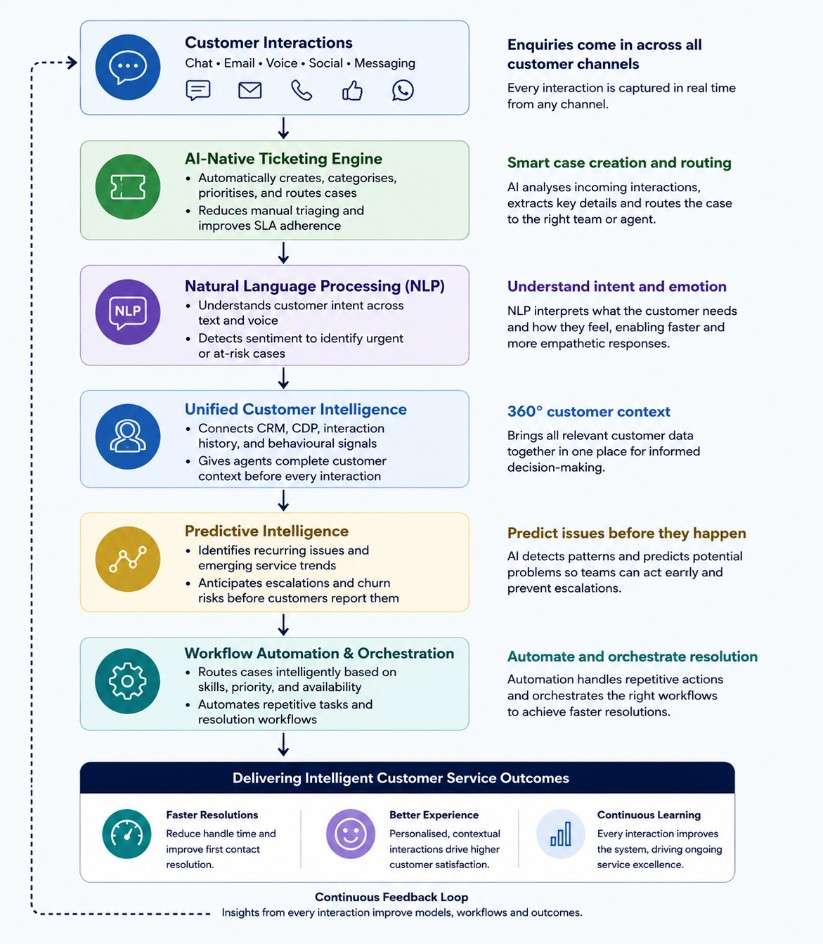
Core Components of AI-Powered Case Management

AI-Native Intelligent Case Management is built on a connected set of capabilities that work together to understand customer intent, automate workflows, and deliver faster, more contextual resolutions. Rather than operating as isolated technologies, these components create a unified framework that continuously improves customer service outcomes.

Components of ai case management

From Ticketing to Predictive Support Infrastructure

Traditional ticketing responds to customer issues after they occur. Predictive support infrastructure takes a fundamentally different approach by continuously analysing customer interactions, behavioural signals, and operational data to anticipate customer needs before issues escalate. This enables organisations to shift from reactive ticket management to proactive customer service that improves efficiency and customer experience.

Traditional ticketing focuses on:

  • Responding to customer issues after they are reported.
  • Managing individual tickets in isolation.
  • Manual prioritisation, routing, and escalation.
  • Resolving problems through reactive customer service.
  • Measuring performance based on ticket volumes and resolution times.

Predictive support infrastructure enables organisations to:

  • Identify potential issues using customer interactions, behavioural signals, and operational data.
  • Automate case creation, prioritisation, and workflow execution.
  • Provide agents with complete customer context through Unified Customer Intelligence.
  • Resolve routine enquiries through intelligent automation and self-service.
  • Continuously improve customer service by learning from every interaction and optimising future outcomes.

By combining AI-native intelligence with automation and unified customer context, predictive support infrastructure transforms customer service from a reactive support function into a proactive business capability that delivers faster resolutions, greater operational efficiency, and improved customer experiences.

Key Use Cases of Intelligent Case Management

AI-Native Intelligent Case Management applies intelligence across every stage of the customer service lifecycle, helping organisations automate routine tasks, improve decision-making, and deliver more proactive customer service. Key use cases include:

Use CaseBusiness Value
Intelligent Ticket RoutingAutomatically assigns cases based on customer context, agent expertise, workload, and priority, improving first-contact resolution and reducing reassignment.
Automated Issue ResolutionResolves routine enquiries such as order updates, billing questions, password resets, and returns through AI-driven self-service and workflow automation.
Proactive Customer ServiceIdentifies emerging issues through customer interactions and operational signals, enabling proactive notifications and early intervention before customers raise a case.
Intelligent SLA ManagementDynamically prioritises and routes cases to meet service commitments while improving operational efficiency.
Sentiment-Aware EscalationDetects customer frustration and automatically escalates high-risk interactions, helping protect customer relationships and improve service outcomes.

Benefits of AI-Driven Case Management

AI-Native Intelligent Case Management delivers measurable improvements across customer service operations by combining automation, unified customer intelligence, and predictive decision-making. Beyond improving operational efficiency, it enables organisations to deliver more consistent customer experiences while supporting long-term business growth.

Key benefits include:

  • Improved operational efficiency – Automates ticket classification, routing, and repetitive service tasks, reducing manual effort and enabling customer service teams to manage higher volumes without increasing operational complexity.
  • Faster resolution times – Uses intelligent workflows, automation, and complete customer context to accelerate case resolution and improve first-contact resolution rates.
  • Enhanced customer experiences – Delivers faster, more personalised, and consistent service by understanding customer intent, interaction history, and preferences across every touchpoint.
  • Lower cost-to-serve – Reduces ticket volumes through proactive issue resolution and self-service, allowing organisations to optimise customer service resources while maintaining service quality.
  • Continuous service improvement – Learns from customer interactions and operational data to refine workflows, identify recurring issues, and improve future service delivery.

By transforming reactive ticket handling into an intelligent, data-driven customer service operation, AI-Native Intelligent Case Management helps organisations improve operational resilience, strengthen customer relationships, and create a scalable foundation for future growth.

Industry Insight: According to McKinsey, organisations implementing AI in customer service can reduce resolution times by up to 30% while lowering operational costs through greater automation and workflow efficiency.

Intelligent Case Management vs Traditional Ticketing

The table below compares both approaches across six critical performance dimensions:

AspectTraditional TicketingIntelligent Case Management
ApproachReactivePredictive and proactive
Ticket HandlingManual triage and assignmentFully automated with AI routing
Context AwarenessLimited to current interactionUnified customer history and intent
Resolution SpeedModerate; queue-dependentFast; automated or intelligently routed
ScalabilityConstrained by agent headcountHigh; automation absorbs volume growth
Business ImpactFocuses on resolving ticketsImproves customer service, operational efficiency, and customer loyalty

Intelligent Case Management extends beyond traditional ticket handling by combining AI-native intelligence, automation, and unified customer context to deliver faster resolutions, improve operational efficiency, and create more proactive customer service experiences.

Challenges in Implementation

Implementing Intelligent Case Management involves more than deploying AI technologies. Success depends on building the right data foundation, integrating existing systems, and preparing customer service teams to adopt new ways of working. Organisations that address these areas early are better positioned to realise long-term value from AI-native customer service.

Common implementation challenges include:

  • Integrating existing systems – Connecting CRM platforms, contact centre solutions, communication channels, and business applications to create a unified customer service environment.
  • Building a unified customer data foundation – AI-native decision-making relies on accurate, connected customer data. Fragmented or inconsistent information can limit the effectiveness of automation and predictive intelligence.
  • Driving organisational adoption – Customer service teams need clear processes, training, and confidence in AI-assisted workflows to ensure successful adoption and long-term value.
  • Maintaining governance and compliance – Organisations must implement appropriate security, access controls, and data governance while complying with regulatory requirements such as UK GDPR and the Data Protection Act 2018.

A phased implementation approach, supported by strong governance and continuous optimisation, enables organisations to modernise customer service while minimising operational disruption.

Best Practices for Adoption

Successful deployment follows a sequenced approach that balances strategic ambition with operational realism. Establishing a unified customer data foundation should precede AI model deployment.

Beginning with high-volume, repetitive use cases delivers early ROI and builds confidence in AI-driven workflows. Implementing automated triaging and routing before advanced predictive capabilities ensures manageable adoption.

Maintaining human oversight for complex cases ensures service quality, while continuous optimisation through feedback loops enables long-term system improvement.

Intelligent case management ai ticketing system

The Future: Autonomous Support Ecosystems

Customer support is evolving towards autonomous ecosystems in which AI systems continuously detect, predict, and resolve issues without manual initiation. These environments operate as self-improving platforms, learning from every interaction and expanding their resolution capability over time.

Agentic AI represents the next stage of this evolution, enabling systems to operate with goal-directed autonomy — executing actions, adapting to feedback, and achieving outcomes without direct human intervention.

As predictive systems incorporate broader data signals, support functions will increasingly operate as proactive intelligence layers rather than reactive service channels.

Driving the Shift to Predictive Support Infrastructure

Building a predictive support infrastructure requires more than AI-enabled ticketing. It requires an AI-native platform that connects customer interactions, service operations, and customer intelligence into a single ecosystem.

Together, these capabilities enable organisations to move beyond reactive ticket handling and build a scalable, AI-native customer service operation that improves efficiency, strengthens customer relationships, and delivers measurable business outcomes.

FAQs

1. What is intelligent case management?

Intelligent case management is an AI-driven framework that automates and optimises customer support by predicting issues, managing cases proactively, and integrating customer context into every stage of the resolution process.

2. How does AI improve ticketing systems?

AI enhances ticketing by automating categorisation, routing, and resolution, applying sentiment analysis for dynamic prioritisation, and enabling predictive models.

3. What is predictive support infrastructure?

Predictive support infrastructure refers to AI-native systems that identify and resolve issues before customers initiate contact.

4. Can AI completely replace human agents in support?

AI handles repetitive tasks, but human agents remain essential for complex and sensitive interactions.

5. How does AI reduce ticket volume in practice?

AI reduces ticket volume by resolving common queries automatically, issuing proactive alerts, and identifying recurring issues before escalation.

Related Posts

Unified Intelligence AI for Banking Finance

Unified Intelligence AI for Finance: Improving Retention, Cross-Sell, and Cost Efficiency

Business-to-business (B2B) customer engagement has changed significantly as buyers now expect faster responses, connected interactions, and highly personalised experiences across every stage of the customer journey. Decision-makers no longer compare B2B experiences only with competitors within the same industry. They compare them with the seamless digital experiences they receive across retail, banking, streaming platforms, and consumer applications. This shift has increased pressure on enterprises to modernise how they manage customer relationships, support operations, and lifecycle engagement.

Unified Intelligence for Energy and Utilities

Unified Intelligence AI for Energy & Utilities: Enhancing Service Efficiency, Payment Timeliness, Cost Optimisation

Business-to-business (B2B) customer engagement has changed significantly as buyers now expect faster responses, connected interactions, and highly personalised experiences across every stage of the customer journey. Decision-makers no longer compare B2B experiences only with competitors within the same industry. They compare them with the seamless digital experiences they receive across retail, banking, streaming platforms, and consumer applications. This shift has increased pressure on enterprises to modernise how they manage customer relationships, support operations, and lifecycle engagement.

Unified Intelligence AI for Insurance

Unified Intelligence AI for Insurance: Improving Conversion, Retention, and Policyholder Lifetime Value

Business-to-business (B2B) customer engagement has changed significantly as buyers now expect faster responses, connected interactions, and highly personalised experiences across every stage of the customer journey. Decision-makers no longer compare B2B experiences only with competitors within the same industry. They compare them with the seamless digital experiences they receive across retail, banking, streaming platforms, and consumer applications. This shift has increased pressure on enterprises to modernise how they manage customer relationships, support operations, and lifecycle engagement.