

Unified Intelligence AI for Finance: Improving Retention, Cross-Sell, and Cost Efficiency
Insights / Unified Intelligence AI for Finance: Improving Retention, Cross-Sell, and Cost Efficiency

Table of Contents
Financial institutions operate in a highly competitive, regulation-driven, and margin-sensitive environment where revenue growth is no longer driven by acquisition alone. Banks, fintechs, and Non-Banking Financial Companies (NBFCs) continue to invest heavily in digital acquisition, yet face persistent challenges such as low onboarding completion, rising contact centre costs, increasing churn, and fragmented customer data. At the same time, customers expect instant responses, seamless onboarding, personalised financial guidance, and consistent service across digital and assisted channels. When these expectations are not met, conversion drops, churn increases, and cost-to-serve rises, often before the impact is fully visible in performance metrics.
These pressures are interconnected and compound across the customer lifecycle. High acquisition cost makes every lost onboarding journey more expensive, while fragmented data across core banking systems, customer relationship management (CRM), lending platforms, and support channels limits visibility into customer intent, value, and behaviour. Repetitive service queries increase operational strain, while weak cross-sell execution reduces revenue per customer. Retention strategies often remain reactive, making it difficult to identify churn risk early or act with precision. As a result, institutions face revenue leakage, higher operating costs, and reduced lifetime customer value.
Worktual’s unified intelligence offers a more effective model by connecting customer data, engagement, service operations, and lifecycle execution into one central intelligence system. Worktual delivers this through a consultancy-led, bespoke approach built around a Cognitive Data Platform AI-native intelligence hub, unifying customer data across all sources to provide clear visibility into what has happened and why, and enabling more accurate anticipation of what comes next for better decision-making. This enables financial institutions to improve onboarding conversion, reduce churn, increase cross-sell, and lower cost-to-serve, creating a more predictable and commercially efficient growth model.
- What unified intelligence means for financial services customer lifecycle and revenue growth
- Financial services pain points affecting onboarding, retention, and operational efficiency
- Solutions financial institutions need to improve lifecycle performance and cost efficiency
- Impact, ROI, and revenue gains from unified intelligence in financial services
- Why Worktual works for financial institutions
- FAQs
What unified intelligence means for financial services customer lifecycle and revenue growth
Unified intelligence in financial services means connecting customer data, engagement activity, service interactions, and lifecycle execution into one continuously updated system. Instead of operating across disconnected systems such as core banking, CRM, loan origination systems, billing platforms, and support channels, institutions operate from a shared intelligence layer that provides a complete and real-time view of each customer. This creates a stronger foundation for decision-making across onboarding, servicing, retention, and cross-sell while reducing delays between insight and action, and enabling faster, more coordinated execution across teams and improving visibility across customer journeys.
The financial customer journey is complex and multi-stage. A customer may explore products online, begin an application, pause due to uncertainty, seek clarification through support, and complete onboarding later. Post-acquisition, behaviour evolves through transactions, repayments, service interactions, and product usage. Each interaction reveals intent, risk, and opportunity. Worktual’s unified intelligence connects these signals, enabling institutions to understand what is happening, why it is happening, and where intervention will improve conversion, retention, or value across different lifecycle stages and customer segments, and across multiple financial products.
For leadership teams, this represents a shift from product-led growth to lifecycle-led performance. Growth depends on improving onboarding completion, increasing cross-sell penetration, reducing churn, and optimising cost-to-serve. Worktual’s unified intelligence enables institutions to act earlier with greater precision, improving customer experience, operational efficiency, and long-term customer value. It supports better forecasting, risk management, and commercial decision-making across the organisation, while also improving alignment between marketing, sales, service, and risk functions.
Financial services pain points affecting onboarding, retention, and operational efficiency
Financial institutions face structural challenges that directly affect both revenue and operational performance. Digital onboarding journeys often experience high drop-off rates across loan applications, credit card sign-ups, and insurance onboarding. Customers abandon processes due to complexity, lack of clarity, or delayed responses, reducing conversion and increasing acquisition cost. At the same time, regulatory requirements add friction, making it harder to balance compliance with seamless customer experience, increasing time-to-conversion across onboarding journeys, and reducing overall acquisition efficiency, particularly in high-volume digital acquisition environments where scale amplifies inefficiencies.
Operational inefficiencies further increase pressure on service teams. Contact centres handle high volumes of repetitive queries such as balance enquiries, EMI calculations, billing clarifications, and policy status updates. Manual handling of these interactions increases cost-to-serve, slows response times, and affects service consistency. As demand grows, operational strain increases, leading to longer resolution times and reduced customer satisfaction across channels, increasing pressure on service quality, SLA performance, and internal efficiency, especially during peak demand periods and high transaction volumes.
Data fragmentation compounds these issues. Customer information is spread across core banking systems, CRM platforms, lending systems, billing tools, and support channels. Without a unified view, institutions struggle to personalise engagement, identify cross-sell opportunities, or predict churn effectively. Retention remains reactive, cross-sell penetration remains low, and customer lifetime value is under-optimised. The result is revenue leakage, higher operational costs, and limited visibility into overall customer performance and future growth opportunities across portfolios,customer segments,product lines, and lifecycle stages.
Solutions financial institutions need to improve lifecycle performance and cost efficiency
Improving performance requires an integrated system built on unified intelligence rather than disconnected tools. This begins with a central intelligence hub that unifies customer data across all systems into a real-time, actionable view, as delivered through Worktual’s unified intelligence Cognitive Data Platform. This hub enables institutions to understand customer behaviour, intent, and value across the lifecycle, forming the foundation for more accurate decision-making, faster response, and more effective engagement. Without this layer, optimisation remains fragmented and inconsistent across departments, limiting both performance and scalability and slowing down decision-making processes across teams and business units.
Around this central hub, Worktual’s connected capabilities activate intelligence at critical moments across the customer journey. Real-time engagement supports onboarding, product discovery, application completion, and service interactions without delay. Communication remains consistent across channels, while structured workflows ensure efficient routing, escalation, and resolution of customer queries. These capabilities improve speed, reduce operational workload, and ensure consistent service delivery, directly influencing both conversion and retention outcomes, while also improving coordination across teams and operational functions for better alignment between service, sales, and support operations.
Financial Services Customer Data Platform capability, Customer Value Management, and lifecycle orchestration then convert data into revenue and retention outcomes. With unified profiles, value-based prioritisation, churn prediction, and automated journeys such as onboarding completion, cross-sell activation, and retention engagement, institutions can increase customer lifetime value while reducing cost-to-serve. The key is integration, ensuring all components operate as one connected system that continuously learns, adapts, improves performance, and drives sustained commercial outcomes over time while enabling long-term scalability and efficiency improvements.
Impact, ROI, and revenue gains from unified intelligence in financial services
The commercial impact of Worktual’s unified intelligence in financial services is measurable across both revenue growth and operational efficiency. Improving onboarding completion rates by 10–25% directly increases acquisition yield without increasing spend, making existing demand more valuable. Even small improvements at scale create significant financial impact across large customer bases, improving revenue quality, reducing acquisition inefficiency, and strengthening overall conversion consistency, while also increasing customer acquisition efficiency across channels, product categories, financial products, customer segments, and varying customer risk profiles.
Additional gains come from improved retention and cross-sell. Reducing churn by 3–8% protects existing revenue, while increasing cross-sell penetration can drive 5–15% uplift in average revenue per user. With better segmentation and value-based engagement, institutions can target customers more effectively, reducing promotional waste and improving overall commercial performance. This creates a more stable and predictable revenue model over time that strengthens long-term customer relationships and portfolio performance, while also improving revenue distribution across products and services, customer lifecycle stages, and engagement touchpoints.
Operational efficiency provides further return. Automating 40–60% of routine customer interactions reduces contact centre workload, improves response times, and enhances service consistency. Structured workflows improve SLA performance and regulatory compliance while reducing operational risk. Combined, these improvements enable institutions to reduce cost-to-serve, improve customer experience, and deliver measurable return on investment, making Worktual’s unified intelligence a commercially grounded growth strategy with both immediate and sustained benefits. It offers long-term scalability across expanding customer bases and evolving digital service environments, while also increasing digital adoption rates.

Why Worktual works for financial institutions
Worktual works for financial institutions because it approaches customer lifecycle performance as one connected commercial system rather than isolated capabilities. In a sector where onboarding, servicing, retention, and cross-sell are interdependent, treating them separately creates inefficiency and revenue leakage. Worktual begins with a consultancy-led assessment, identifying where onboarding conversion drops, customer retention weakens, operational cost increases, and fragmented systems limit visibility. This ensures alignment with commercial priorities, regulatory requirements, and the complexity of digital banking and fintech environments.
At the centre of this model is a unified intelligence layer powered by a financial customer data platform that brings together customer data, engagement signals, service activity, and lifecycle behaviour into one continuously updated system. This supports AI-driven financial insights, enabling institutions to understand customer intent, predict churn, and identify next-best actions. Around this central hub, Worktual’s connected capabilities enable consistent engagement, workflow automation, and coordinated service delivery. Worktual’s proprietary AI keeps sensitive customer and financial data protected at every level, from access controls to how data is handled and stored. In a sector where regulatory scrutiny is constant and data breaches are costly, security is a mandatory foundation on which confident, uninterrupted operation is built.
Worktual provides institutions with a unified AI platform for banking where every interaction contributes to better decision-making and outcomes. Worktual continues to optimise performance over time, ensuring the system evolves alongside customer behaviour and market conditions. This supports higher onboarding completion, stronger cross-sell, improved customer lifetime value, and reduced cost-to-serve, providing a scalable path to growth through one connected system designed to improve revenue quality, efficiency, and long-term retention.
Discover how Worktual can improve onboarding conversion, customer engagement, and retention while increasing revenue per customer through unified intelligence tailored to your financial institution.
FAQs
1. What is Worktual’s unified intelligence for financial services?
Worktual’s unified intelligence for finance connects customer data, engagement, and lifecycle execution into one system, enabling faster decisions and improved outcomes. It acts as a unified AI platform for banking that improves visibility, coordination, and customer lifecycle management.
2. Why is onboarding completion critical for financial institutions?
Low onboarding completion leads to lost acquisition investment and higher cost per customer. Improving it increases conversion efficiency and strengthens overall banking revenue growth strategies.
3. How does fragmented data affect financial performance?
Fragmented systems limit personalisation, weaken cross-sell banking products, and reduce visibility into churn risk. An AI-native financial data platform helps unify insights and improve decision-making.
4. How can Worktual AI reduce churn in banking?
Worktual AI for financial services identifies early churn signals and enables timely, personalised engagement. This helps improve customer retention in banking and protect long-term revenue.
5. What drives high cost-to-serve in financial services?
Repetitive queries, manual workflows, and disconnected systems increase operational cost. Banking automation software and unified intelligence reduce service load and improve efficiency.
6. How does Customer Value Management improve revenue?
It prioritises high-value customers, identifies cross-sell opportunities, and supports personalised financial product recommendations. This increases customer lifetime value and improves revenue quality.
7. Why is lifecycle orchestration important in finance?
It enables automated journeys such as onboarding completion, retention engagement, and upselling financial services. This improves conversion, engagement, and overall customer lifecycle performance.
8. How is Worktual different from standard fintech AI platforms?
Worktual operates as a consultancy-led, unified intelligence platform for banking, connecting data, engagement, and operations into one system. It focuses on measurable outcomes like retention, cross-sell, and cost optimisation rather than isolated tools.

Related Posts

What Is a Super Agent in AI? Architecture, Components and Use Cases for UK Enterprises
Business-to-business (B2B) customer engagement has changed significantly as buyers now expect faster responses, connected interactions, and highly personalised experiences across every stage of the customer journey. Decision-makers no longer compare B2B experiences only with competitors within the same industry. They compare them with the seamless digital experiences they receive across retail, banking, streaming platforms, and consumer applications. This shift has increased pressure on enterprises to modernise how they manage customer relationships, support operations, and lifecycle engagement.

What the UK’s Own AI Safety Incident Reveals About Deploying Agents Without a Harness
Business-to-business (B2B) customer engagement has changed significantly as buyers now expect faster responses, connected interactions, and highly personalised experiences across every stage of the customer journey. Decision-makers no longer compare B2B experiences only with competitors within the same industry. They compare them with the seamless digital experiences they receive across retail, banking, streaming platforms, and consumer applications. This shift has increased pressure on enterprises to modernise how they manage customer relationships, support operations, and lifecycle engagement.
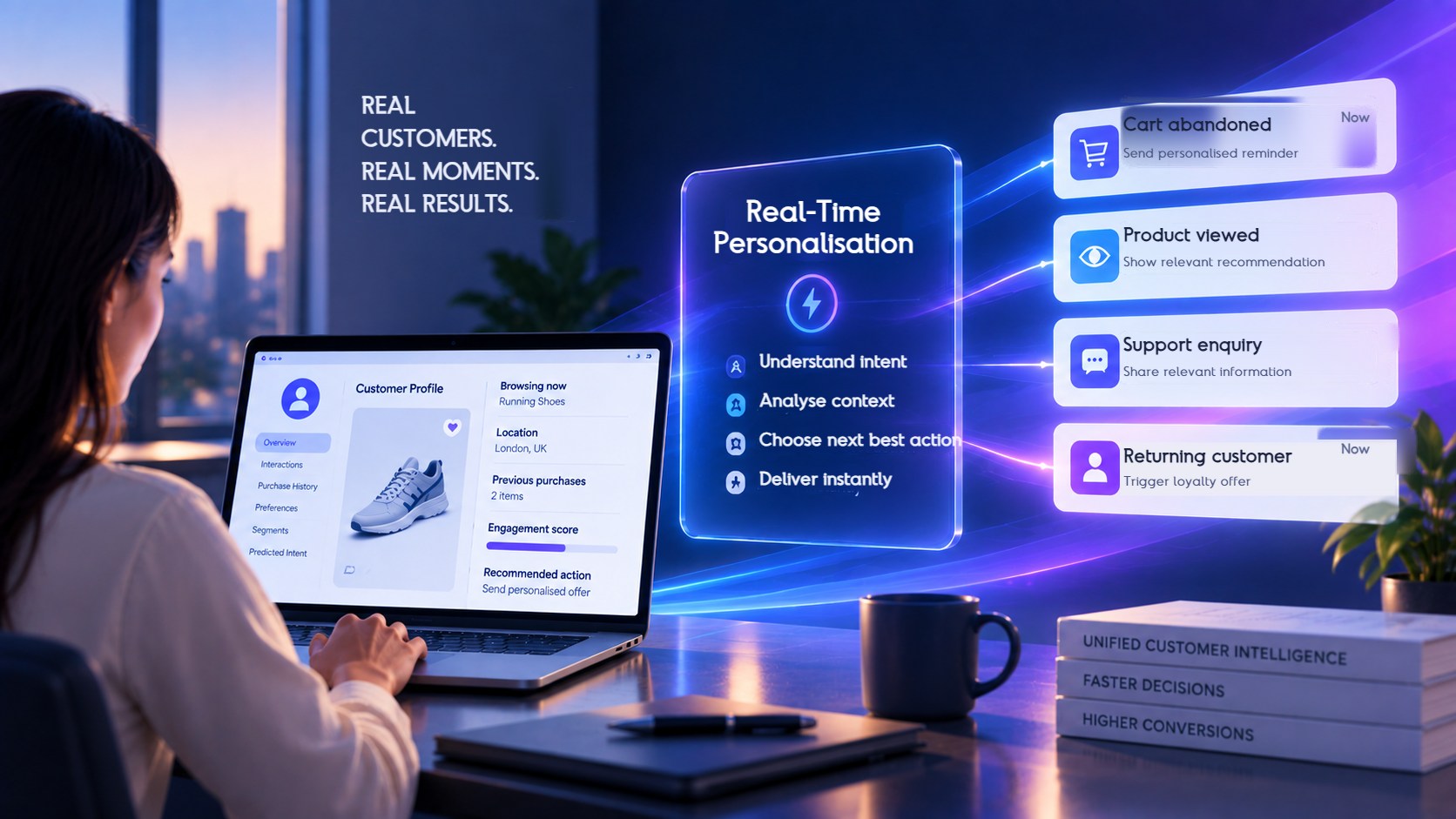
Real-Time vs. Batch Personalisation: Why the Lag Is Costing You the Sale
Business-to-business (B2B) customer engagement has changed significantly as buyers now expect faster responses, connected interactions, and highly personalised experiences across every stage of the customer journey. Decision-makers no longer compare B2B experiences only with competitors within the same industry. They compare them with the seamless digital experiences they receive across retail, banking, streaming platforms, and consumer applications. This shift has increased pressure on enterprises to modernise how they manage customer relationships, support operations, and lifecycle engagement.


