
Ticket Deflection vs Ticket Resolution: Why the Metric Everyone Tracks Is the Wrong One

Insights / Ticket Deflection vs Ticket Resolution: Why the Metric Everyone Tracks Is the Wrong One
Ticket Deflection vs Ticket Resolution

Most support teams track one number above all others: deflection rate — the share of conversations that never reach a human agent. It’s easy to report, and it usually goes up once AI gets involved.

But there’s a problem. Deflection measures whether a conversation reached a human. It doesn’t tell you whether the customer’s problem was solved. A customer who gets the right answer through self-service is a successful deflection. A customer who gets nowhere and simply gives up is also counted as a deflection.

That’s where the metric can become misleading. Resolution rate asks a more important question: did the customer’s issue actually get solved? The two numbers can move in opposite directions and a support team watching only deflection may not notice until customers start leaving.

Deflection vs Resolution: What's the Difference?

Deflection RateResolution Rate
What it measuresConversations that don't reach a humanIssues actually resolved end to end
Customer gives upCounted as a deflectionNot counted as resolved
Customer contacts support againMay not affect the original numberShould trigger review
What it tells youHow much volume avoided a human agentWhether the customer's problem was solved

The gap between the two isn’t small. Deflection and resolution rates can differ by 20 to 40 percentage points on the same ticket volume, depending on how deflection is defined and measured.

The difference can be significant.

Why a Rising Deflection Rate Can Hide a Real Problem

A high deflection rate looks good on a dashboard. But consider what happens when the customer doesn’t actually get the help they need. They try self-service. They don’t find the answer. They try again. They eventually contact the business through another channel — or simply give up. The original interaction may still be recorded as a successful deflection.

The customer sees an unresolved problem. The dashboard sees an efficiency gain. That matters because high-effort experiences can directly affect loyalty. Gartner has found that 96% of customers who classify an interaction as high effort become disloyal afterwards.

Escalation creates another gap.

SQM Group’s benchmarking reports customer satisfaction of 89% for issues resolved without escalation, compared with 67% when a ticket escalates. Its average First Contact Resolution benchmark is 70%, with top-performing teams reaching 85%. So a support operation can appear increasingly efficient while First Contact Resolution quietly falls.

What the Industry Numbers Tell Us

Deflection rates vary considerably depending on how the metric is defined and what types of queries an AI system handles.

Zendesk‘s CX Trends 2026 and Salesforce‘s State of Service 2026 put median Tier-1 deflection at around 41%, with top-quartile performers closer to 59%. But the number needs context.

Deflection tends to work best when AI is handling:

  • Well-structured questions
  • Clearly defined requests
  • Queries with straightforward answers
  • Issues where the AI can check against a reliable backend system

The problem comes when AI is applied indiscriminately. A high deflection rate isn’t necessarily evidence of better service. It may simply mean more conversations are ending without human intervention.

The real question is what happens afterwards.

What Should Support Teams Track Instead?

Deflection shouldn’t disappear from the dashboard. It just shouldn’t be the only measure of success.

1. Resolution rate

Did the customer’s issue actually get resolved? Not simply: Did the conversation end?

2. Re-contact rate

Did the customer return with the same issue? This is one of the clearest signals that a conversation was closed without actually solving the problem.

3. Escalation quality

Don’t just measure how often tickets escalate. Measure what happens when they do. Does the human agent receive enough context to resolve the issue quickly, without making the customer repeat everything?

4. First Contact Resolution

Was the issue resolved during the first interaction?

SQM Group’s benchmarking puts the average FCR rate at 70%, with top-performing teams reaching 85%.

Ticket Deflection vs Resolution

Deflection Is Still Valuable — When It Represents Real Resolution

There is a genuine economic case for automation. The average UK contact centre call costs $7.16, which ContactBabel reports is 42% more than a web chat interaction.

So if AI genuinely resolves an issue without human intervention, the business can reduce both cost and workload.

But consider the alternative. A customer interacts with AI, doesn’t get their problem solved, and calls the contact centre a few days later. The business hasn’t actually eliminated the cost of that interaction. It has delayed it.

And it has potentially added:

  • A frustrated customer
  • A repeat interaction
  • Additional handling time
  • A higher likelihood of escalation

The value of AI isn’t therefore measured by how many customers don’t reach an agent. It’s measured by how many customer problems are successfully resolved without unnecessary human intervention.

Where Worktual's Ticketing System Fits

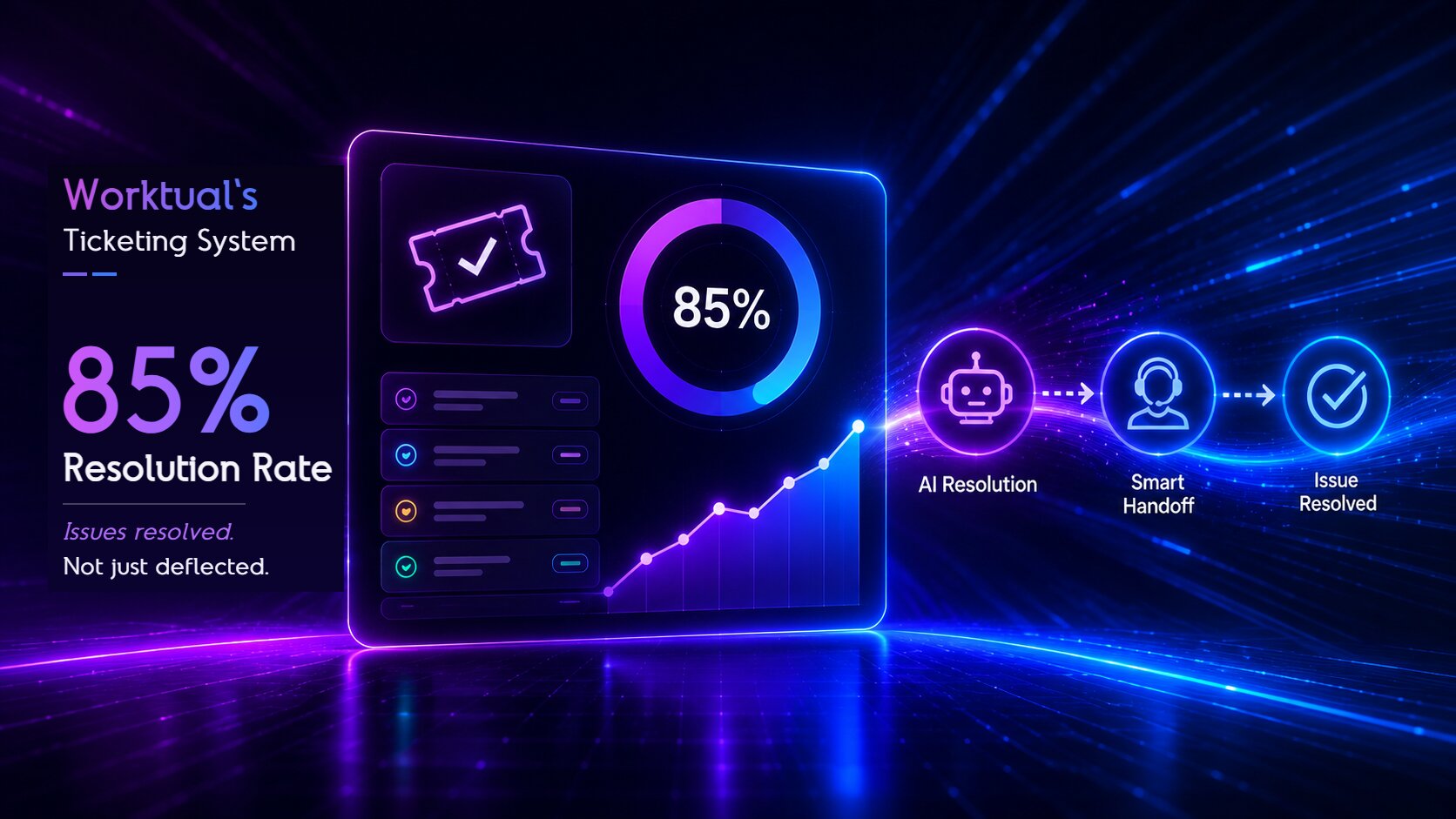
Worktual‘s Ticketing System is designed around resolution rather than deflection alone. When a supposedly closed ticket generates repeat contact, that signal can be surfaced rather than disappearing into a headline deflection number.

And when a conversation starts with Lola, Worktual’s AI agent for chat and voice, the conversation context can carry through when the case is escalated to a human agent. That means escalation doesn’t have to mean starting over.

The customer shouldn’t have to explain the same problem again simply because AI couldn’t resolve it. The goal isn’t maximum deflection. It’s maximum effective resolution with human intervention where it adds value.

Conclusion

Deflection rate answers a narrow question: How much support volume avoided a human agent? Resolution rate answers the question that matters more: Did the customer’s problem get solved?

A support operation that tracks only deflection can look more efficient while customer satisfaction and repeat contacts quietly move in the wrong direction. The answer isn’t to abandon deflection. It’s to stop treating it as the ultimate measure of AI success.

Book a Free Worktual AI Demo .

Frequently Asked Questions

1. What is the difference between ticket deflection and ticket resolution?

Deflection measures conversations that don’t reach a human agent. Resolution measures whether the customer’s issue was actually closed end to end. The two can differ significantly depending on how each metric is defined.

2. Why can a high deflection rate still mean poor customer service?

Because a deflected conversation isn’t necessarily a resolved conversation. A customer may abandon self-service or return through another channel with the same issue.

3. What is a good First Contact Resolution rate?

SQM Group’s benchmark puts average FCR at 70%, with top-performing support teams reaching 85%.

4. What should support teams track alongside deflection?

Track resolution rate, same-issue re-contact rate, escalation quality and First Contact Resolution. Together, these metrics provide a much clearer picture of whether AI is actually solving customer problems.

5. How does Worktual’s Ticketing System address this?

Worktual’s Ticketing System focuses on resolution rather than deflection alone, including identifying repeat contact and carrying conversation context through when cases from Lola are escalated to human agents.