

10 Best AI Chatbots for eCommerce Platforms in the UK (2026 Guide)
Insights / 10 Best AI Chatbots for eCommerce Platforms in the UK (2026 Guide)
Table of Contents
Choosing an AI chatbot for ecommerce is really a question about one thing: how many of the shoppers who almost buy actually complete the purchase. A shopper adds three items to a basket on a UK retailer’s site, gets pulled away mid-checkout, and returns to find the site has forgotten who they are; no saved basket, no record of intent, just a blank homepage. They leave. Multiplied across a business’s full traffic, that single moment stops being a UX detail and becomes a board-level revenue question.
The scale is not marginal. The global average cart abandonment rate is 70.22%, based on a meta-analysis of 50 studies (Baymard Institute, updated September 2025). For UK retailers, the exposure is rising: online sales made up 28.7% of total UK retail spending in March 2026, up from 28.2% the month before (Office for National Statistics). A growing share of revenue now depends on exactly the moments a shopper almost buys, then does not.
AI adoption has moved past the pilot stage many leadership teams still associate with it. 88% of organisations now report regular AI use in at least one business function, up from 78% a year earlier (McKinsey, State of AI 2025). For ecommerce leadership, customer-facing support is typically where that adoption starts, because it is where query volume and shopper expectations meet most directly, and where an AI chatbot can recover baskets, cut response times, and reduce support cost simultaneously.
This guide compares the ten leading AI chatbots for UK ecommerce businesses in 2026, what to check before signing a contract, and where the category is genuinely differentiated versus interchangeable.
10 Top eCommerce Chatbots for UK Retailers in 2026
- Worktual (London, UK)
- Ebi.AI (Warwick, UK)
- Promptchat (East Devon, UK)
- Click4Assistance (Essex, UK)
- Ubisend (Norwich, UK)
- Flochat (Telford, UK)
- Humley (Northampton, UK)
- Creative Virtual (London, UK)
- Futr AI (London, UK)
- eDesk (UK office, HQ in Dublin)
Where AI Chatbots Deliver Return First
Not every automation carries equal weight. Query volume data across UK ecommerce support consistently shows the same six patterns dominate — worth automating roughly in this order:
- Order tracking and status updates. “Where is my order?” is typically the single highest-volume query for any online store. Connected to an OMS or carrier API, it resolves without human involvement, 24/7.
- Returns and refund initiation. Usually the second-highest volume type. The chatbot presents policy, collects the order number and reason, and generates a return label automatically, cutting processing time from days to minutes.
- Product FAQs at the checkout decision point. Pre-purchase micro-questions (“Is this in size M?”) cost the sale when unanswered instantly.
- Abandoned cart recovery. A follow-up message on web, WhatsApp, or email when a shopper starts checkout and leaves. Any WhatsApp or email recovery message that is promotional counts as marketing under UK consent rules, distinct from a purely transactional order update — see the compliance note below.
- WhatsApp and social commerce support. UK shoppers increasingly message brands directly; a connected chatbot handles this inside the app they already use, reducing contact centre volume.
- Post-purchase upsell. Trust is highest immediately after a successful delivery, making it a strong cross-sell window.
Why UK-Specific Matters, and What to Check for Compliance
UK ecommerce customers have expectations that differ from US or global markets, and choosing a platform built for them (or properly configured for them) is not a cosmetic preference — it affects trust, conversion, and compliance exposure.
At minimum, confirm a platform delivers: British English by default, not a manually configured dialect setting; native GBP pricing; recognition of UK carriers (Royal Mail, Evri, DPD, DHL); UK GDPR-compliant data handling (post-Brexit rules apply, not just EU GDPR); and GMT/BST-aware handover to human agents. WhatsApp is not a niche add-on here — 90% of UK adults used it in May 2025, up from 87% the year before (Ofcom, Online Nation 2025), making it one of the highest-reach channels a chatbot can operate inside.
A compliance point worth flagging directly to whoever owns this decision: promotional WhatsApp and Instagram messages — including cart-recovery nudges — are treated as “electronic mail” under PECR, meaning they need consent or a valid soft opt-in, the same standard as email marketing. Transactional messages like order updates are assessed separately under UK GDPR. Confirm with any vendor exactly how their platform (or WhatsApp Business Solution Provider) handles this distinction before automated campaigns go live — this is a genuine liability question, not fine print.
What to Check Before Signing a Contract
Use this framework to evaluate any platform, not just the ten below:
| Factor | Why It Matters | Key Question |
|---|---|---|
| Ecommerce Integration | Must sync with Shopify/WooCommerce/Magento for live order context | Which platforms does it integrate with natively? |
| AI Quality | Determines how well it handles unscripted product and returns queries | What share of queries resolve without human handover? |
| Omnichannel | Customers contact via web, WhatsApp, Instagram — needs one inbox | Can it operate on all three from one dashboard? |
| UK Compliance | UK GDPR, PECR consent, and data residency are non-negotiable | Where is data stored? How is consent for promotional messages handled? |
| Pricing Model | Per-agent vs per-conversation; AI features are often a separate add-on | What is in the base plan, and what is billed on top? |
| Human Handover | AI must escalate with full context intact, not a blank slate | How does mid-conversation handover actually work? |
| Analytics & Reporting | Conversation data should surface trending issues and CSAT scores | What analytics and dashboards come with the platform? |
At a Glance: Pricing and Channel Coverage
| Chatbot | UK-Based | Starting Price | Channels | Best For |
|---|---|---|---|---|
| Worktual | Yes | Custom | Web, phone, CRM | Affordable smart automation |
| Ebi.AI | Yes | Free up to 100 requests/month, then usage-based (from ~£99/month) | Web, social | SME support automation |
| Promptchat | Yes | From $5.75/operator/month | SMS, WhatsApp | Agencies and resellers |
| Click4Assistance | Yes | From £19.95/month | Web, video | Mid-size ecommerce |
| Ubisend | Yes | From £1,200/month | Web, SMS, social | Large enterprises |
| Flochat | Yes | Free plan available; 14-day free Pro trial | Web, social, SMS | Fast omnichannel setup |
| Humley | Yes | Free self-serve tier; paid plans custom | Internal + web | Regulated industries |
| Creative Virtual | Yes | Custom | Voice, chat, IVR | Public sector, large retail |
| Futr AI | Yes | From ~£28,000/year base licence plus usage (published G-Cloud pricing) | Social, web | Local government and SMEs |
| eDesk | Partial | From $39/agent/month | Email, web, social | Marketplace sellers |
Top 10 AI Chatbots for eCommerce in the UK, 2026
1. Worktual
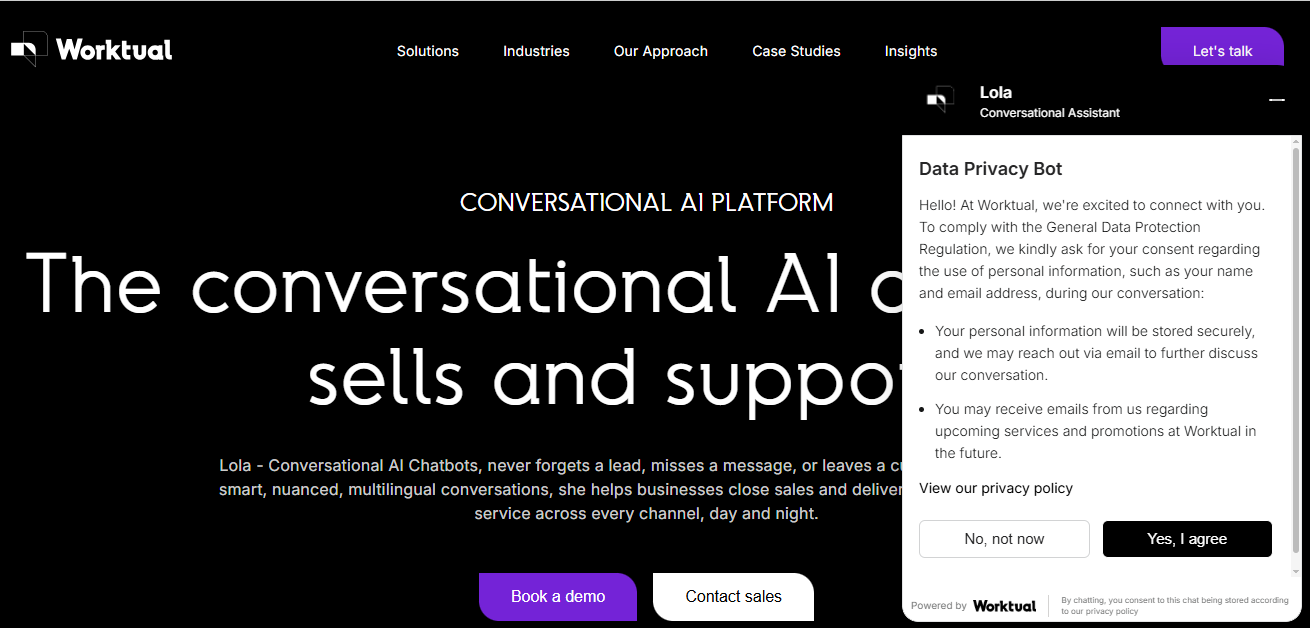
A conversational AI chatbot platform built for customer-facing teams, managing high volumes of chats and voice conversations. Its AI chatbot and voicebot, Lola, combines the speed of AI agents with human clarity, so customers get help instantly while staying heard and understood.
Key Features:
- AI agents for chat and multilingual voice
- Smooth handoff to human agents with full chat history
- Sentiment detection and smart routing
- Unified inbox for all support channels
- Live dashboards and team performance tracking
Pros: Easy to set up and scale; an AI agent is included in the base plans; supports multiple languages natively.
Cons: No free or trial version; the starter plan has fewer customisation options.
Pricing: Custom pricing.
Best for: Companies that receive frequent queries through chat or voice and want to streamline support with AI while keeping human agents ready for complex chats.
2. Ebi.AI (Warwick, UK)
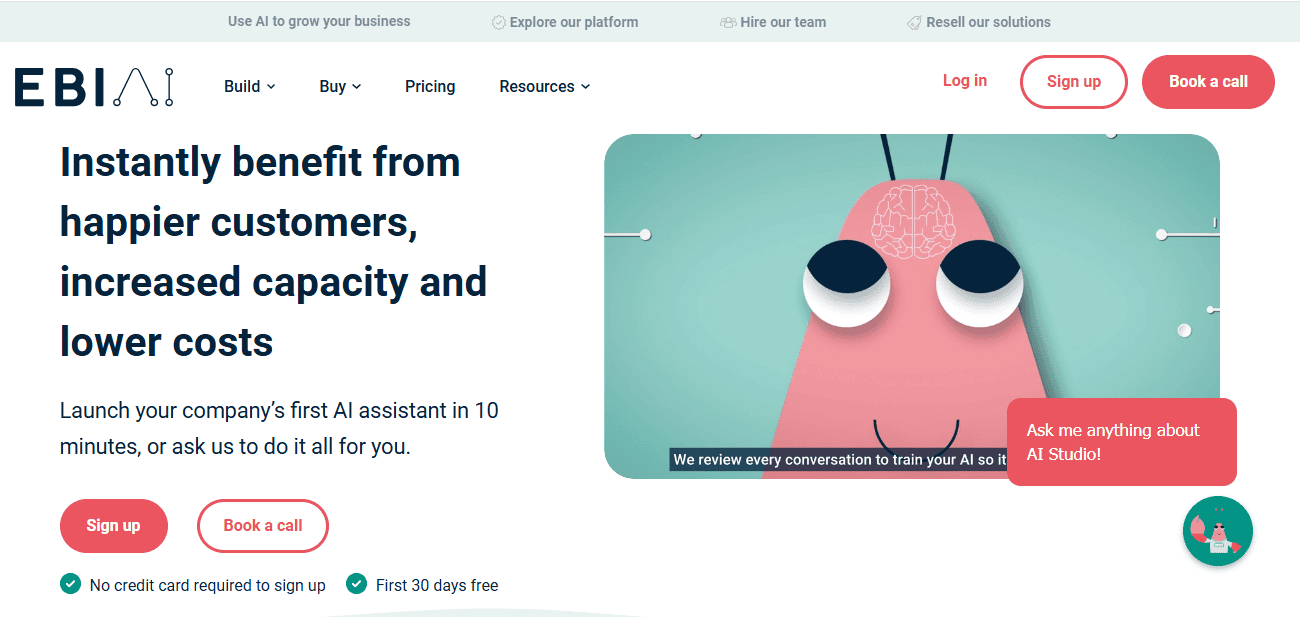
Advanced conversational AI for businesses looking to automate customer support across voice and chat.
Key Features: AI assistant for chat and voice; integrates with CRM and back-end systems; multilingual support and custom journeys; human handover and escalation.
Pros: Free for the first 100 requests per month, then usage-based pricing with no bolt-on fees, per Ebi.AI’s own pricing page; 24/7 AI chat with live agent fallback.
Cons: Enterprise implementations may require technical support to set up.
Pricing: Free up to 100 requests/month, then a small per-request fee; higher-volume plans from around £99/month.
Best for: SMEs needing a tailored AI solution with deep backend integrations and voice capabilities.
3. Promptchat (East Devon, UK)
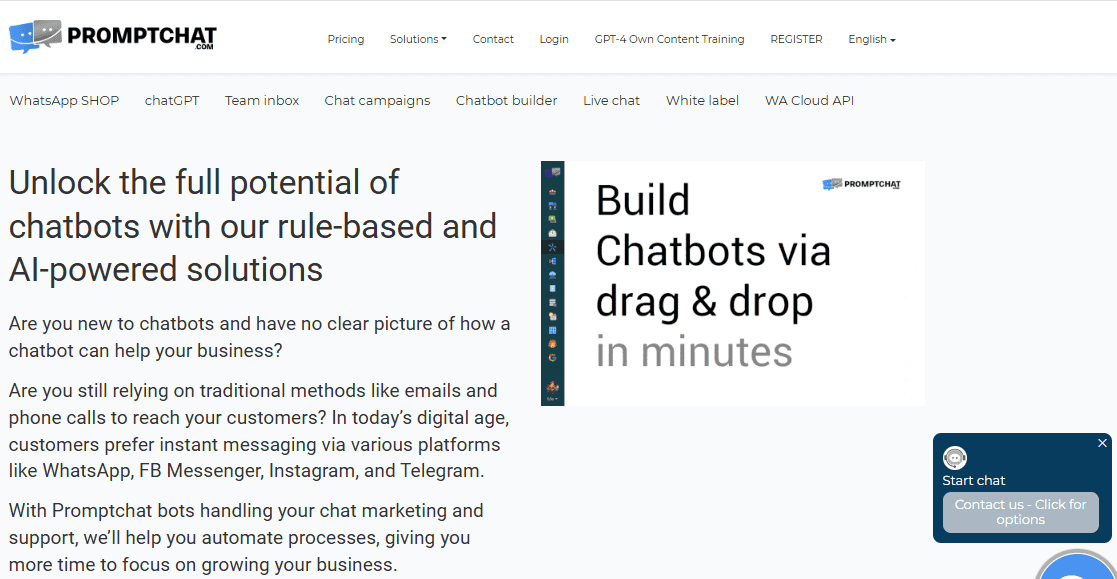
Key Features: No-code chatbot builder; multi-language support; live chat and chatbot switching; white-label options for agencies.
Pros: Drag-and-drop chatbot builder with OpenAI integration; self-hosted or white-labelled cloud version; multilingual and omnichannel (SMS, WhatsApp, web).
Cons: Best suited to simpler query flows rather than complex support cases.
Pricing: From $5.75 per operator per month; a self-hosted perpetual licence is also available from around $2,680 one-time.
Best for: Small businesses and resellers looking for a flexible, low-cost chatbot platform.
4. Click4Assistance (Essex, UK)
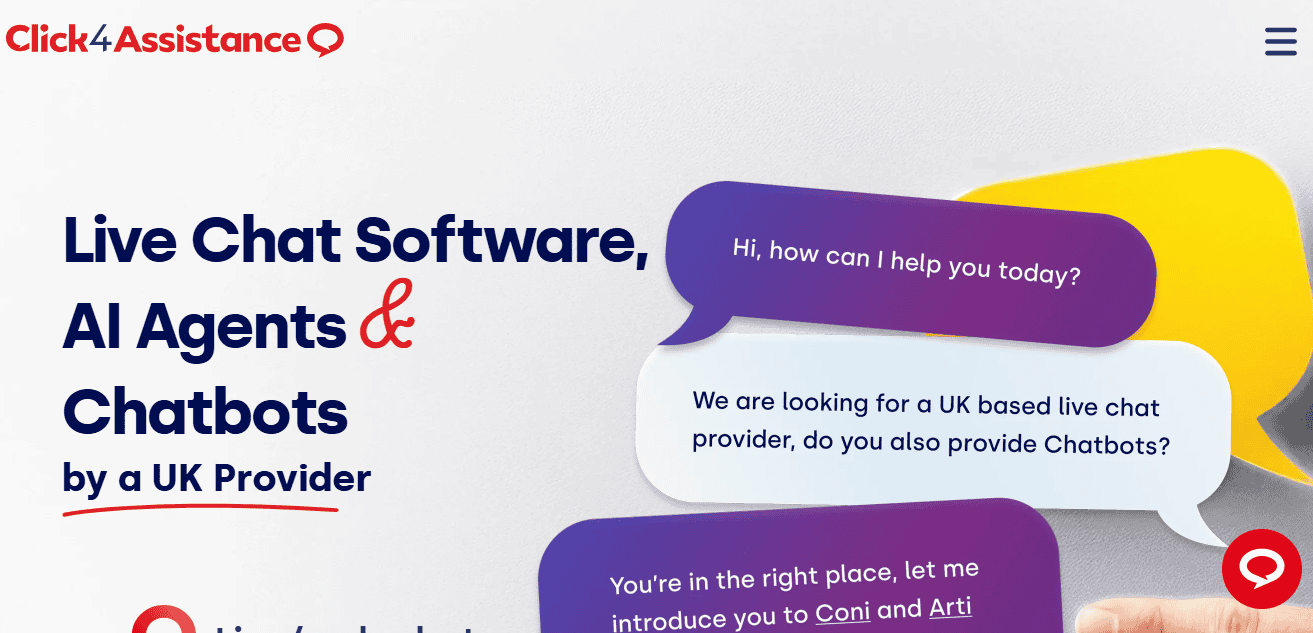
Live chat with chatbot automation, co-browsing, video chat, and visitor engagement features.
Key Features: Live chat with chatbot automation; co-browsing and video support; visitor tracking and proactive messaging; CRM and email integration.
Pros: Over 20 years of UK live chat experience; offers an AI chatbot with ChatGPT integration; customisable for retail and public sector; UK servers and support.
Cons: Best suited to teams that want human-led support with moderate AI automation, rather than an AI-first approach.
Pricing: From £19.95/month.
Best for: Service-focused websites that want human-led support with moderate AI automation.
5. Ubisend (Norwich, UK)
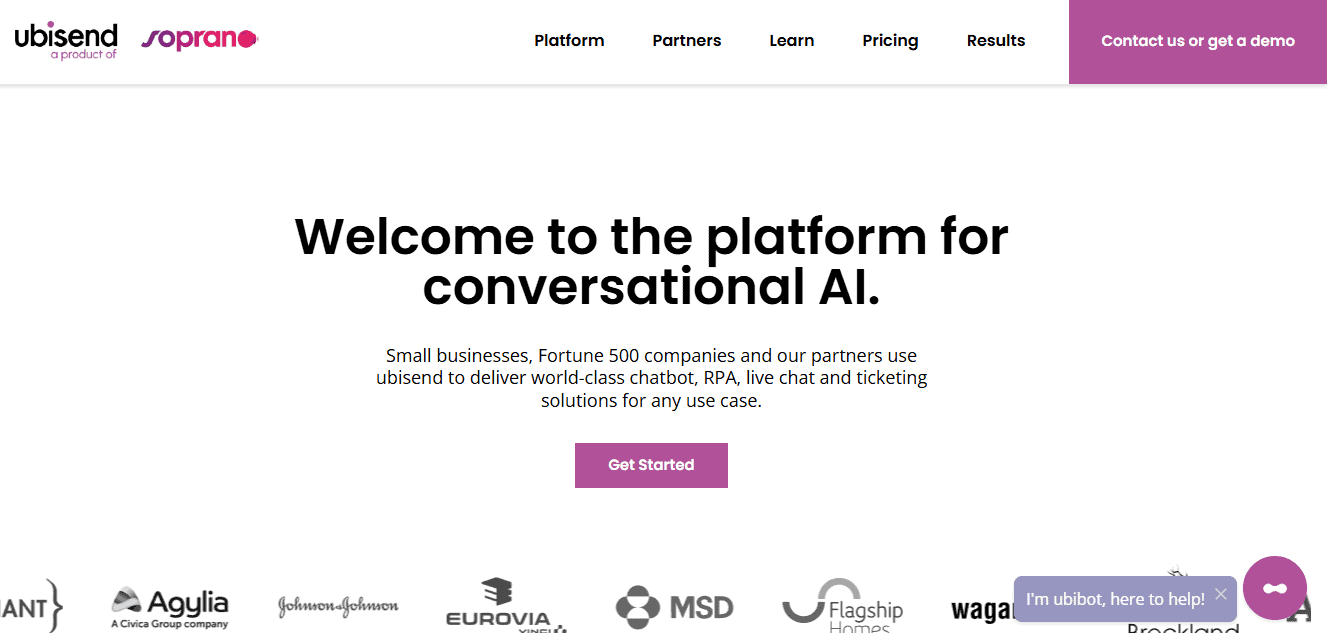
AI chatbots that automate everyday tasks across HR, internal tools, and customer service.
Key Features: Custom chatbot workflows; HR and IT automation templates; multi-channel support; GDPR-compliant data handling.
Pros: Enterprise-grade AI platform; multi-bot management and RPA integration; supports web, SMS, WhatsApp, Messenger.
Cons: Entry pricing is higher than SME-focused competitors.
Pricing: From £1,200/month.
Best for: Large-scale ecommerce and enterprise businesses needing secure, compliant bots for internal and external use.
6. Flochat (Telford, UK)
Conversational AI for boosting engagement across Messenger, WhatsApp, and other apps, tailored for lead generation and marketing use cases.
Key Features: Multichannel chatbot for messaging apps; drip campaigns and broadcast tools; lead capture and routing; real-time analytics.
Pros: No-code platform with multi-channel support; prebuilt workflows for ecommerce and lead capture; free plan available, plus a 14-day free Pro trial.
Cons: Better suited to marketing and lead-generation use cases than deep, complex customer support.
Pricing: Free plan available; paid plans add extra chatbots from £7/month.
Best for: Marketing teams and ecommerce stores looking to boost engagement and lead capture on chat platforms.
7. Humley (Northampton, UK)
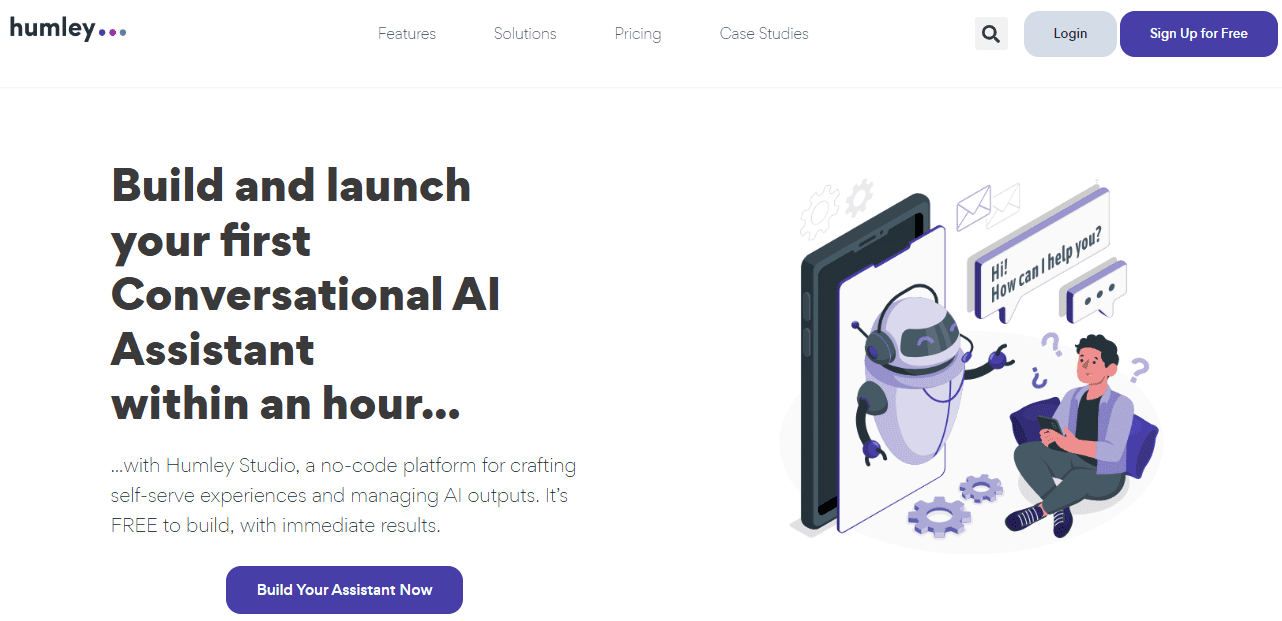
Conversational AI built to support both customers and employees, known for quick setup and easy deployment.
Key Features: NLP-driven chatbot builder; integrates with Microsoft Teams and Slack; prebuilt templates for HR, IT, and support; omnichannel and voice-ready.
Pros: Generative AI chatbot for enterprise use; pre-trained language models and process automation; a free self-serve tier to get started.
Cons: Focuses more on internal use cases than customer-facing ecommerce support.
Pricing: Free self-serve tier; paid plans (Start-Up, Scale-Up, SME, Pro) are quote-based.
Best for: Organisations wanting to automate internal support across multiple channels, including voice.
8. Creative Virtual (London, UK)
Enterprise-level conversational AI chatbot, voicebot, and virtual assistant solutions designed for complex support needs, combining AI with human input.
Key Features: AI plus human-in-the-loop design; multilingual and omnichannel; live chat integration; strong analytics and customisation.
Pros: Highly customisable virtual assistants and voice bots; used by large UK retailers and the public sector; proof-of-concept model available.
Cons: Better suited to larger teams with the resources for technical setup and training.
Pricing: Custom pricing only; Creative Virtual itself notes that enterprise conversational AI pricing is rarely transparent industry-wide.
Best for: Large enterprises that need advanced conversational AI with human fallback and full control.
9. Futr AI (London, UK)
AI chat solutions tailored for public services, retail, and SMB use, designed to automate everyday queries while keeping accessibility and inclusion at the core.
Key Features: AI chatbots with multilingual support; integrations with WhatsApp, Messenger, and web; real-time handover to live agents; accessible chatbot design.
Pros: AI chatbot and live chat combo; wide multilingual translation support; published, transparent pricing structure via the G-Cloud framework.
Cons: Enterprise base licence cost may be high for smaller retailers.
Pricing: Published G-Cloud pricing lists a base platform licence of around £28,000/year plus usage-based interaction costs; total cost depends on volume tier.
Best for: Councils, public services, and businesses focused on accessibility and fast customer support.
10. eDesk (UK office, HQ in Dublin)
Ticketing, live chat, and AI in one platform, helping manage customer conversations across marketplaces and online stores.
Key Features: Centralised inbox for multichannel queries; AI-powered responses and insights; integrates with Amazon, eBay, Shopify; order and shipping data linked to chats.
Pros: Helpdesk and AI chatbot built for Amazon, eBay, and Shopify integrations; smart ticketing and AI replies.
Cons: Focused on support rather than proactive sales automation; add-ons (WhatsApp, AI resolution credits) can add meaningfully to the headline price, so request a fully-loaded quote.
Pricing: From $39/agent/month (Essential plan, billed annually); Growth and Professional tiers run higher, with AI automation typically billed as a separate add-on.
Best for: Online retailers managing customer support across multiple marketplaces and web stores.

Why Worktual Stands Out Among Ecommerce AI Chatbots
Worktual combines UK-focused support, smart automation, and affordability. It is well suited to ecommerce brands that want practical AI tools without the cost or complexity of enterprise-only platforms.
- Local pricing and language
- Combined CRM and ecommerce integrations
- Chatbot, virtual phone, and ticketing in one platform
- Built for British customer expectations
Tips for choosing the right chatbot: match features to your business size and sales model; prioritise integrations and automation depth over feature count; test with a demo before committing; avoid paying for capabilities you will not use.
Explore how Worktual can support AI-native customer conversations across digital and contact-centre channels, for eCommerce brands trading in the UK.
FAQs
1. Which AI chatbot is best for ecommerce?
The best AI chatbot depends on your business size, ecommerce platform, support volume, and automation needs. Compare integrations, AI accuracy, pricing, and analytics before deciding, and request a demo built around your actual product catalogue rather than relying on a generic sales walkthrough.
2. Can AI chatbots increase ecommerce sales?
Yes. AI chatbots can support sales growth by recommending products, reducing cart abandonment, answering customer questions instantly, and providing more personalised shopping experiences. The scale of the impact varies by store and implementation, so request vendor-specific evidence rather than industry-wide averages.
3. Are AI chatbots better than traditional chatbots?
AI chatbots understand natural language and provide contextual responses, while traditional rule-based chatbots follow predefined decision trees. AI chatbots generally handle a wider range of unscripted customer questions, though rule-based bots can still suit narrow, highly predictable query types.
4. Do AI chatbots work with Shopify?
Yes. Most modern AI chatbots integrate natively with Shopify, letting businesses automate customer support, recommend products, and support conversions from within the storefront. Always confirm whether the integration is native or requires a third-party connector, since connector-based setups can add ongoing maintenance and cost.
5. Can AI chatbots integrate with WhatsApp?
Many AI chatbot platforms offer WhatsApp Business API integration for order updates, product recommendations, and support. UK businesses should confirm how the vendor handles consent for promotional messages, since these are treated as marketing under UK electronic communications rules.
6. Which AI chatbot is best for a small ecommerce business in the UK?
For small UK ecommerce businesses, Worktual (UK-based, GBP-native), Promptchat (from $5.75/operator/month, no-code), and Ebi.AI (usage-based, free entry tier) are strong starting points. The right choice depends on budget and whether you need deep backend integrations or a simple, fast setup.
7. How much does an AI chatbot for ecommerce cost in the UK?
Costs vary widely by vendor and usage volume, from free or low-cost entry tiers for small stores to enterprise contracts running into thousands per month. Add-ons such as WhatsApp API fees, CRM integrations, and onboarding can add meaningfully to the headline price, so always request a fully-loaded quote before comparing vendors.
8. Can an AI chatbot recover abandoned shopping carts?
Yes. AI chatbots can send follow-up messages via web chat, WhatsApp, or email when a visitor abandons checkout. Recovery rates vary by store and message type, and promotional recovery messages on WhatsApp or email are subject to UK marketing consent rules, distinct from purely transactional order updates.
9. Do AI chatbots work on WhatsApp for ecommerce?
Yes. Several UK ecommerce chatbot platforms, including Worktual, Promptchat, Flochat, and Ubisend, integrate with the WhatsApp Business API. A WhatsApp chatbot can handle order tracking, returns, product questions, and cart-recovery messages inside the app UK shoppers already use to contact brands.
10. What is the difference between an ecommerce chatbot and an AI assistant?
An ecommerce chatbot typically handles transactional queries: order tracking, returns, and product FAQs. An AI assistant goes further, proactively recommending products, personalising the shopping experience based on browsing history, and in some cases taking autonomous actions like initiating a refund without human involvement.
11. Which ecommerce platforms do AI chatbots integrate with?
Most leading UK ecommerce chatbots integrate with Shopify, WooCommerce, Magento, and BigCommerce natively, alongside CRM platforms such as Salesforce, HubSpot, and Klaviyo. Coverage varies by vendor and plan tier, so always verify which integrations are included as standard versus charged as paid add-ons before signing.
12. Are there AI chatbots that handle product recommendations for ecommerce?
Yes. AI chatbots such as Worktual’s can use browsing history, basket contents, and past purchase data to recommend relevant products in real time. This differs from basic FAQ chatbots, since personalised recommendation typically requires CRM or OMS integration to surface contextual suggestions.
13. How do I choose between a live chat widget and an AI chatbot for my ecommerce site?
In most cases, use both. A live chat widget alone needs human agents online; an AI chatbot handles queries 24/7 without added staffing costs. The strongest setup combines an AI chatbot for common queries (order tracking, returns, FAQs) with clean escalation to a human agent for complex or sensitive conversations.
Related Posts
The Best Multilingual AI Chatbots for UK Businesses
Demand for multilingual AI chatbots is rising fast. Why? Because customers now expect service in their own language, not a bot-induced game of linguistic charades.
Top Zendesk Alternatives & Competitors in 2026
Customer service has entered an era where AI chatbots are no longer optional but essential. From rapidly scaling startups to large enterprises aiming to reduce costs, the right conversational AI can reshape customer experiences and boost business outcomes.

Agentic AI CCaaS: The Future of Agentic AI Contact Centres
Agentic AI CCaaS is a cloud-based contact centre solution powered by autonomous AI agents that can independently handle customer interactions, make decisions, and execute tasks without constant human intervention.


