

Customer Intelligence for Financial Services in the UK (Cognitive CDP)
Insights / Customer Intelligence for Financial Services in the UK (Cognitive CDP)

Table of Contents
UK financial institutions have access to more customer data than ever; from digital banking activity and transactions to contact centre interactions, branch visits and marketing engagement. The challenge is no longer collecting that data. It is bringing it together quickly enough to understand the customer behind it.
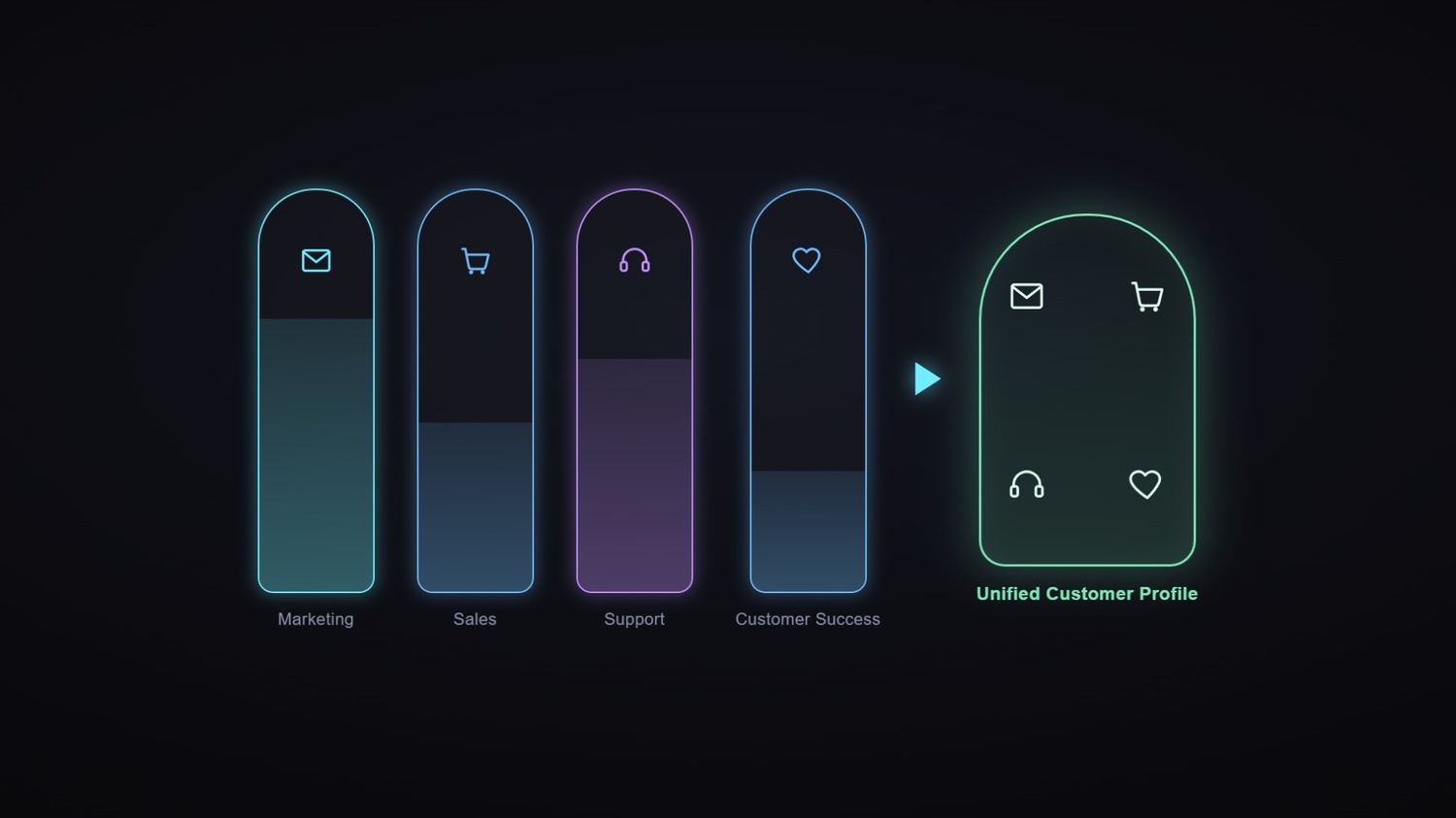
Customers don’t experience a bank through individual systems or departments. They experience one relationship. When each interaction is informed by a different slice of their history, that relationship can feel fragmented, even when the institution has all the information it needs.
A unified, continuously updated view helps financial institutions understand behaviour as it happens, recognise emerging intent and respond with greater relevance moving beyond simply storing customer data towards using it to personalise engagement and strengthen the value of every relationship.
Worktual’s Cognitive Customer Data Platform (CDP) and Customer Value Management (CVM) provide the intelligence layer that makes this possible, bringing customer signals together, using AI to identify patterns and intent, and helping the business determine what to do next.
Why Customer Intelligence Matters in UK Financial Services
75% of UK adults now use mobile banking, roughly 41 million people, up from 60% just a year earlier, according to Finder’s 2026 research. Open Banking adoption has followed a similar curve — 41% of UK adults used an Open Banking-enabled service in 2024, projected to reach 60.5% by 2026.
That shift has raised the baseline expectation across the board. Retail banks, building societies, insurers, investment firms and fintech platforms are all competing on the same ground: whoever understands the customer best, fastest, wins the relationship.
Quarterly segmentation can’t keep up with customers whose behaviour changes from one interaction to the next.
The Biggest Customer Data Challenges
• Data silos — the mobile app, contact centre, branch, and CRM each hold a different fragment of the same customer.
• Disconnected CRM — updated manually, already out of date by the time it matters.
• Multiple customer IDs — the same person looks like three different records across three systems.
• Limited personalisation — campaigns built for a segment, not the individual.
• Inconsistent customer journeys — a query resolved on WhatsApp has to be re-explained by phone.
• Slow marketing decisions — built on last quarter’s data, not this week’s behaviour.
What Is Worktual's Cognitive CDP — and What Is CVM?
A traditional Customer Data Platform (CDP) unifies customer data into one profile, and stops there. A person still has to decide what to do with it.
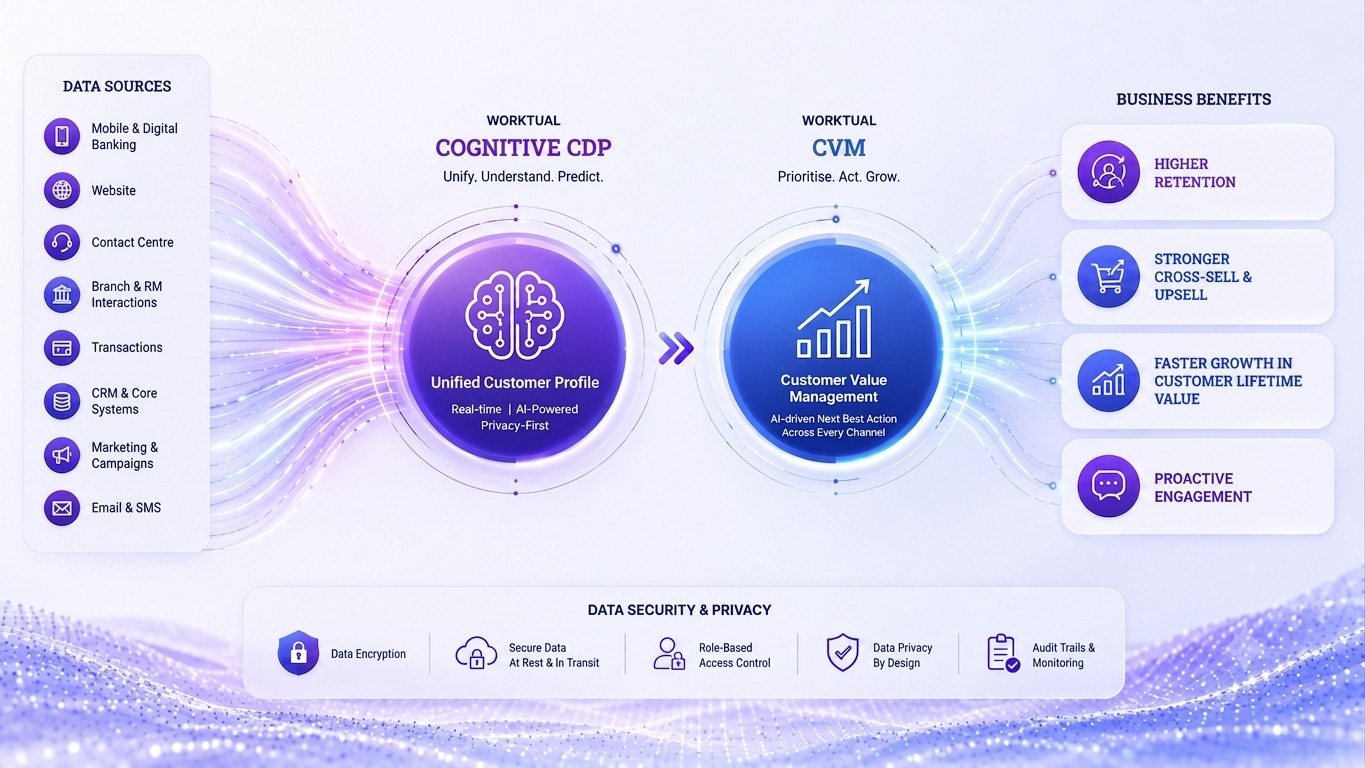
Worktual’s Cognitive CDP is the capture and unification layer. In real time, it:
- Unifies data from every channel and connected system into one profile.
- Keeps that profile continuously current, not a batch update.
- Gives every team — the app, the contact centre, a relationship manager — the same live picture.
CVM (Customer Value Management) is the strategy layer built on top of that unified profile. CVM does the scoring — churn risk, purchase intent, lifetime value trajectory — and determines the next best action: a specific offer, an alert to a relationship owner, a triggered retention workflow.
Where Cognitive CDP answers “what do we know about this customer, right now?”, CVM answers “what should we actually do about it, to grow the value of this relationship?”
Together, they close the gap between knowing the customer and knowing what to do next: capture the data, score it, act on it.
Building a 360° Customer View
A genuine 360° view pulls from every source a UK financial institution actually runs on; mobile banking, website, contact centre, branch visits, CRM, email, transaction history, and marketing campaigns.
For most institutions, this means unifying Worktual’s own solutions alongside existing core banking and CRM systems already in place. The CDP sits as the hub, with every one of those systems feeding it as a spoke, so a relationship manager sees the same live picture the mobile app and contact centre are already working from.
How AI Generates Customer Intelligence
Once Cognitive CDP has unified the data, CVM does the analysis:
• Behaviour analysis — reading patterns across every channel, not just the last interaction.
• Intent prediction — flagging a customer likely to need a product before they ask.
• Risk scoring — informing both product recommendations and retention priority.
• Customer segmentation — dynamic, updated continuously, not rebuilt quarterly.
• Lifetime value prediction — directing attention to the relationships worth investing in.
• Next-best-product recommendation — the specific offer most likely to land.
• Churn prediction — flagging risk early enough to actually act on it.
Practical Use Cases in UK Financial Services
This is where the two work together: the Cognitive CDP provides the live customer picture; CVM turns that insight into action.
Retail Banking
- Predicting personal loan interest.
- Flagging credit card eligibility.
- Identifying mortgage intent before the customer applies.
Insurance
- Predicting renewal likelihood.
- Surfacing cross-selling opportunities.
- Reading claim behaviour patterns.
Wealth Management
- Recommending investment products.
- Timing portfolio reviews.
- Flagging high-value engagement moments.
Building Societies & Challenger Banks
- Delivering the same real-time personalisation as larger banks, without a proportionally larger data or analytics team.
Personalisation Across Every Customer Touchpoint
The same unified profile powers personalisation consistently across website, mobile app, email, SMS, WhatsApp, the call centre, and a relationship manager’s own conversation.
The offer a customer sees in the app matches what the contact centre already knows, rather than each channel personalising independently against a different slice of the same customer.
CDP + CVM Decisioning in Practice
- A customer opens the mobile app.
- Cognitive CDP captures that session against her existing profile.
- CVM predicts intent from that session and recent behaviour, and recommends a specific, relevant offer.
- Marketing automation delivers it on the right channel.
- Sales is notified if the signal is strong enough to warrant a human follow-up.
- That follow-up is triggered automatically, with full context attached — not a cold call starting from zero.
Business Benefits
Worktual’s Cognitive CDP does not just add AI to a CRM. It changes what the data does:
| Customer profile | Static, updated manually | Dynamic, updated in real time |
| Segmentation | Manual, rule-based | AI-driven, behaviour-based |
| Marketing approach | Reactive, after the fact | Predictive engagement |
| Insight depth | Limited to what's logged | Genuine customer intelligence |
| Campaigns | Generic, segment-wide | Personalised to the individual |
Turning Customer Intelligence into Business Value
A unified customer profile is valuable only when the business can act on what it reveals. This is where Customer Value Management (CVM) comes in — turning customer signals and AI-driven insights into targeted actions that improve retention, grow relationships and increase customer lifetime value.
• Higher retention — act on a churn signal before renewal, rather than after the customer has already decided to leave.
• Stronger cross-sell and upsell — present relevant offers when genuine intent emerges, rather than targeting an entire segment on a fixed schedule.
• Faster growth in customer lifetime value — focus investment and engagement where there is real potential to grow the relationship.
• Proactive engagement — reach out when customer behaviour signals that a moment matters, rather than simply because the campaign calendar says it’s time.
Data Privacy and Compliance Considerations in the UK
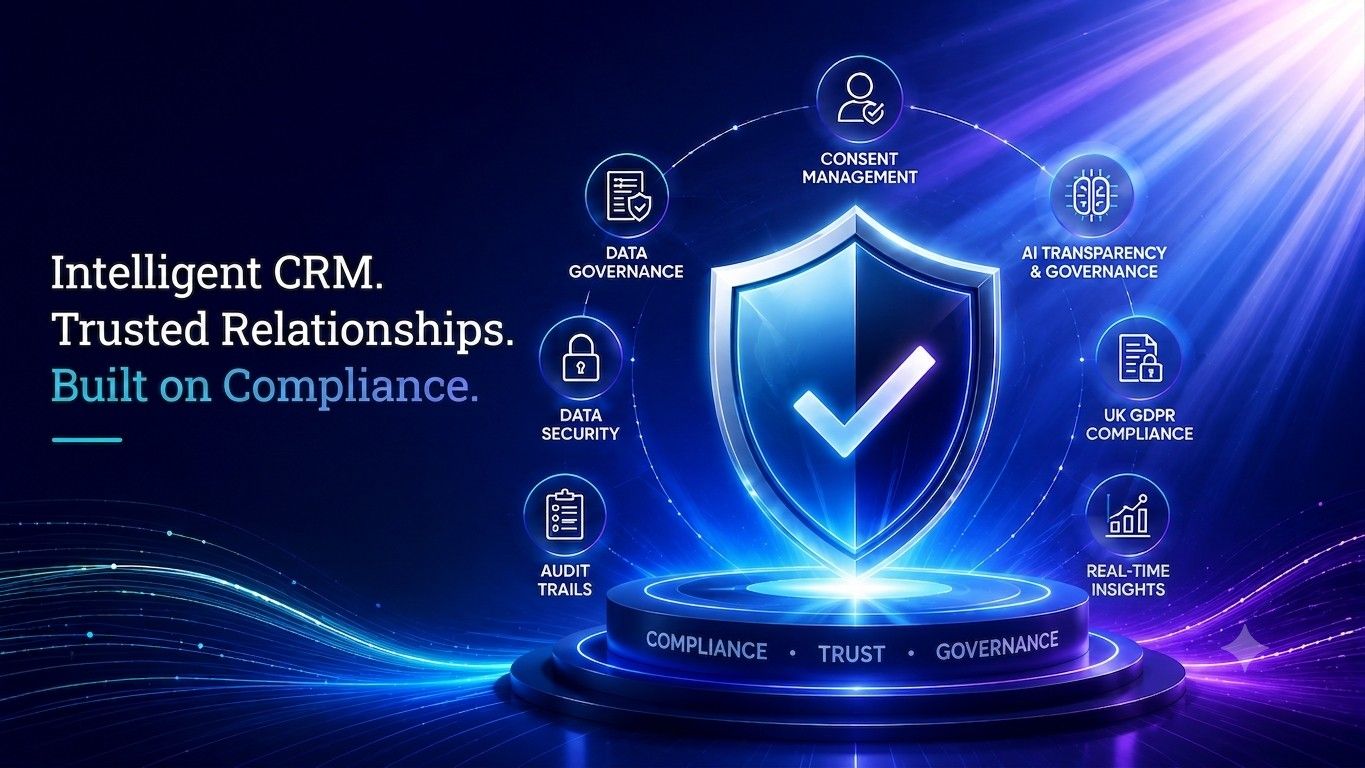
• Secure hosting — customer data is hosted on Oracle Cloud, adhering to standard data policies and guardrails.
• Role-based access controls — limiting who sees what.
• Explicit consent management — captured and auditable, not assumed.
• UK GDPR alignment — processing under a lawful basis such as legitimate interest (Article 6(1)(f)), and the ICO’s incoming binding Code of Practice on AI and automated decision-making, in force from 12 May 2026.
• Responsible AI governance — predictions and recommendations that can be explained and audited, not a black box.
Conclusion
Cognitive CDP and CVM working together help UK financial institutions:
- Unify fragmented customer data.
- Deliver genuinely personalised experiences.
- Improve retention.
- Increase cross-sell and upsell opportunities.
- Enable AI-driven decision-making, not manual guesswork.
See how Worktual‘s Cognitive CDP and CVM can modernise customer intelligence and accelerate digital transformation across your institution — book a demo with Worktual.
Frequently Asked Questions
1. What is a Cognitive Customer Data Platform (Cognitive CDP)?
A platform that unifies customer data from every channel into one profile, using which CVM predicts behaviour, identify intent, and recommend the next best action — going beyond a traditional CDP’s unification-only role.
2. What is CVM, and how does it relate to Cognitive CDP?
CVM (Customer Value Management) is the strategy layer built on top of the Cognitive CDP’s unified profile. The CDP supplies the real-time picture of the customer; CVM turns it into a specific retention, cross-sell, or lifetime-value action.
3. Why is customer intelligence important for UK financial institutions?
With mobile banking adoption at 75% of UK adults and strong competition across banks and fintechs, institutions that understand customer intent fastest win the relationship. Static, quarterly segmentation cannot keep pace with that expectation.
4. How is a Cognitive CDP different from a traditional CRM?
A traditional CRM holds static profiles a person has to act on manually. A Cognitive CDP maintains dynamic, AI-driven profiles and recommends or triggers the next action directly.
5. What types of customer data can a Cognitive CDP unify?
Mobile banking activity, website behaviour, contact centre interactions, branch visits, CRM records, email, transaction history, and marketing campaign data, brought into one continuously updated profile.
6. How does AI improve customer engagement in financial services?
By predicting intent and recommending the next best action in real time, so a customer’s mobile app, contact centre call, and relationship manager conversation all draw on the same current picture, rather than three disconnected ones.
7. Where is customer data hosted?
Data is hosted and stored on Oracle Cloud, adhering to standard data policies and guardrails — a detail worth confirming directly for any institution with its own data residency requirements.

Related Posts

What Is an AI CRM? A Plain-English Guide for UK Businesses (2026)
An AI CRM is customer relationship management software with artificial intelligence built into its core workflows. Rather than simply storing contact records, it scores leads, drafts follow-ups, forecasts deals, and surfaces the next action automatically. The difference from a normal CRM is not an added chatbot; it is that the software itself does some of the work, not just the record-keeping.
Best Salesforce Alternative for UK Teams in 2026
AI-Native CRM That British Businesses Actually Adopt
It is 5:45pm on a Friday in Manchester, and a sales rep has just finished her fourth call of the afternoon. She knows she should log the notes in Salesforce before the weekend. She also knows it’ll take fifteen minutes she doesn’t have, so it waits until Monday, half-remembered.
Why Intelligent CRM Is Becoming a Compliance Requirement, Not Just a Sales Tool
For years, CRM software had one job: keep track of leads, log calls, and give sales teams a pipeline to work from. That’s still how many organisations view it today — a sales tool, and little more.


