What Is Unified Intelligence? The Future of AI-Native Customer Growth

Insights / What Is Unified Intelligence? The Future of AI-Native Customer Growth

What Is Unified Intelligence? The Future of AI-Native Customer Growth

Businesses today generate vast amounts of customer data across sales, marketing, support, ecommerce, and operational systems. However, most organisations still operate with fragmented technologies that fail to convert this data into intelligent, real-time action.

Traditional systems function in silos:

  • CRMs store customer information
  • Marketing tools track engagement
  • Support platforms manage service requests
  • Analytics dashboards provide reporting

Yet these systems rarely communicate intelligently with one another.

As customer expectations continue to rise, businesses are facing increasing pressure to deliver:

  • Faster response times
  • Personalised customer experiences
  • Real-time engagement
  • Seamless cross-channel communication
  • Operational efficiency at scale

This is driving the rise of Unified Intelligence — an AI-native operational framework that combines customer data, AI agents, automation, analytics, and decision-making into one connected intelligence layer.

According to McKinsey & Company, generative AI could contribute trillions of dollars annually to the global economy through productivity improvements and intelligent automation. Similarly, Gartner predicts that autonomous and AI-driven systems will increasingly become central to enterprise operations over the next decade.

Unified Intelligence represents the evolution from traditional software systems to continuously learning AI-powered business ecosystems.

  • What Is Unified Intelligence?
  • Why Traditional Business Systems Are Failing
  • Key Challenges Facing Modern Enterprises
  • Core Components of Unified Intelligence
  • Industry Applications of Unified Intelligence
  • Why Unified Intelligence Delivers Higher ROI
  • Unified Intelligence vs Traditional Automation
  • The Future of AI-Native Customer Growth
  • FAQs

What Is Unified Intelligence?

Unified Intelligence is an AI-native business model where customer intelligence, conversational AI, automation, analytics, and autonomous AI agents work together as a unified operational system.

Unlike traditional software platforms that require constant human intervention, Unified Intelligence systems can:

  • Analyse customer behaviour in real time
  • Predict customer intent
  • Automate workflows autonomously
  • Personalise interactions dynamically
  • Coordinate cross-functional business processes
  • Continuously learn and optimise outcomes

Rather than simply storing information, Unified Intelligence enables businesses to operate intelligently and proactively.

This shift is becoming increasingly important as organisations move beyond static automation toward adaptive, AI-driven operations.

Why Traditional Business Systems Are Failing

Most legacy enterprise systems were designed primarily for record management and task execution — not intelligent decision-making.

As businesses scale, this creates several operational challenges:

Key Challenges Facing Modern Enterprises

Fragmented Customer Data

Customer information is often spread across multiple disconnected platforms, limiting visibility and slowing decision-making.

Manual Workflows

Employees continue to spend significant time on repetitive administrative tasks that reduce operational efficiency.

Inconsistent Customer

Disconnected systems create inconsistent engagement across channels and customer touchpoints.

Delayed Response Times

Slow lead responses and customer support delays negatively impact conversion rates and retention.

Limited Predictive Intelligence

Traditional systems primarily report past activity rather than predicting future customer behaviour.

Research from Salesforce indicates that customers increasingly expect connected, personalised experiences across all channels, while businesses continue struggling with operational silos.

Unified Intelligence addresses these limitations by creating one continuously learning AI-powered ecosystem across the organisation.

Core Components of Unified Intelligence

AI-Native CRM

AI-native CRMs move beyond static customer databases by automatically capturing signals, updating customer journeys, prioritising opportunities, and automating engagement workflows.

Business Benefits

  • Faster lead qualification
  • Improved sales productivity
  • Reduced manual data entry
  • Real-time customer insights
  • Intelligent pipeline management

AI-native CRM platforms help organisations improve sales efficiency while enabling more proactive customer engagement.

Conversational AI

Conversational AI includes AI chatbots, AI voice assistants, and multilingual virtual agents capable of handling customer interactions naturally across websites, messaging apps, and contact centres.

According to IBM, AI-powered virtual agents can significantly reduce customer support workloads while improving service availability.

Common Applications

  • 24/7 customer support
  • AI-powered contact centres
  • Appointment scheduling
  • Customer enquiry automation
  • Voice-based engagement
  • Multilingual communication

Cognitive Data Platforms

A cognitive data platform unifies customer information from multiple systems into real-time intelligent customer profiles.

This enables organisations to:

  • Build unified customer views
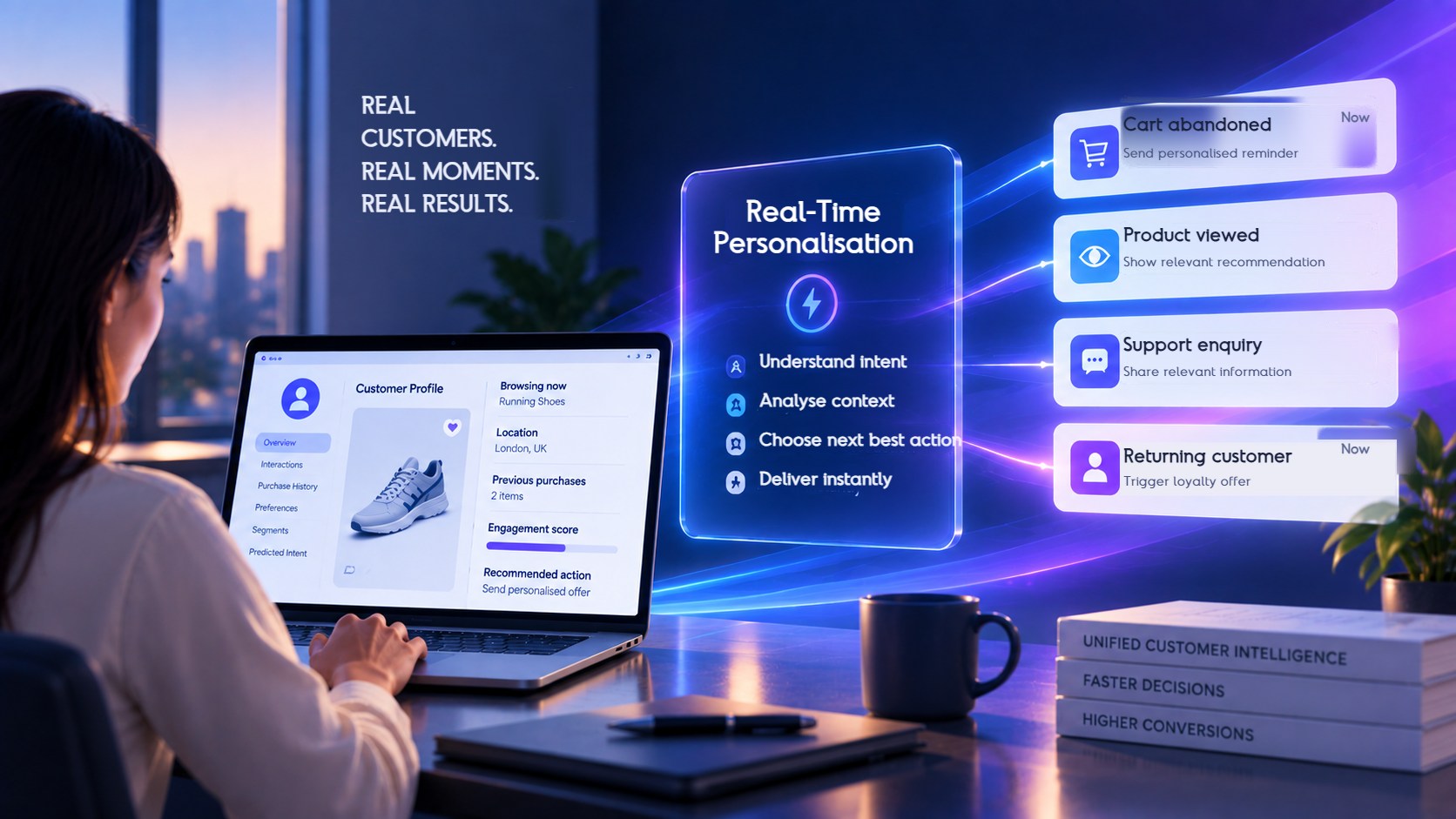
  • Deliver real-time personalisation
  • Analyse behavioural patterns
  • Predict customer intent
  • Improve decision-making accuracy

By centralising customer intelligence, businesses gain deeper visibility into customer behaviour and engagement trends.

Autonomous AI Agents

Autonomous AI agents can independently execute workflows, analyse information, make decisions, and optimise processes within defined governance frameworks.

AI Agent Capabilities

  • Automated customer engagement
  • Workflow orchestration
  • Intelligent routing
  • Predictive recommendations
  • Sentiment analysis
  • Real-time operational optimisation

As organisations move beyond rule-based automation, autonomous AI agents are becoming central to scalable AI-driven operations.

Industry Applications of Unified Intelligence

Ecommerce

Unified Intelligence for ecommerce helps businesses deliver personalised shopping experiences, automate customer engagement, and improve conversion rates through AI-powered interactions.

Use Case

  • AI product recommendations
  • Cart abandonment recovery
  • Predictive customer targeting
  • AI shopping assistants
  • Real-time customer segmentation

Telecommunications

Unified Intelligence for telecommunications enables telecom providers to automate customer support, reduce churn, and improve operational efficiency at scale.

Use Cases

  • AI-powered customer support
  • Billing assistance automation
  • Churn prediction models
  • AI contact centres
  • Outage communication systems

Healthcare

Unified Intelligence for healthcare improves patient communication, automates workflows, and enhances operational efficiency across healthcare organisations.

Use Cases

  • AI appointment scheduling
  • Intelligent patient communication
  • Healthcare support assistants
  • Care coordination workflows
  • Automated follow-up systems

Education

Unified Intelligence for education helps institutions personalise student engagement, automate communication, and streamline administrative operations.

Use Cases

  • AI admissions assistants
  • Student enquiry automation
  • Learning support systems
  • Personalised communication journeys
  • Intelligent scheduling systems

Real Estate

Unified Intelligence for real estate enables property businesses to automate lead management, improve customer responsiveness, and optimise sales workflows.

Use Cases

  • AI property assistants
  • Automated lead qualification
  • Viewing appointment scheduling
  • Intelligent customer engagement
  • AI-powered sales workflows

Finance

Unified Intelligence for finance helps financial organisations strengthen compliance, automate operations, and improve customer experiences securely.

Use Cases

  • AI customer onboarding
  • Intelligent fraud monitoring
  • Financial support automation
  • Compliance workflow management
  • Predictive customer insights

Hospitality

Unified Intelligence for hospitality helps hotels and travel brands deliver personalised guest experiences, automate bookings, and improve engagement across channels.

Use Cases

  • AI concierge assistants
  • Booking automation
  • Multilingual guest support
  • Personalised travel recommendations
  • Intelligent customer engagement

Legal

Unified Intelligence for legal services enables law firms to automate client intake, improve communication, and streamline administrative workflows.

Use Cases

  • AI legal intake assistants
  • Consultation scheduling
  • Client communication automation
  • Intelligent case triaging
  • Administrative workflow automation

Why Unified Intelligence Delivers Higher ROI

what is a unified intelligence

Unified Intelligence improves business performance by integrating customer intelligence, automation, and AI decision-making into one continuously optimising ecosystem.

Key Business Benefits

Increased Operational Efficiency

AI automation reduces repetitive manual tasks and streamlines workflows across departments.

Improved Customer Experience

Real-time personalisation and faster engagement improve customer satisfaction and retention.

Higher Conversion Rates

Predictive intelligence enables businesses to engage customers at the right time with relevant interactions.

Reduced Operational Costs

AI-powered automation lowers support costs while increasing scalability.

Smarter Decision-Making

Unified customer intelligence provides more accurate business insights and forecasting capabilities.

According to industry research, organisations implementing AI-driven automation often experience measurable improvements in productivity, operational efficiency, and customer engagement outcomes.

Unified Intelligence vs Traditional Automation

Traditional SystemsUnified Intelligence
Reactive workflowsPredictive AI-driven operations
Manual task executionAutonomous workflow orchestration
Disconnected systemsUnified intelligence ecosystem
Static automation rulesContinuously learning AI systems
Limited customer visibilityReal-time customer intelligence
Siloed communicationCross-channel orchestration

The Future of AI-Native Customer Growth

Businesses are entering a new operational era where AI becomes the intelligence layer behind customer engagement, sales, support, and business operations.

The next generation of industry leaders will not simply deploy isolated AI tools. They will build Unified Intelligence ecosystems capable of continuously learning, adapting, and optimising customer experiences in real time.

As AI adoption accelerates across ecommerce, telecommunications, healthcare, education, finance, hospitality, legal, and real estate industries, Unified Intelligence is rapidly becoming the foundation of scalable, AI-native customer growth.

Organisations that successfully unify customer intelligence, automation, and AI orchestration will be better positioned to improve operational agility, customer satisfaction, and long-term business performance in the evolving digital economy.

FAQs

1. What is Unified Intelligence in AI?

Unified Intelligence is an AI-native framework that combines customer data, automation, analytics, conversational AI, and autonomous AI agents into one connected system to improve decision-making, customer engagement, and business operations.

2. How does Unified Intelligence differ from traditional CRM systems?

Traditional CRMs mainly store customer data and require manual workflows, while Unified Intelligence platforms use AI to analyse behaviour, automate actions, predict outcomes, and optimise customer interactions in real time.

3. Which industries can benefit from Unified Intelligence?

Industries including ecommerce, telecommunications, healthcare, education, finance, hospitality, legal, and real estate can use Unified Intelligence to automate workflows, improve customer experiences, and increase operational efficiency.

4. How does Unified Intelligence improve customer growth?

Unified Intelligence improves customer growth by enabling personalised engagement, faster response times, predictive customer insights, automated workflows, and real-time decision-making across the entire customer journey.

5. What technologies are used in Unified Intelligence platforms?

Unified Intelligence platforms typically combine AI-native CRM systems, conversational AI, cognitive data platforms, autonomous AI agents, predictive analytics, workflow automation, and real-time customer intelligence systems.

Related Posts

Unified Intelligence AI for Banking Finance

Unified Intelligence AI for Finance: Improving Retention, Cross-Sell, and Cost Efficiency

Business-to-business (B2B) customer engagement has changed significantly as buyers now expect faster responses, connected interactions, and highly personalised experiences across every stage of the customer journey. Decision-makers no longer compare B2B experiences only with competitors within the same industry. They compare them with the seamless digital experiences they receive across retail, banking, streaming platforms, and consumer applications. This shift has increased pressure on enterprises to modernise how they manage customer relationships, support operations, and lifecycle engagement.

Unified Intelligence AI for Travel and Hospitality

Unified Intelligence AI for Travel & Tourism Hospitality: Increasing Direct Bookings, Guest Value, and Operational Efficiency

Customer expectations for support have evolved rapidly, with users expecting immediate, seamless assistance when they contact a business. Whether it is checking a service status, resolving an issue, or accessing account information, customers want quick and accurate responses without delays. However, traditional voice support systems often struggle to meet these expectations due to long wait times, rigid call flows, and limited scalability. As demand increases, maintaining consistent service quality becomes more challenging, placing pressure on support operations.

Unified Intelligence for Ecommerce CLV Growth

Driving Customer Lifetime Value with Unified Intelligence: How Worktual’s CVM and Campaign Orchestration Deliver Seamless Ecommerce Growth

Customer lifetime value (CLV) has become one of the most significant metrics in ecommerce, yet many businesses underperform against it. Heavy investment in first-time acquisition continues to dominate budgets,