

Unified Intelligence AI for Telecommunications: Reducing Churn, Increasing ARPU, Optimizing Cost Efficiency
Insights / Unified Intelligence AI for Telecommunications: Reducing Churn, Increasing ARPU, Optimizing Cost Efficiency

Table of Contents
Telecommunications providers operate in a market defined by intense competition, price sensitivity, infrastructure investment demands, and rising expectations for seamless digital service. Revenue growth is harder to sustain when switching barriers are low and customers compare offers instantly. Many operators also manage fragmented legacy systems, inconsistent service journeys, and rising support costs. When network quality, billing clarity, or response speed falls short, dissatisfaction grows quickly. In this environment, telecom customer experience management has become central to protecting value, improving loyalty, and sustaining profitable growth across consumer and enterprise segments.
These pressures rarely occur in isolation. Weak onboarding journeys can reduce early engagement, while poor service interactions increase complaints and accelerate churn risk. Limited visibility across billing, usage, customer relationship management (CRM), and contact centre data makes it harder to identify expansion opportunities or personalise offers. Manual processes slow responses and raise operating costs. Low upsell conversion affects monetisation, while reactive retention programmes often intervene too late. The combined effect is revenue leakage, inefficient acquisition spend, and reduced lifetime value across mobile, broadband, and business connectivity portfolios for many operators globally.
Worktual addresses these challenges through a consultancy-led and bespoke model of unified intelligence for telecommunications. Powered by a centralised Cognitive Data Platform, it connects customer data, engagement activity, service operations, and lifecycle execution into one intelligence system. This creates clearer visibility into behaviour, intent, value, and operational friction. With stronger coordination across teams and channels, operators can act earlier, improve relevance, and streamline decisions. The result is a more effective path to reducing churn, increasing Average Revenue Per User (ARPU), and optimising cost efficiency through connected execution and informed enterprise-wide growth decisions.
- What unified intelligence means for telecommunications customer lifecycle and revenue growth
- Telecommunications pain points affecting reducing churn, increasing ARPU, and optimising cost efficiency
- Solutions telecommunications organisations need to improve lifecycle performance and cost efficiency
- Impact, ROI, and revenue gains from unified intelligence in telecommunications
- Why Worktual works for telecommunications organisations
- FAQs
What unified intelligence means for telecommunications customer lifecycle and revenue growth
Worktual unified intelligence for telecommunications means connecting customer data, engagement signals, service interactions, network events, and lifecycle execution into one continuously updated operating layer. Rather than relying on disconnected billing tools, CRM platforms, support systems, and usage databases, operators work from a shared source of insight. This improves visibility across acquisition, onboarding, service, retention, and expansion journeys. It also enables faster decisions, better prioritisation, and more consistent execution across teams responsible for growth, service quality, and operational performance across fixed, mobile, broadband, and enterprise business lines.
The telecom customer journey is dynamic and multi-touchpoint. A prospect may compare plans online, request clarification through chat, activate service digitally, contact support about billing, then consider upgrades later. Existing customers generate behavioural signals through usage patterns, roaming activity, add-on purchases, complaints, and contract milestones. Each interaction can indicate risk, intent, or revenue opportunity. Worktual helps unify these signals so providers can understand changing needs earlier and respond with relevant actions across consumer households, small businesses, and larger enterprise accounts more effectively over time.
For leadership teams, this creates a shift from siloed channel management to lifecycle-led commercial performance. Growth becomes driven by stronger retention, smarter monetisation, improved customer value, and lower cost-to-serve rather than acquisition alone. Worktual’s unified intelligence supports better forecasting, faster execution, and clearer accountability across departments. It aligns marketing, sales, service, and operations around one customer view. Worktual enables operators to combine AI-native telecom solutions with practical decision discipline, helping leadership teams pursue sustainable growth with greater confidence and resilience.
Telecommunications pain points affecting reducing churn, increasing ARPU, and optimising cost efficiency
Telecommunications providers face commercial pressures that directly affect revenue quality and customer retention. Competitive pricing, aggressive promotions, and low switching barriers make loyalty harder to sustain. New customers may join through discounted offers yet fail to develop long-term value. Weak onboarding journeys, unclear plan benefits, and inconsistent first-service experiences can reduce engagement early. Many operators also struggle to increase ARPU when offers are generic or poorly timed. Without precise targeting, upgrades, bundles, and add-ons underperform, limiting telecom revenue optimisation across prepaid, postpaid, broadband, and enterprise segments in increasingly crowded markets.
Operational inefficiencies place further strain on margins and service performance. Contact centres often manage high volumes of repetitive requests relating to billing disputes, recharge issues, outages, installation scheduling, and plan changes. Manual case handling slows resolution times and increases workload pressure. Customers moving between app, call, store, and web channels may need to repeat information, creating friction and dissatisfaction. Field service coordination can also become fragmented, affecting installation speed and repair quality. These issues increase servicing cost while weakening trust and overall customer experience management outcomes for brands across networks.
Data fragmentation compounds these challenges. Customer information is frequently spread across billing systems, CRM platforms, network monitoring tools, retail channels, and support environments. This limits a unified view of behaviour, profitability, intent, and churn risk. Teams may work from conflicting reports, slowing action and reducing accountability. Cross-sell opportunities are missed when usage trends and lifecycle triggers are invisible. Retention campaigns become reactive instead of predictive. Without real-time decision intelligence telecom operators need, the result is revenue leakage, higher operating cost, inconsistent engagement, and lower lifetime value across the subscriber base.
Ofcom Compliance and Complaints Handling
UK telecom operators are subject to Ofcom’s rules on complaints handling, including strict timelines for acknowledgement and resolution, and requirements around transparency when customers are unhappy with service. Operators that fail to meet these standards face regulatory scrutiny and reputational damage, particularly as complaints data is often published and compared across providers.
Worktual helps operators manage complaints consistently against Ofcom’s requirements, with automated case routing, escalation tracking, and audit-ready records of how complaints were handled and resolved. This reduces compliance risk while improving the speed and consistency of complaint resolution across every customer channel.
Managing Customer Experience During 5G Rollout
Ongoing 5G network expansion continues to generate a distinct category of customer contact — questions about coverage, device compatibility, and service quality during the transition period. These enquiries often require different handling than standard billing or plan queries, and inconsistent responses can damage trust in the rollout itself.
Worktual equips operators to manage 5G-related enquiries with accurate, up-to-date information tailored to the customer’s location and device, reducing frustration during the rollout period and freeing network operations teams from handling routine coverage queries directly.
Prepaid vs. Postpaid Retention Strategy
Prepaid and postpaid customers behave very differently, and treating them with the same retention strategy leads to weaker outcomes on both sides. Prepaid customers respond to different signals — recharge frequency, balance depletion, promotional timing — while postpaid retention depends more on contract milestones, usage trends, and service satisfaction.
Worktual’s segmentation and lifecycle orchestration capabilities allow operators to build distinct, behaviour-driven retention strategies for prepaid and postpaid segments, ensuring interventions are timed and targeted according to how each customer type actually engages with the service.
Solutions telecommunications organisations need to improve lifecycle performance and cost efficiency
Improving telecom performance requires a unified intelligence hub rather than disconnected operational tools. Operators need a real-time data layer that combines billing records, CRM activity, network signals, support history, and commercial interactions into one trusted customer view. This enables clearer prioritisation, faster decisions, and stronger accountability across teams. Leaders gain visibility into churn drivers, service friction, and monetisation opportunities without waiting for delayed reports. With Worktual unified intelligence for telecommunications, decision-making becomes more responsive, coordinated, and commercially relevant across consumer and enterprise portfolios at scale globally.
Around this intelligence layer, connected execution capabilities are essential. Customers expect fast and consistent service whether they engage through mobile apps, websites, stores, messaging, or contact centres. Worktual AI chatbots, omnichannel telecom engagement tools, workflow automation, and intelligent ticket routing help reduce friction while improving response quality. Internal teams benefit from clearer case ownership, faster escalations, and smoother handovers across departments. This creates a more reliable operating model where service interactions support loyalty rather than erode it through delays, repetition, or disconnected experiences across every customer touchpoint.
Worktual’s Customer Data Platform capability, Customer Value Management, and lifecycle orchestration then turn insight into commercial outcomes. Unified profiles support segmentation by value, behaviour, and risk. Predictive analytics for telecom churn can identify customers needing timely intervention, while next-best-action models guide upgrades, bundles, and retention offers. Automated journeys can support onboarding completion, contract renewals, roaming activation, and loyalty engagement. Worktual helps integrate these capabilities into one operating system, allowing operators to increase relevance, strengthen retention, improve ARPU, and optimise cost efficiency through coordinated execution over time sustainably across markets.
Impact, ROI, and revenue gains from unified intelligence in telecommunications
In telecommunications, revenue performance is shaped by subscriber acquisition, ARPU growth, and churn control across prepaid, postpaid, and enterprise accounts. When usage data, recharge patterns, plan history, network experience, and support interactions use Worktual’s unified intelligence, operators gain earlier visibility into customer behaviour. This also improves activation and conversion rates by 10–20% and increases plan upgrades or add-on adoption by 5–15%. More relevant offers, based on data consumption, usage trends, and tenure, can improve ARPU and reduce discount dependency. These gains help operators monetise subscribers more effectively while improving yield from existing customer bases.
Likewise, retention and revenue stability improve when churn signals are identified and acted on early. Indicators such as declining usage, recharge delays, network complaints, or reduced engagement can trigger targeted retention actions. This may contribute to a 3–8% reduction in churn and a 5–12% improvement in customer lifetime value. With Worktual, proactive plan recommendations, bundled offers, and timely communication can increase stickiness across mobile, broadband, and enterprise services. This shifts growth from acquisition-heavy models to more balanced lifecycle monetisation.
Operational efficiency plays a critical role in overall ROI. With Worktual unified intelligence, automation can handle 40–60% of routine interactions across billing queries, plan changes, service requests, and complaint management. Real-time visibility improves coordination between customer support, network operations, and field service teams. This may reduce resolution times by 15–25% and improve first-contact resolution rates. These efficiencies support subscriber growth, network utilisation, and more predictable revenue.

Why Worktual works for telecommunications organisations
Worktual works for telecommunications organisations because it approaches growth, retention, and service performance as one connected commercial system rather than separate tools. In telecom, acquisition, onboarding, billing, support, network experience, and renewal decisions all influence customer value. When these functions operate independently, friction increases and opportunities are lost. Worktual helps unify them into one operating model built around measurable outcomes. This allows providers to improve execution quality while creating stronger alignment between revenue, customer experience, and operational efficiency priorities across consumer and enterprise environments at scale.
The model begins with a consultancy-led engagement designed to identify where value is being lost. Worktual assesses churn drivers, conversion drop-offs, weak monetisation points, fragmented reporting, and service inefficiencies across the lifecycle. This ensures solutions are shaped around commercial priorities rather than generic technology deployment. By understanding existing systems, processes, and organisational barriers, Worktual creates a practical roadmap for improvement. Operators gain clearer direction on where unified intelligence can deliver the greatest operational and revenue impact first while reducing transformation complexity and internal execution risk significantly.
At the centre of delivery is Worktual’s Cognitive Data Platform, connecting data sources into a continuously updated intelligence layer. Worktual’s AI insights highlight information about churn signals, customer opportunities, and operational bottlenecks, while the platform’s proprietary AI – maintains trust and keeps security and compliance embedded at the platform’s core. From access controls to data handling, every layer is designed to protect sensitive information and enable confident operations. Secure infrastructure, workflow automation, and continuous optimisation support dependable execution. This gives operators a scalable path to stronger retention, healthier revenue growth, improved efficiency, and better decision-making through one coordinated platform.
Discover how Worktual can reduce churn, increase ARPU, and improve cost efficiency while strengthening customer engagement through unified intelligence tailored to your telecommunications organisation.
FAQs
1. What is unified intelligence in telecommunications?
Unified intelligence in telecommunications helps telecom providers connect customer data, engagement activity, and operational systems into one intelligent ecosystem. Worktual enables this through its AI-powered Cognitive Data Platform, helping businesses improve decision-making, customer visibility, and operational efficiency.
2. Why does retention matter in telecom?
Retention in telecom matters because it protects recurring revenue, reduces customer acquisition costs, and improves customer lifetime value. Worktual supports telecom providers strengthen retention through AI-driven engagement, predictive insights, and personalised customer journeys that improve loyalty and reduce churn.
3. How does fragmented data hurt telecom growth?
Fragmented data in telecom hurts growth because disconnected systems reduce visibility into customer behaviour, churn risks, and revenue opportunities. Worktual’s platform allows unify siloed customer and operational data into one connected platform for faster insights, smarter decisions, and coordinated engagement.
4. How can AI reduce churn in telecom?
AI in telecom reduces churn by identifying behavioural patterns, dissatisfaction signals, and switching intent before customers leave. Worktual uses predictive intelligence and AI-powered automation to trigger timely, personalised retention actions that improve customer satisfaction and loyalty.
5. How does automation reduce telecom cost?
Automation in telecom reduces cost by handling repetitive requests, improving routing efficiency, and minimising manual workloads across service operations. Worktual helps automate customer engagement and workflows through AI-driven orchestration that improves efficiency, scalability, and response times.
6. How does Customer Value Management improve revenue?
Customer Value Management in telecom improves revenue by helping providers identify high-value customers, personalise offers, and improve monetisation opportunities. Worktual supports this with AI-driven segmentation, predictive insights, and personalised engagement strategies that increase customer lifetime value.
7. Why is lifecycle orchestration important in telecom?
Lifecycle orchestration in telecom is important because it keeps onboarding, upgrades, renewals, and retention journeys connected and consistent. Worktual supports automate and coordinate these customer interactions through AI-driven workflows that improve customer experience and operational efficiency.
8. How is Worktual different from other Telecom AI platforms?
Worktual differs from other Telecom AI platforms by combining consultancy-led strategy, AI insights, lifecycle orchestration, and a Cognitive Data Platform into one integrated ecosystem. This helps telecom providers connect intelligence with execution while improving retention, engagement, operational efficiency, and revenue growth.

Related Posts
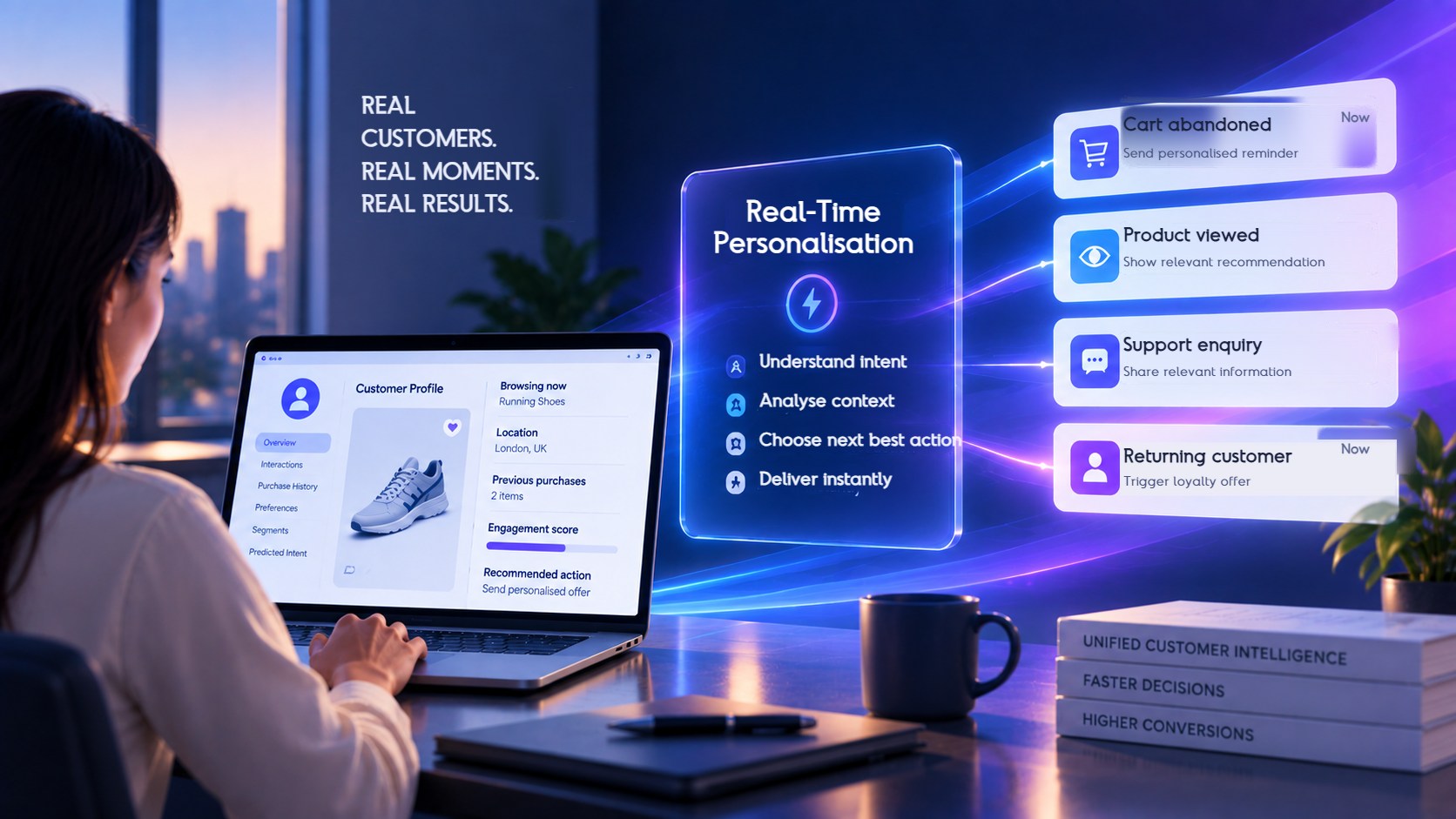
Real-Time vs. Batch Personalisation: Why the Lag Is Costing You the Sale
Business-to-business (B2B) customer engagement has changed significantly as buyers now expect faster responses, connected interactions, and highly personalised experiences across every stage of the customer journey. Decision-makers no longer compare B2B experiences only with competitors within the same industry. They compare them with the seamless digital experiences they receive across retail, banking, streaming platforms, and consumer applications. This shift has increased pressure on enterprises to modernise how they manage customer relationships, support operations, and lifecycle engagement.

What Is a Super Agent in AI? Architecture, Components and Use Cases for UK Enterprises
Business-to-business (B2B) customer engagement has changed significantly as buyers now expect faster responses, connected interactions, and highly personalised experiences across every stage of the customer journey. Decision-makers no longer compare B2B experiences only with competitors within the same industry. They compare them with the seamless digital experiences they receive across retail, banking, streaming platforms, and consumer applications. This shift has increased pressure on enterprises to modernise how they manage customer relationships, support operations, and lifecycle engagement.

AI-Driven Campaign Management: A Simple Guide for UK Businesses
Business-to-business (B2B) customer engagement has changed significantly as buyers now expect faster responses, connected interactions, and highly personalised experiences across every stage of the customer journey. Decision-makers no longer compare B2B experiences only with competitors within the same industry. They compare them with the seamless digital experiences they receive across retail, banking, streaming platforms, and consumer applications. This shift has increased pressure on enterprises to modernise how they manage customer relationships, support operations, and lifecycle engagement.


