System of Record vs System of Intelligence: The Real Difference Between AI-Native CRM and Traditional CRM

Insights / System of Record vs System of Intelligence: The Real Difference Between AI-Native CRM and Traditional CRM

Ai native CRM

UK businesses invested in CRM to centralise customer data. That problem is largely solved. The real question now is what to do with that data next and how fast that action gets identified without someone having to notice the pattern first. That is the shift from storing information to generating intelligence.

  • From Paper Records to AI-Native CRM
  • System of Record vs System of Intelligence
  • Why This Matters in Practice
  • The UK Business Landscape
  • The Hidden Cost of Staying on a Record-Only System
  • Where This Shows Up in Practice
  • FAQs

From Paper Records to AI-Native CRM

CRM has moved through five stages: paper records, on-premise systems, cloud CRM, automation layered on top, and now AI-native CRM, where a reasoning layer sits above the record and recommends action. Each shift responded to the same pressure, customers now move across WhatsApp, email, and a contact centre within one query, and expect the business to already know the full context.

System of Record vs System of Intelligence

A System of Record stores and organises customer data accurately; it answers “what happened?” A System of Intelligence sits above that record, using predictive analytics and automation to answer “what should happen next?” It does not replace the record; it makes it actionable.

DimensionSystem of RecordSystem of Intelligence
Core questionWhat happened?What should happen next?
Data modelStatic, manually updatedContinuously enriched, behaviourally scored
Update frequencyBatch — daily or weeklyReal time
ReportingHistorical dashboardsLive, predictive, with recommended actions
ForecastingRep judgementModelled probability
Lead scoringManual or rule-basedMachine-learned, updated per interaction
AutomationSimple triggersMulti-step, adapts to context
Decision supportRequires human interpretationSurfaces the next action directly
Churn predictionReactivePredictive, flagged early
ROI measured inData accuracy, complianceRevenue, retention, time saved

Why This Matters in Practice

Many UK consumers know this failure first-hand. A customer tells a call centre, repeatedly, that they can only be reached on weekends and want to be served in a specific language. The note is logged correctly — the System of Record has done its job. The next call still comes on a Tuesday, in the wrong language, because nothing was built to notice the same instruction had already been given and act on it. The data was never the problem. Nothing was reading it.

The UK Business Landscape

  • AI adoption is rising steadily: 23% of UK businesses used AI in some form by late 2025, up from 9% in 2023 (ONS).
  • Around three-quarters of UK AI adopters report a productivity uplift (DSIT) pushing evaluation of AI-native tools across the stack, CRM included.
  • UK GDPR shapes what an AI layer can do with customer data, particularly automated decision-making — it does not prohibit it.
  • Skills shortages are consistently the top cited barrier to AI adoption, ahead of cost or trust.

Department Impact

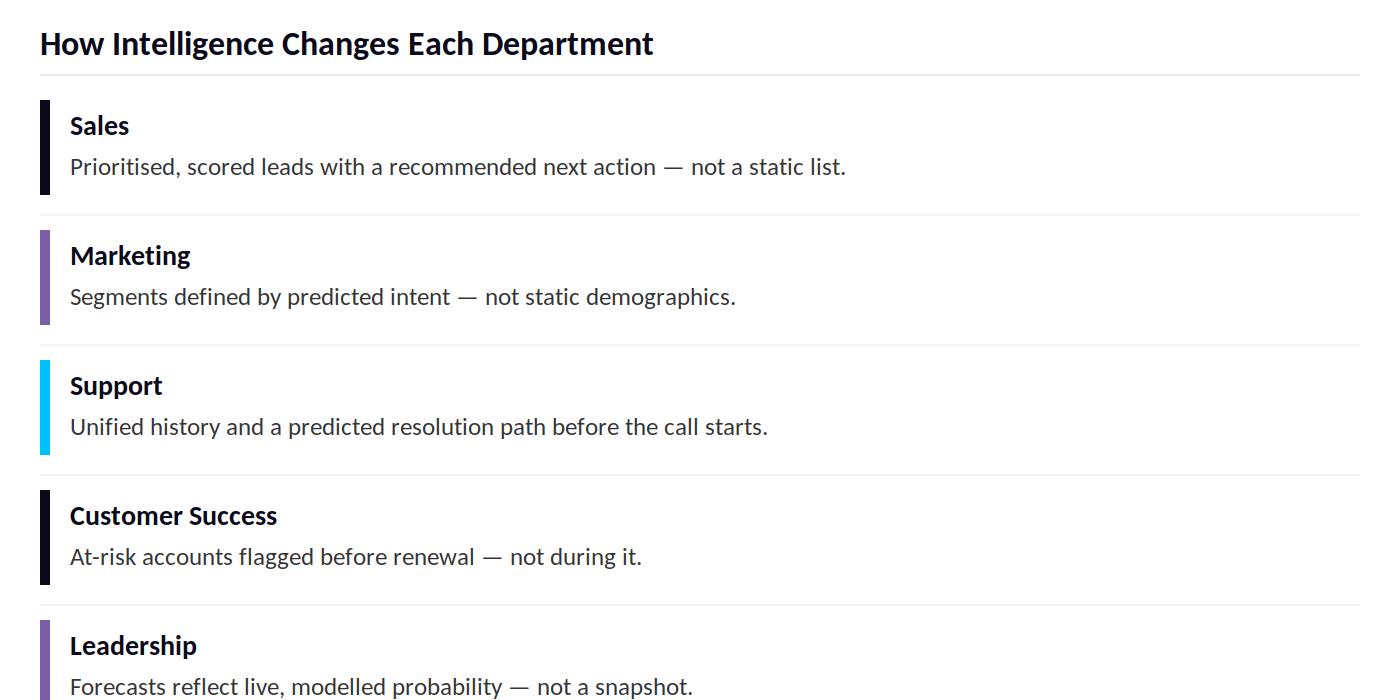
Ai Intelligence in Department

The Hidden Cost of Staying on a Record-Only System

Missed follow-ups, slow response times, preventable churn, and inaccurate forecasts rarely show up as one dramatic failure. They accumulate as a steady, largely invisible revenue leak — which is exactly why they persist so long before anyone addresses them.

Common Misconceptions

  • “AI will replace CRM” — it sits above the record; the record still has to exist and be accurate.
  • “AI will replace our people” — the architecture keeps a human decision step; it removes manual pattern-spotting, not judgement.
  • “This is only for large enterprises” — smaller UK firms have less capacity to manually monitor every account, so automated flagging matters more, not less.
  • “UK GDPR makes this too risky” — GDPR shapes how automated decisions are made; it does not block them.

Where This Shows Up in Practice

Ai Native CRM vs Traditional CRM

This distinction isn’t just conceptual; it shapes what Worktual’s platform is built to deliver, organised around three things a customer actually experiences:

  • Connected Intelligence — the customer is recognised as the same person no matter which channel they use, instead of repeating themselves each time.
  • Continuous Intelligence — that recognition reflects what’s true right now, not a record that was accurate last week.
  • Actionable Intelligence — the business acts on what it already knows: the call routed to the right agent, the risk flagged before it becomes a complaint, the offer that matches what the customer is asking for.

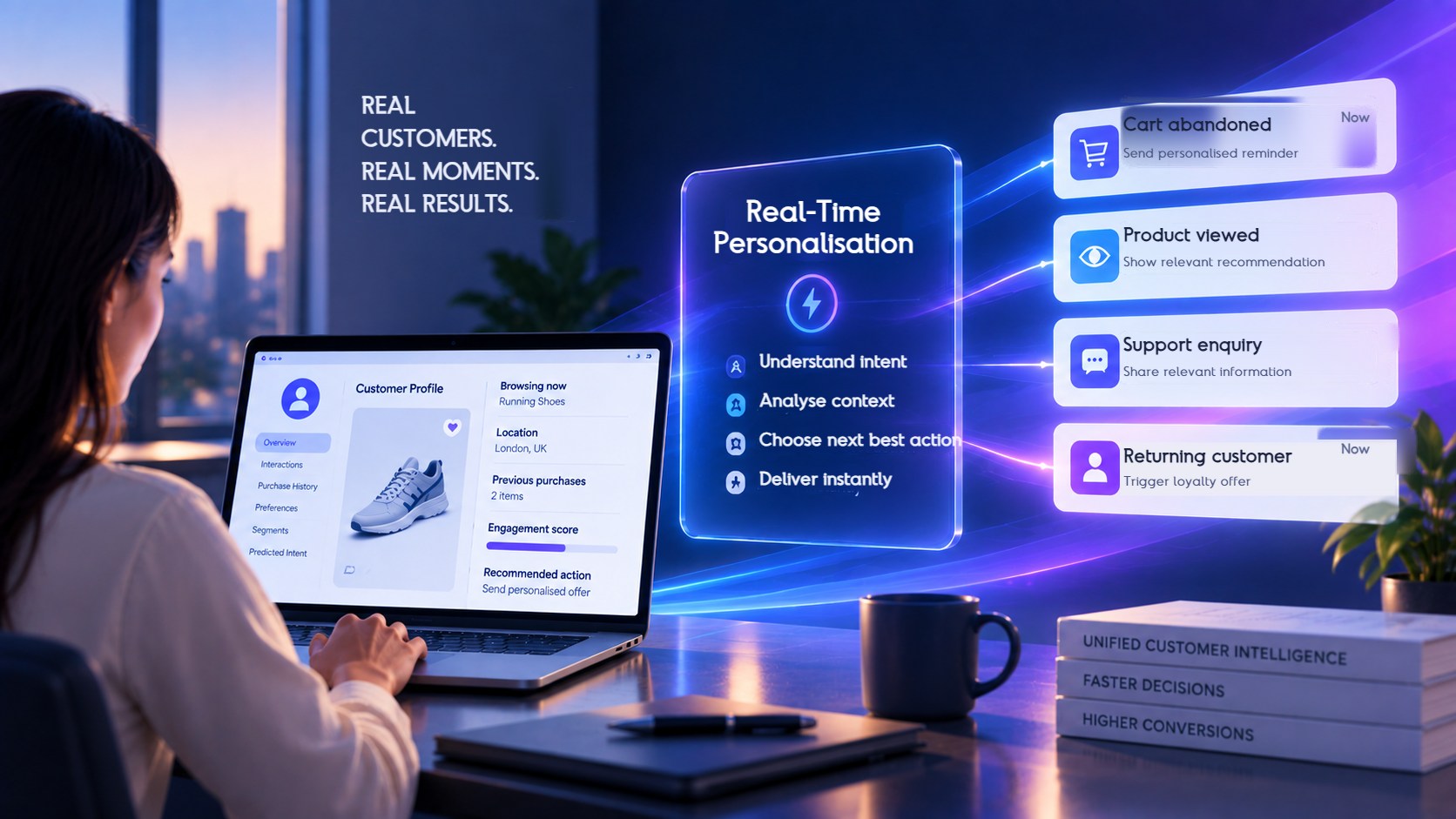
Worktual’s CRM is a standalone system of record in its own right. The intelligence layer comes into play when it’s integrated with Cognitive Customer Data Platform (CDP) and channels like Lola or Contact Centre as a Service (CCaaS); account history, live behavioural signals, and channel interactions then feed one continuously updated profile. An integrated NBA engine turns a predicted risk or opportunity into a specific recommended action, rather than leaving that to whoever next opens the account. Teams can track the commercial effect directly: time from signal to action (TAT), CSAT following an intervention, and the resulting shift in customer lifetime value (LTV).

FAQs

1. What is the difference between a System of Record and a System of Intelligence?

A System of Record stores and organises customer data accurately. A System of Intelligence interprets that data and recommends or triggers the next action, answering what should happen next rather than only what already happened.

2. Will an AI-native CRM replace our sales and support teams?

No. It removes manual pattern-spotting, such as noticing a churn signal, but keeps a human decision step for judgement calls. It reduces repetitive work rather than eliminating the role.

3. Is AI-native CRM only relevant for large enterprises?

No. Smaller organisations often have less capacity to manually monitor every account, which makes automated flagging proportionally more valuable, regardless of company size.

4. How does UK GDPR affect AI-native CRM adoption?

UK GDPR shapes what an AI layer can do with customer data, particularly around automated decision-making. Data residency and explainability are genuine evaluation criteria for UK buyers, not a blocker.

5. Does switching to an AI-native CRM require a full data migration?

Not necessarily. Most AI-native CRM platforms are designed to layer intelligence over an organisation’s existing customer data, rather than requiring a full system replacement from day one.

Related Posts

B2B Buyer Intent before rfp

B2B Buyer Intent in the UK Market: Predicting the Moment before the RFP

By the time an RFP or tender is issued, the shortlist has typically already formed. Research from 6sense and Gartner indicates that a substantial majority of the B2B buying journey happens anonymously, before a vendor is ever contacted — placing control of the timeline firmly with the buyer rather than the seller.

intelligent case management ai ticketing

Intelligent Case Management: How AI Transforms Ticketing into Predictive Support Infrastructure

Customer service has evolved from a reactive support function into a strategic driver of customer loyalty, operational efficiency, and long-term business growth. As organisations manage increasing volumes of customer interactions across digital channels, every enquiry, complaint, and service request influences customer experience and business outcomes. Yet many organisations continue to rely on traditional ticketing systems that were designed to organise work, not understand customers.

AI-Native Cognitive Data Platform for Ecommerce

How AI-Native Cognitive Customer Data Platforms Are Transforming Ecommerce: Improving Customer Retention, Purchase Intelligence, and Real-Time Omnichannel Engagement

Business-to-business (B2B) customer engagement has changed significantly as buyers now expect faster responses, connected interactions, and highly personalised experiences across every stage of the customer journey. Decision-makers no longer compare B2B experiences only with competitors within the same industry. They compare them with the seamless digital experiences they receive across retail, banking, streaming platforms, and consumer applications. This shift has increased pressure on enterprises to modernise how they manage customer relationships, support operations, and lifecycle engagement.